• About and Contact
  • Air Fryer Cooking Charts and Conversions
  • Air Fryer Recipes – Update: August 2020 – Chicken Olivia
  • Barcode Country List
  • Boise Foodie Blog Recipes – Updates: Nov 2024 Basic Hollandaise Sauce and Cream of Mushroom Soup
  • Boise Restaurant Guide – 52 Restaurant Choices! Updated: July 2018
  • Companion Garden Planting
  • Instant Pot Recipes – Update August 2020 – IP Chicken with Ketchup, Honey and Soy
  • Recipes from the Captain’s Shack: Dec 2020 – CS Prime Rib

Boise Foodie Guild

~ – Enjoy a meal or a recipe with us! Be sure to check the Sidebar and Menu above. Interesting resources are listed there. Most are hot links. Air Fryer (AF), Instant Pot (IP) and Captain's Shack (CS) recipes now have their own page. Subscribe to the blog. It's still FREE!

Boise Foodie Guild

Category Archives: Interesting Information

Scrapple – What?

29 Sunday Mar 2015

Posted by Bob and Robin in Captain's Shack, Classic Cuisines, Comfort Food, Cooking Styles, Ethnic Foods, Hard To Find Foods, Interesting Information, Pennsylvania Dutch, Photos By: Bob Young, Pork, Scrapple, Special Information, What's For Dinner?, Whats For Breakfast?

≈ 2 Comments

Tags

Comfort Food, Rappa Brand Scrapple, scrapple


Tango-Corte-Window-FloridaScrapple is an acquired taste. It has been described as “everything from the pig except the oink!” We have our scrapple shipped in from Ralph and Paul Adams, Rapa Brand Scrapple in Philadelphia. I’m a purist. I like the original scrapple and will probably leave the turkey scrapple alone. Wikipedia says,

Scrapple, also known by the Pennsylvania Dutch name panhaas or “pan rabbit,” is traditionally a mush of pork scraps and trimmings combined with cornmeal and wheat flour, often buckwheat flour, and spices. The mush is formed into a semi-solid congealed loaf, and slices of the scrapple are then pan-fried before serving. Scraps of meat left over from butchering, not used or sold elsewhere, were made into scrapple to avoid waste. Scrapple is best known as a rural American food of the Mid-Atlantic states (Delaware, Maryland, New Jersey, Pennsylvania and Virginia). Scrapple and panhaas are commonly considered an ethnic food of the Pennsylvania Dutch, including the Mennonites and Amish. Scrapple is found in supermarkets throughout the region in both fresh and frozen refrigerated cases.
Preparation
Scrapple is typically cut into quarter-inch to three-quarter-inch slices and pan-fried until brown to form a crust. It is sometimes first coated with flour. It may be fried in butter or oil and is sometimes deep-fried. Scrapple can also be broiled; this is a good cooking method for those who like their scrapple crisp. Scrapple is usually eaten as a breakfast side dish. It can be served plain or with either sweet or savory condiments: apple butter, ketchup, jelly, maple syrup, honey, or mustard. The state of Maryland is particularly in favor of scrapple topped with grape jelly. In some regions, such as New England, scrapple is mixed with scrambled eggs and served with toast. In the Philadelphia area, scrapple is sometimes fried and then mashed with fried eggs, horseradish, and ketchup.
History and regional popularity
The roots of the culinary traditions that led to the development of scrapple in America have been traced back to pre-Roman Europe. The more immediate culinary ancestor of scrapple was the Low German dish called panhas, which was adapted to make use of locally available ingredients, and it is still called “Pannhaas,” “panhoss,” “ponhoss,” or “pannhas” in parts of Pennsylvania. The first recipes were created by German colonists who settled near Philadelphia and Chester County, Pennsylvania in the 17th and 18th centuries. As a result, scrapple is strongly associated with rural areas surrounding Philadelphia, Baltimore, Washington D.C., eastern Pennsylvania, New Jersey, Maryland, Delaware, eastern Virginia, and the Delmarva Peninsula. Its popularity on the Delmarva Peninsula is celebrated the second weekend of October during the annual “Apple Scrapple Festival” in Bridgeville, Delaware. In composition, preparation, and taste, scrapple is similar to the white pudding popular in Ireland, Scotland, and parts of England and the spicier Hog’s pudding of the West Country of England.

Why do I like it? Because I come from Delaware, about 15 miles south of Philadelphia, and my Dad was Pennsylvania Dutch. Here is how I make it. Remember – Use a good, non-stick pan to cook the scrapple and over high heat and about 2 Tablespoons of vegetable oil, Crisco. Form a brown crust before trying to turn the scrapple over. If not, it may all fall apart. Here are some photos of scrapple preparation. Cheers!

Slice the scrapple with a very sharp knife about 1/4 to 1/2" thick. Work carefully.

Slice the scrapple with a very sharp knife about 1/4 to 1/2″ thick. Work carefully.

Starting to fry in a hot pan. It is sizzling. Do not disturb until the crust is formed! If you do, it may all fall apart.

Starting to fry in a hot pan. It is sizzling. Do not disturb until the crust is formed! If you do, it may all fall apart.

The brown crust has formed and the scrapple is turned to brown the second side. The one piece on the right, may have been turned a little early. It came out OK though.
The brown crust has formed and the scrapple is turned to brown the second side. The one piece on the right, may have been turned a little early. It came out OK though.

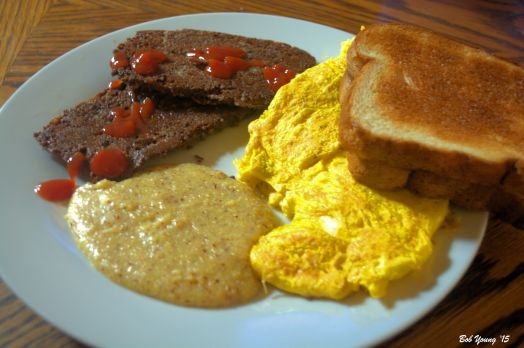
Scrapple with Ketchup Scrambled Idaho Fresh Eggs Fresh Idaho Polenta (Grits) Toast

Scrapple with Ketchup
Scrambled Meadowlark Farms Fresh Eggs
Fresh Idaho Polenta (Grits)
Hawaiian Toast

Reblog:

  • Click to email a link to a friend (Opens in new window) Email
  • Click to share on Pinterest (Opens in new window) Pinterest
  • Click to share on Facebook (Opens in new window) Facebook
  • Click to print (Opens in new window) Print
  • More
  • Click to share on X (Opens in new window) X
  • Click to share on Instagram (Opens in new window) Instagram
Like Loading...

The Difference Between Cajun and Creole Cuisines

31 Saturday Jan 2015

Posted by Bob and Robin in Cajun Food, Classic Cuisines, Cooking Styles, Creole Food, Cultural Differences, History of Food, Holiday Gatherings, Interesting Information, Main Dish, Mardi Gras, Oysters, Party Time, Seafood, Shell Fish, Shrimp, What's For Dinner?

≈ Leave a comment

Tags

cajun, Cajun cuisine, creole, Creole cuisine, Mardi Gras


Mardi Gras Have FunOK. The McCall (ID) Winter Carnival Parade opened up the Mardi Gras season today. And you are Cajun if you can answer this question, “Who’s Your Mama, Are You Catholic, and Can You Make A Roux?” You might enjoy Mardi Gras then. But what are Creole? What is Creole cuisine? What is the difference between Cajun and Creole foods? Here is some really good information on these two cuisines. Enjoy!

Difference Between Creole and Cajun Cooking Styles

From the website http://southernfood.about.com/od/cajuncuisine/a/Creole-And-Cajun-Cookery.htm, “The similarities between Creole and Cajun cuisines are due to the French heritage of both cultures, and the new ingredients to which French cooking techniques were applied by Creoles and by Cajuns. Both types of cooking have culinary roots in France, with a nod to Spain, Africa, and Native America, and to a lesser degree to the West Indies, Germany, Ireland, and Italy. Both cultures take their food very seriously, and love to cook, eat, and entertain.
It is said that a Creole feeds one family with three chickens and a Cajun feeds three families with one chicken. Another major difference between Creole and Cajun food is in the type of roux used as the base of sauces, stews, soups, and other savory dishes. Creole roux is made from butter and flour (as in France), while Cajun roux is made from lard or oil and flour. This is partly due to the scarcity of dairy products in some areas of Acadiana (Acadia + Louisiana) when Cajun cuisine was being developed. Gumbo is perhaps the signature dish of both cuisines. Creole gumbo has a tomato base and is more of a soup, while Cajun gumbo has a roux base and is more of a stew.
Mardi Gras Cajun HouseThe cultural difference between the two methods of cooking lies in the fact that Creoles had access to local markets, and servants to cook their food while Cajuns lived mostly off the land, were subject to the elements of the seasons, and generally cooked meals in one large pot.
Cooking Style. Creole cooking is city cooking: refined, delicate and luxurious, developed and originally prepared by servants. There is greater emphasis on cream, butter, seafood (though not shellfish), tomatoes, herbs, and garlic, and less use of cayenne pepper and file powder than in Cajun cooking, resulting in rich sauces, elegant pureed bisques, and time-intensive soups, brunch dishes, and desserts.
Cajun Country is the southwest section of Louisiana, unique unto itself. Acadiana is an area comprising twenty-two parishes (counties) in Southwest Louisiana. This area is predominately populated by Cajun people who are, technically, descendents of the Acadians expelled from Acadia, now known as Nova Scotia, in 1755. While their new home in Acadiana was familiar in terms of being an agrarian setting already populated by Catholic, French-speaking people, the Cajuns had to adjust to the unknown terrain of swamps, bayous, and prairies that presented some exotic forms of meat, game, fish, produce, and grains.
Mardi Gras Cajun Food RouxIngredients. The Cajuns applied their French cooking techniques to these new ingredients, with a result that is recognized and respected as some of the best regional cooking in America, as well as one of the world’s most unique cuisines. There are versions of Cajun dishes on restaurant menus across the Country, from upscale to hip and trendy to fast food establishments. Unfortunately, many of these restaurants misrepresent Cajun food by using their standard menu items and carelessly over-spicing them, making the food unbearably hot, then calling it “Cajun.”
Seasonings. Cajun food and culture has little to do with the mass media hype of the past twenty years that presents Cajun cookery as fiery hot, and Cajun people as hot pepper eating, beer swilling caricatures of themselves. Pepper and spices are merely one element of Cajun cookery, and not the most important one at that.
Cooking Style. Cajuns in Southwest Louisiana have steadfastly adhered to the preservation of their habits, traditions, and beliefs in terms of lifestyle, language and cooking. They became noticed by society during the oil boom in the mid-1900s, which brought many outlanders (non-Cajuns) into the area. These new residents began to discover the food-oriented, talented Cajun cooks whose lives and socializing revolve, to a large extent, around the preparation, sharing, and enjoyment of food. The word began to spread.”

And from http://www.louisianatravel.com/articles/cajun-vs-creole-food-what-difference, ” So if you’re versed on Louisiana history and culture, then all you really need to know is that Creole cuisine uses tomatoes and proper Cajun food does not. You can stop reading now. That’s how you tell a Cajun vs. Creole gumbo or jambalaya. You’re welcome (to be fair, some Cajun food, such as a sauce piquant, does include tomatoes as a key ingredient). However, if you’d like to know more, please continue reading so that you can learn why the terms “Cajun” and “Creole” that have become used so loosely and interchangeably when describing Louisiana food, are not at all the same.
Mardi Gras PartyA vastly simplified way to describe the two cuisines is to deem Creole cuisine as “city food” while Cajun cuisine is often referred to as “country food.” While many of the ingredients in Cajun and Creole dishes are similar, the real difference between the two styles is the people behind these famous cuisines. They say in order to really know someone, meet their family. The same goes for food. In Louisiana, the best place to find authentic Cajun and Creole cooking is in homes across the state, which is what makes the food so special. Many of Louisiana’s most talented chefs learned their trade from their parents or grandparents. Cajun and Creole are two distinct cultures, and while over the years they continue to blend, there is still a vast distinction in Louisiana, and both have their own unique stories… The word “Cajun” originates from the term “les Acadians,” which was used to describe French colonists who settled in the Acadia region of Canada which consisted of present-day New Brunswick, Prince Edward Island and Nova Scotia. With the British Conquest of Acadia in the early 1700s, the Acadians were forcibly removed from their home in what become known as Le Grand Derangement, or the Great Upheaval. Many Acadians eventually settled in the swampy region of Louisiana that is today known as Acadiana.
Actually, four regions of south Louisiana were settled by the Cajuns, each with different resources and influences. Those distinct areas are the levees and bayous (Lafourche and Teche), prairies (Attakapas Indian land), swamplands (Atchafalaya Basin), and coastal marshes (New Orleans area and Houma)… The term “Creole” describes the population of people who were born to settlers in French colonial Louisiana, specifically in New Orleans. In the 18th century Creoles consisted of the descendants of the French and Spanish upper class that ruled the city. Over the years the term Creole grew to include native-born slaves of African descent as well as free people of color. Typically, the term “French Creole” described someone of European ancestry born in the colony and the term “Louisiana Creole” described someone of mixed racial ancestry. ”

There is a lot more information at the links that I have supplied, including some recipes from both cuisines. Enjoy the food and the information. Happy Mardi Gras!

Reblog:

  • Click to email a link to a friend (Opens in new window) Email
  • Click to share on Pinterest (Opens in new window) Pinterest
  • Click to share on Facebook (Opens in new window) Facebook
  • Click to print (Opens in new window) Print
  • More
  • Click to share on X (Opens in new window) X
  • Click to share on Instagram (Opens in new window) Instagram
Like Loading...

Awesome Dinner For The Boise Farmers Market

06 Monday Oct 2014

Posted by Bob and Robin in Acme Bake Shop, Appetizers, Beef, Beets, Boise Adventures, Boise Farmers Market, Bread, Butternut Squash, Buy Idaho, Cheese, Classic Cuisines, Coffee, Dinner With Friends, Dinner With Robin, Healthy Eating, Heirloom Squash, Heirloom Tomatoes, Idaho Beef, Idaho Breweries, Idaho Chefs, Idaho Wine, Interesting Information, Local Farmers Markets, Local Harvests, Local Markets, Locavore, Organic Foods, Party Time, Peaceful Belly Farms, Photos By: Bob Young, Purple Sage Farms, Restaurants, Restaurants To Try, Rice Family Farms, Saint Lawrence Gridiron, Salad, Soup, Special Information, Vegetables, What's For Dessert?, What's For Dinner?, Wines - Idaho

≈ Leave a comment

Tags

beef short ribs, eat local, micro greens, neckar coffee


05Oct2014_1_Farners-Market-Dinner_Gridiron-SignYes it was! And many thanks to all of the Boise Farmers Market producers for supplying the awesome meal items and the Saint Lawrence Gridiron, at 703 W Bannock in Boise (208) 433-5598, for supplying the space, the Waite Staff and an awesome Chef! Just a super, super night!
I do believe that this was the first of dinners like this to raise funds for the Boise Farmers Market. And I do hope that they continue to do this Fund Raising Dinner next year and many years to follow. When you look at the menu and photos below, you will see the superb meal that we had. Congratulations to all who worked so hard to make this a success! Left-Click any of these photos to see them enlarged.

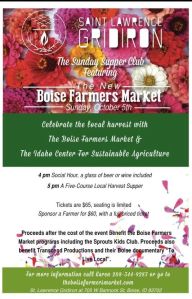
The flyer for this year's event.

The flyer for this year’s event.

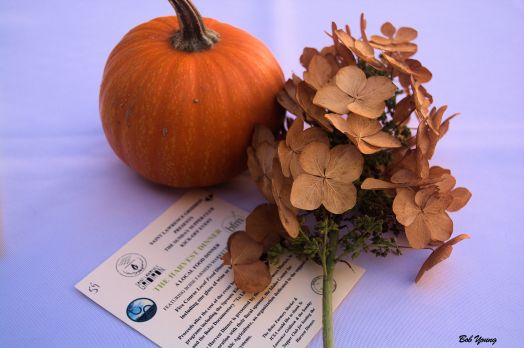
Delightful table center pieces added to the Fall theme.

Delightful table center pieces added to the Fall theme.

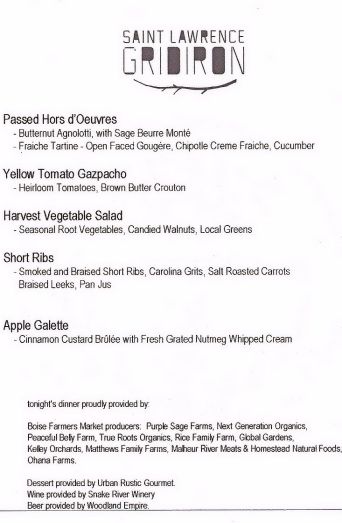
The wonderful menu!

The wonderful menu!

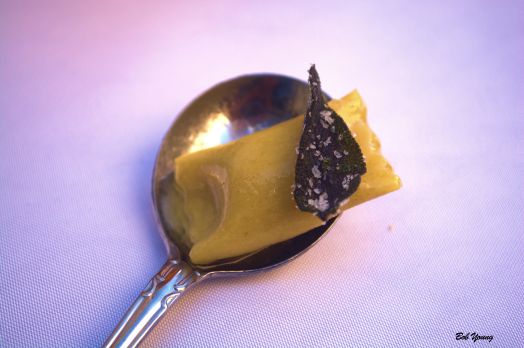
Butternut Agnolotti with Sage Monte

Butternut Agnolotti with Sage Beurre Monté

Fraiche Tartine open faced gougere chipotle fraiche cucumber

Fraîche Tartine
open faced gougére, chipotle fraîche and cucumber

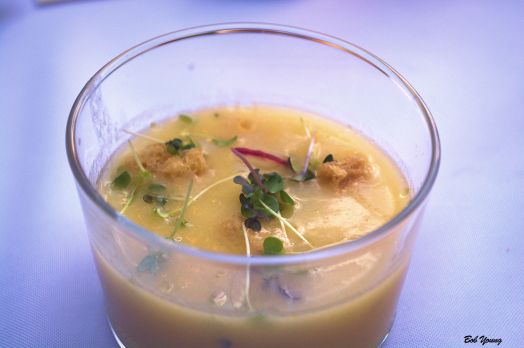
Yellow Tomato Gazpacho heirloom tomatoes brown butter crouton

Yellow Tomato Gazpacho
heirloom tomatoes and brown butter crouton

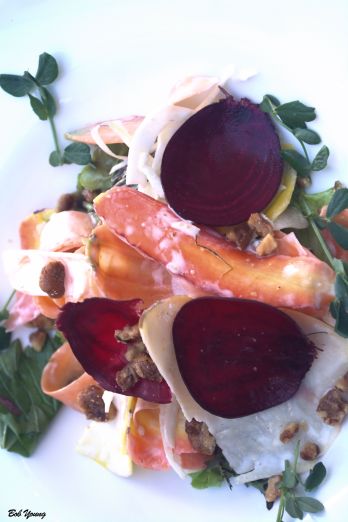
Harvest Vegetable Salad seasonal root vegetables candied walnuts local greens

Harvest Vegetable Salad
seasonal root vegetables, candied walnuts and local greens

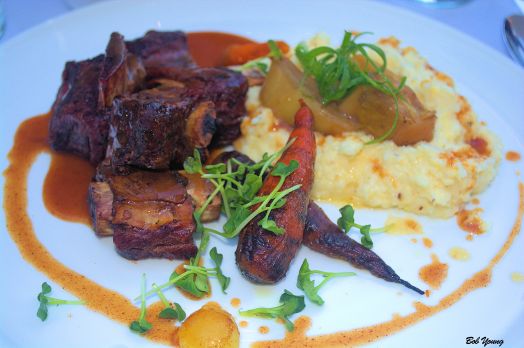
Short Ribs smoked and braised short ribs, Carolina grits, salt roasted carrots, braised leeks and pan jus

Short Ribs
smoked and braised short ribs, Carolina grits, salt roasted carrots, braised leeks and pan jus

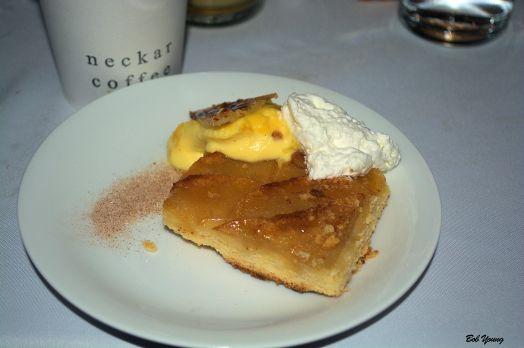
Apple Galette cinnamon custard brulee with fresh grated nutmeg whipped cream

Apple Galette
cinnamon custard brûlée with fresh grated nutmeg whipped cream

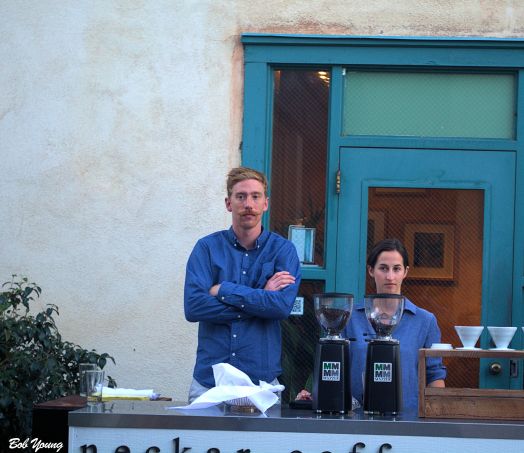
Neckar Coffee added some delightful coffee to our dinner. Thank-You!

Neckar Coffee added some delightful coffee to our dinner. Thank-You!

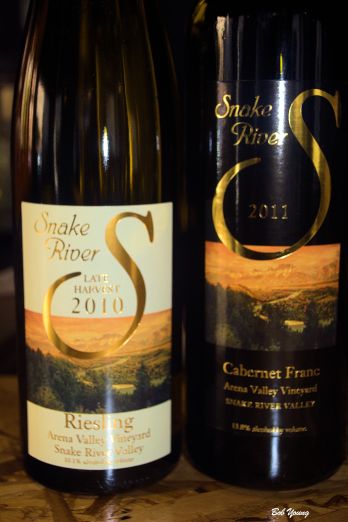
Snake River Winery offered wines with the dinner and beer was also available from Woodland Empire Brewery.

Snake River Winery offered wines with the dinner and beer was also available from Woodland Empire Brewery.

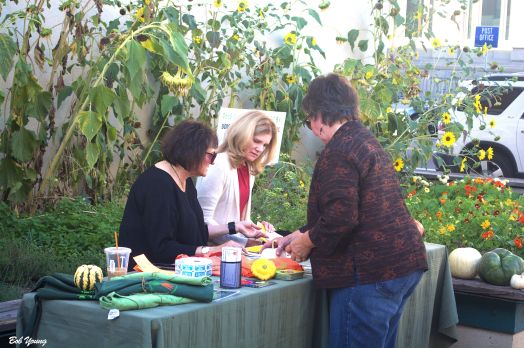
The Check-In table

The Check-In table

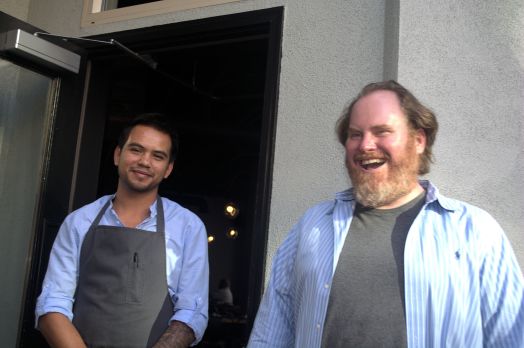
The Chef for the meal and on the right owner Brian Garrett. Thank-You both for this delightful evening.

The Chef for the meal and on the right owner Brian Garrett. Thank-You both for this delightful evening.

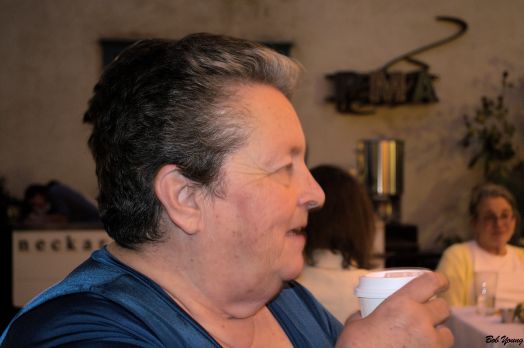
Robin enjoys some Neckar Coffee.

Robin enjoys some Neckar Coffee.

Thank-You everyone for this event. It takes a lot of hard work to arrange this. Karen Ellis – Thank-You!

Reblog:

  • Click to email a link to a friend (Opens in new window) Email
  • Click to share on Pinterest (Opens in new window) Pinterest
  • Click to share on Facebook (Opens in new window) Facebook
  • Click to print (Opens in new window) Print
  • More
  • Click to share on X (Opens in new window) X
  • Click to share on Instagram (Opens in new window) Instagram
Like Loading...

Shrimp and Peach Spring Rolls and Ceviche for Dinner

18 Monday Aug 2014

Posted by Bob and Robin in Ahi Tuna, Asian Food, Boise Farmers Market, Captain's Shack, Ceviche, Dinner With Robin, Interesting Information, Local Farmers Markets, Local Harvests, Local Markets, Meatless Monday, Photos By: Bob Young, Recipe by: Robin and Bob Young, Recipes, Reel Foods, Seafood, Shrimp, Spring Rolls, Vegetarian Foods, Vietnamese Food, What's For Dinner?, Wines - Spanish

≈ Leave a comment

Tags

ahi tuna, ceviche, fenugreek seeds, Shoyu soy sauce, spring rolls, Vietnamese food


Robin-Bob-In-Kitchen_Looking-RightWhat an adventure this was to make. Fresh veggies from the Boise Farmers Market as were the herbs. Fresh Ahi Tuna from Reel Foods here in Boise. All of these were YUM! Add to that a wonderful glass, or two, of Castaneda White Sangria from Spain, and we had an awesome meal. And, oh yes, we did find some fenugreek today – powdered, dried leaves and seeds. At the Indian Market on Fairview in Boise, if you are looking for it. (“Fenugreek is used as an herb (dried or fresh leaves), spice (seeds), and vegetable (fresh leaves, sprouts, and microgreens). Sotolon is the chemical responsible for fenugreek’s distinctive sweet smell … Cuboid-shaped, yellow-to-amber colored fenugreek seeds are frequently encountered in the cuisines of the Indian subcontinent, used both whole and powdered in the preparation of pickles, vegetable dishes, daals, and spice mixes such as panch phoron and sambar powder. They are often roasted to reduce bitterness and enhance flavor … Fresh fenugreek leaves are an ingredient in some Indian curries. Sprouted seeds and microgreens are used in salads. When harvested as microgreens, fenugreek is known as Samudra Methi in Maharashtra, especially in and around Mumbai, where it is often grown near the sea in the sandy tracts, hence the name (Samudra, “ocean” in Sanskrit). Samudra Methi is also grown in dry river beds in the Gangetic plains. When sold as a vegetable in India the young plants are harvested with their roots still attached and sold in small bundles in the markets and bazaars. Any remaining soil is washed off to extend their shelf life.’ [Wikipedia]) You can see these photos enlarged by Left-Clicking on the graphic. Enjoy these photos, but first some information on Spring Rolls. What are they?

Fresh spring rolls, are a Vietnamese delicacy known as gỏi cuốn. Depending on region, salad rolls were made differently. Some vegetarian families make vegetarian spring rolls rather than meat spring rolls. However, the typical ingredients include slivers of cooked pork (most often cha pork sausages), shrimp, sometimes chicken or tofu, fresh herbs like basil and cilantro, lettuce, cucumbers, sometimes fresh garlic chives, rice vermicelli, all wrapped in moistened rice paper. Fresh Vietnamese spring rolls can be made at home or found at Vietnamese restaurants and some grocery stores. They are served at room temperature with dipping sauce. Nước chấm, tương xào or a hoisin peanut sauce are all common dipping sauces. A typical hoisin dipping sauce includes chili, hoisin sauce, peanut butter and sugar. A standard nước mắm pha (nước chấm) dipping sauce is composed of fish sauce, lime, garlic, sugar, and chilies. [Wikipedia]

Our Spring Rolls had shrimp, cucumber, daikon radish, cilantro, Thai basil and mint. These were delicious and especially after we let them rest for several hours in the refrigerator. Then we made a dipping sauce of Sesame oil, rice vinegar and a good soy sauce, Johsen Organic Shoyu traditional soy sauce.

Our Spring Rolls had shrimp, cucumber, daikon radish, cilantro, Thai basil, fresh peaches and mint. These were delicious and especially after we let them rest for several hours in the refrigerator. Then we made a dipping sauce of Sesame oil, rice vinegar and a good soy sauce, Johsen Organic Shoyu traditional soy sauce. This is available at almost any Oriental market.

Then we made a wonderful ceviche. Here is a little information on ceviche from Wikipedia.

Ceviche (Spanish pronunciation: [seˈβitʃe]; is a seafood dish popular in the coastal regions of the Americas, especially Central and South America. The dish is typically made from fresh raw fish cured in citrus juices, such as lemon or lime, and spiced with ají or chili peppers. Additional seasonings, such as chopped onions, salt, and coriander, may also be added. Ceviche is usually accompanied by side dishes that complement its flavors, such as sweet potato, lettuce, corn, avocado or plantain. As the dish is not cooked with heat, it must be prepared fresh to minimize the risk of food poisoning.

The origin of ceviche lies in the area of present-day Peru. Ceviche is marinated in a citrus-based mixture, with lemons and limes being the most commonly used. In addition to adding flavor, the citric acid causes the proteins in the seafood to become denatured, appearing to be cooked. (However, acid marinades will not kill bacteria or parasitic worms, unlike the heat of cooking.) Traditional-style ceviche was marinated for about three hours. Modern-style ceviche, popularized in the 1970s, usually has a very short marinating period. With the appropriate fish, it can marinate in the time it takes to mix the ingredients, serve, and carry the ceviche to the table.
Most Latin American countries have given ceviche its own touch of individuality by adding their own particular garnishes.

Then we combined the spring rolls. Here we have the Peach and Shrimp Spring Rolls and Ahi Tuna Ceviche on a bed of Boston Lettuce. Mango Salsa and Rice Crackers. The ceviche had Ahi tuna, from Reel Foods in Boise, cut into small cubes, two diced spring onions, greens and all, and two diced fennel whites, one diced serrano chili and seeds and ribs removed and the juice of two limes. We let it cure in the refrigerator for 1 hour. It was delicious!!

Then we combined the spring rolls. Here we have the Peach and Shrimp Spring Rolls and Ahi Tuna Ceviche on a bed of Boston Lettuce. Mango Salsa and Rice Crackers. The ceviche had Ahi tuna, from Reel Foods in Boise, cut into small cubes, two diced spring onions, greens and all, and two diced fennel whites, one diced serrano chili and seeds and ribs removed and the juice of two limes. We let it cure in the refrigerator for 1 hour. It was delicious!!

Hope you enjoyed this post. If you did, please Rate the post above. Thanks.

Reblog:

  • Click to email a link to a friend (Opens in new window) Email
  • Click to share on Pinterest (Opens in new window) Pinterest
  • Click to share on Facebook (Opens in new window) Facebook
  • Click to print (Opens in new window) Print
  • More
  • Click to share on X (Opens in new window) X
  • Click to share on Instagram (Opens in new window) Instagram
Like Loading...

Goodbye Spring, Hello Summer!

22 Sunday Jun 2014

Posted by Bob and Robin in Antipasto, Appetizers, Buy Idaho, Chardonnay, Comfort Food, Dinner With Robin, Hat Ranch Winery, Idaho Trout, Idaho Wine, Interesting Information, Local Harvests, Locavore, Main Dish, Marsing, Merlot, Orchard House, Photos By: Bob Young, Restaurants, Snake River AVA, Special Dinners, Special Events, Special Information, Syrah, The Orchard House, Things To Do, Trout, Weston On The Lake Winery, What's For Dinner?, Wine and Food, Wines - Idaho

≈ Leave a comment

Tags

chardonnay, Hat Ranch Winery, Idaho wines, merlot, syrah, The Orchard House, Weston Winery


Hat-Ranch-Winery-LogoClear blue skies! Light, cooling breezes! 88 degree temperatures. Only thing missing is a tempting ocean breeze. We spent the day both at Hat Ranch Winery off of Plum Road in Marsing (their postal address is in Caldwell) and the Snake River AVA and then to a wonderful dinner at The Orchard House. Hat Ranch was releasing their Tempranillo, which is very good. The Orchard House has good meatloaf.
Hat Ranch Winery bought Vale Wine Co., as some of you might already know. Some of the Vale wines were there for us to try also. Their Chardonnay is really a good one and will pare well with foods that need a citru match. Not an oaky chardonnay. The appetizers that they had to accompany the wines, see the photo of the menu board below, were a perfect match. Enjoy these photos and if you are in the area, stop in at both Hat Ranch Winery and The Orchard House. You won’t be disappointed. Cheers!

Hat Ranch Winery, Tempranillo release party, menu board.

Hat Ranch Winery, Tempranillo release party, menu board.

A very good Redpepper Humus. Not overly spiced.

A very good Redpepper Hummus. Not overly spiced.

Good selections on the Antipasto Platter.

Good selections on the Antipasto Platter.

Some of the wines we tried. We also tried a Hat Ranch Merlot and Syrah.

Some of the wines we tried. The Tempranillo will pair with most foods, especially Italian or Spanish.

The Vale Wine Co., Chardonnay.

The Vale Wine Co., Chardonnay.

Orchard_House_Logo_2And then, we went to The Orchard House for dinner. Goodbye diet for today! We always enjoy the meals here. If I were to choose which meal I would constantly get here, it would definitely be the breakfast. It is just so satisfying. But today, we had a good Meatloaf dinner and an Idaho Trout dinner. This is one place that you can get a good meatloaf away from your own kitchen. The Orchard House is located at 14949 Sunnyslope Road, Caldwell (just outside of Marsing) in the Snake River AVA.

We had to check this bottle of wine out. It really is named for the Weiser Old Tyme Fiddlers Festival, which is just over for the year.

We had to check this bottle of wine out. It really is named for the Weiser Old Tyme Fiddlers Festival, which is just over for the year.

This is the back of the bottle. Good information. Left-Click this or any of these photos to see them enlarged.

This is the back of the bottle. Good information. Left-Click this or any of these photos to see them enlarged.

Robin had this good Idaho Trout dinner.

Robin had this good Idaho Trout dinner.

I had their Meatloaf Dinner. Just a good ol' down home dinner.

I had their Meatloaf Dinner. Just a good ol’ down home dinner. We did buy a bottle of Shane Weston’s 2009 Weston On The Lake Pinot Gris. Such a great day today. Super great tour of the area, of sorts, with Robin.

Reblog:

  • Click to email a link to a friend (Opens in new window) Email
  • Click to share on Pinterest (Opens in new window) Pinterest
  • Click to share on Facebook (Opens in new window) Facebook
  • Click to print (Opens in new window) Print
  • More
  • Click to share on X (Opens in new window) X
  • Click to share on Instagram (Opens in new window) Instagram
Like Loading...

400 Companies That Are GMO Free

05 Thursday Jun 2014

Posted by Bob and Robin in Buy Idaho, Cooking Safety, Food Prep, Food Trivia, Gardens, GMOs, Interesting Information, Local Farmers Markets, Local Harvests, Local Markets, Special Information, What's For Dinner?

≈ Leave a comment

Tags

GMO, GMO free, Organic products, PLU, The Free Thought Program, Whole Foods


GMO-Free-LogoHere is an article from The Free Thought Program that lists 400 companies that are GM free, at least some of their products. They do not use GMO’s in their products. Whole Foods is just one of them.

All too often we rely on the state to tell us what to eat and which companies are ethical. And all too often the companies that the state deems ethical and safe are proven to be quite the opposite. The giant agricultural companies that produce GMOs and use millions of tons of chemicals are able to do so because of monetary support. As long as we continue to purchase their products they will continue to pollute the environment and our bodies.

You and I have the power to stop this madness. We can choose to support those companies that do not use GMOs. The best way is to buy from a local organic farmer, or to grow your own; however there are plenty of ethical companies out there that you can support who practice sustainable methods and source from farmers that do not use GMO. [The Free Thought Project]

Another good informational social media site is on Facebook at GMO Awareness USA, which also has some good information on GMO free and resources. And if you are following the PLU numbers, that little 4 or 5 digit number that is on a sticker on most produce, then be aware anything that begins with an “8” is a GMO product. Organic products start with a “9” and conventional growing practices run the gamut from “2” – “7”. Stated another way, organic produce has a 5 digit PLU number that begins with the number 9. Conventional produce has a 4 digit PLU number that begins with the number 4. Genetically modified (GMO) produce has a 5 digit PLU number that begins with the number 8.

Reblog:

  • Click to email a link to a friend (Opens in new window) Email
  • Click to share on Pinterest (Opens in new window) Pinterest
  • Click to share on Facebook (Opens in new window) Facebook
  • Click to print (Opens in new window) Print
  • More
  • Click to share on X (Opens in new window) X
  • Click to share on Instagram (Opens in new window) Instagram
Like Loading...

What is the Tuscan Cooking Style?

28 Monday Apr 2014

Posted by Bob and Robin in Beef, Classic Cuisines, Classics, Cooking Styles, Interesting Information, Italian Food, Italian foods, Lamb, Main Dish, Recipe by: Robin and Bob Young, Tuscan Cuisine, What's For Dinner?, Wild Game, Wine and Food, Wines - Italian

≈ Leave a comment

Tags

chianti, osso buco, Tuscan cuisine, wild game, Wine


(comonstock.com)

(comonstock.com)

I had an interesting question the other day as to what is the Tuscan Cooking Style. Quite simply – It is a very basic style of Italian cooking using the barest of food essentials. Fresh herb, pasta, wine, bread. Not particularly a heavy tomato sauce, although tomatoes are used. Only a light sauce, if any, and pasta with herbs and cheese. There is a wide variety of information on the Tuscan Style of cooking on the web. I offer only a small portion of that information here.
If you are looking for some Tuscan traditional recipes, here is one source: Tuscan Recipes. And if you want that well known 3″ thick Tuscan Porterhouse steak, aka Bistecca alla Fiorentina, here is that recipe: Tuscan Porterhouse. And the traditional Tuscan dish of Osso Buco – here is a recipe for Veal Osso Buco. Or maybe you prefer a Lamb Osso Buco. An Osso Buco is referred to in the article by Delallo (dot) com below.
Information from the Examiner,

Tuscany is the land of simple and honest flavors with cooking that might be heartier than much of the rest of the country. It features excellent ingredients including a fair variety of herbs such as basil, rosemary and sage, strongly flavored olive oils, meat dishes from cattle and wild game like wild boar, and seafood on the coasts. Soffritto, a mixture of chopped celery, onions, garlic, peppers and herbs sautéed in olive oil, similar to the French mirepoix, is used as a base for soups and sauces, might be more popular here than elsewhere. Beans have long been a big part of the diet, and spinach is the most popular green vegetable. Excepting the spinach and the few tomato dishes, much of the cooking is unattractively brown… Commonly found dishes include the hearty peasant bread soup, ribollita, pappa al pomodoro (bread and tomato soup), pappardelle sulla lepre (fresh pasta ribbons with wild hare), pappardelle con cinghiale (with wild boar), fritto misto (fried meats, offal and vegetables), tagliata (thinly sliced beef served with arugla), and the famous bistecca alla fiorentina (a thick steak traditionally from the prized and enormous Chiana cattle that used to clutter the Chianti hills, simply prepared and grilled over an wood-fired flame).

And here is some information fro EHow,

Tuscan-style cooking evolved from “la cucina povera,” or peasant cooking. The cuisine relies on home-grown ingredients, prepared fresh with nothing left to waste … Tuscan-style cooking employs a wealth of vegetables: artichokes, asparagus, green beans, fava beans, peas and all types of greens, including Swiss chard, spinach and escarole. Peaches and pears are popular fruits … The most famous Tuscan meat is the bistecca alla fiorentina, a large grilled porterhouse. Game meats, including wild boar, duck and rabbit are also important to Tuscan-style cooking … Wild porcini mushrooms and truffles add an exotic touch to Tuscan dishes. The porcini can be served raw, grilled, sauteed in olive oil and garlic. Truffles are added to pasta dishes or shaved over eggs or steak … The basis of many Tuscan dishes is soffritto, which means “under-fried” in Italian. Soffritto is made by lightly frying minced vegetables in olive oil. The soffritto goes into sauces, soups and other recipes.

And finally from Delallo (dot) com,

… The single most pervasive food image associated with Tuscany is likely that of the olive tree, which grows in a gnarled profusion throughout the region. But Tuscany’s climate also provides ideal soil for the grapes grown to create the region’s world-renowned Chianti wine. Cattle also weigh heavily in the region’s food production. Chianina cattle is one of the oldest breeds of cattle in the world, as well as one of the largest, producing prized Fiorentina beef for bistecca alla fiorentina (a T-bone steak brushed with olive oil and grilled perfectly rare).
Game meats and fowl, fish, pork, beans, figs, pomegranates, rice, chestnuts and cheese are earthy staples of the Tuscan table, and the coveted white truffle abounds in the region. Tuscan cooking is an interesting blend of dishes made from odds and ends for poor tables, as well as choosier fare created for the powerful noble house of Medici which once occupied and ruled from the Tuscany area. Osso bucco is a well-known favorite of the area, as are finocchiona (a rustic salami with fennel seeds), cacciucco (a delicate fish stew), pollo al mattone (chicken roasted under heated bricks), and biscotti di prato (hard almond cookies made for dipping in the local desert wine, vin santo). Barlotti beans, kidney-shaped and pink-speckled, provide a savory flavor to meatless dishes, and cannellinibeans form the basis for many a pot of slowly simmered soup. Breads are many and varied in Tuscan baking, with varieties including donzelle (a bread fried in olive oil), filone (an unsalted traditional Tuscan bread) and the sweetschiacciata con l’uva (a rolled dough with grapes and sugar on top). Pastas are not heavily relied upon in Tuscan cooking, and papparadelle (a wide egg noodle) is one of the region’s few traditional cuts. Pecorino Toscano cheese is native to Tuscany, as are semi-soft cow’s milk Tendaio and mixed sheep and cow’s milk Accasciato cheeses.
Soups, sauces and stews are the cornerstones of Tuscan cooking, many beginning with and relying upon the mastery of a perfect soffritto on which to build more complex flavors. A soffritto can be considered a sort-of Italian cookedmirepoix, and is a “pre-prep” combination of olive oil and minced browned vegetables (usually onion, carrot and celery) that creates a base for a variety of slow-cooked dishes. Herbs (sage and rosemary are used in many Tuscan dishes) and seasonings can be added to the soffritto as needed to bring out the unique flavors of each different recipe. Try the following Ribollita Toscana (Tuscan soup) recipe any time of year to transform your kitchen with the smells and flavors of the Tuscan countryside.

Wait a minute! What about the big, bold, deep red to purple wines of Tuscany? Have no fear. Here is some delightful information http://www.winecountry.it:

Wines of Tuscany – Tuscany’s winemaking industry counts on one of the most noble and ancient traditions that predates the universally known Chianti wine that often springs to mind when this region is discussed … Nowadays, the most grown variety is the noble Sangiovese, which is often combined with small amounts of locally grown Cabernet Sauvignon, Canaiolo, Ciliegiolo and other grapes into wonderful blends such as the Brunello di Montalcino, Morellino di Scansano, Carmignano and, of course, the signature Tuscan wines, the Chianti and Chianti Classico, which probably are the best known Italian wines in the world. Other grapes grown here are the Mammolo, Malvasia, Colorino, Raspirosso, Gamay, Grand Noir, Barbera, Moscatello, Aleatico and Vernaccia, among others.

Some interesting reading. But like I say, there is much, much more information available on the web about the Tuscan style of cooking. Indulge yourselves and look for more specific answers to your questions. Cheers!

Reblog:

  • Click to email a link to a friend (Opens in new window) Email
  • Click to share on Pinterest (Opens in new window) Pinterest
  • Click to share on Facebook (Opens in new window) Facebook
  • Click to print (Opens in new window) Print
  • More
  • Click to share on X (Opens in new window) X
  • Click to share on Instagram (Opens in new window) Instagram
Like Loading...

Sofrito – Puerto Rican Mirepoix

28 Friday Mar 2014

Posted by Bob and Robin in Classic Herb Blends, Cooking Styles, Ethnic Foods, Food Prep, Hard To Find Foods, Healthy Eating, Herbs, Herbs and Spices, Interesting Information, Puerto Rican Food, Puerto Rican Recipe, Recipes, What's For Dinner?

≈ Leave a comment

Tags

Cajun Holy Trinity, mirepoix, Puerto Rican, sofrito


(Photo: Hungryfoodlove)

(Photo: Hungryfoodlove)

For some reason when I was watching one of the Foodnetwork or Cookingchannel programs, I got “hung up on” sofrito. Almost every cuisine has their own variation on mirepoix. French, probably the best known, is a mixture of carrot, celery and onion that is lightly braised, or sweated. In Cajun cuisine, it is called the Holy Trinity and made up of onion, bell pepper and celery. It can also have garlic, parsley and a variety of other herbs in it.
The Puerto Rican sofrito, also called recaito,

Recaito is a green aromatic puree of onions, culantro (recao) leaves, garlic, green peppers and ajies dulces (small sweet chile peppers).
In Puerto Rico, recaito is used as the base seasoning known as sofrito. When preparing Puerto Rican cuisines, you may notice it called by either name.

Notice the absence of tomatoes. Typically, Puerto Ricans do not add tomatoes to their recaito. Sofrito recipes that do include tomatoes or tomato paste, sauce or juice are generally for Dominican, Cuban, Spanish, Italian, and other Mediterranean cuisines … What is Sofrito?: Simply put, sofrito is a fragrant blend of herbs and spices used throughout the Caribbean, especially Puerto Rico, Cuba and the Dominican Republic. It’s used to season countless dishes of stews, beans, rice, and occasionally meat. In most cases, it is the foundation upon which the rest of the recipe is built. Sofrito mixtures range in color from green to orange to bright red. They also range in flavor from mild to pungent to spicy.
Hundreds of recipes from the Latin Caribbean and other Latin American countries begin by instructing the cook to “make a sofrito”. It’s the first thing to go into the pot and establishes the flavor and seasoning of what’s to come. It is integral to Latin cuisine, which makes it difficult to believe that sofrito did not originate in, nor is it exclusive to Caribbean or Latin American cookery. [AboutdotCom- Latin Caribbean Food]

For more information on the history of sofrito, look at What is Sofrito?. The basic recipe for a sofrito from Recaito Puerto Rican Sofrito , is posted here.

Ingredients:
2 medium green bell or Cubanelle peppers, seeds removed
2 medium onions, peeled
1 head of garlic, peeled
1 bunch culantro leaves
6 ajies dulces (small sweet chile peppers)
Preparation:

1. Chop and blend all the ingredients in a food processor or blender.
Cook’s Notes:
Ingredients: Cubanelle Peppers are also called Italian frying peppers. Removing seeds from the ajies dulces is optional.

How to Use It: Recaito is normally used as the starting base of soups, stews, beans and rice dishes. It is first sautéed in annatto oil or lard, and then the other recipe ingredients are added. However, there are other recipes where the recaito can be added toward the end of cooking time to add a finishing touch to the recipe. [AboutdotCom- Latin Caribbean Food]

The recipe calls for culantro leaves which are like a strong cilantro. It is suggested that if you can not find these leaves to use cilantro. It will be milder. There is a lot of information here. I hope you enjoy it. Cheers!

43.624890 -116.214093

Reblog:

  • Click to email a link to a friend (Opens in new window) Email
  • Click to share on Pinterest (Opens in new window) Pinterest
  • Click to share on Facebook (Opens in new window) Facebook
  • Click to print (Opens in new window) Print
  • More
  • Click to share on X (Opens in new window) X
  • Click to share on Instagram (Opens in new window) Instagram
Like Loading...

Unique – Not New – Recipe Holders

26 Thursday Dec 2013

Posted by Bob and Robin in Captain's Shack, Cooking Safety, Cooking Styles, Food Prep, Help Needed, Interesting Information, Photos By: Bob Young, Prep Work, Recipes, Special Information, Things To Do

≈ Leave a comment

Tags

hanger, recipe hanger, recipe holder


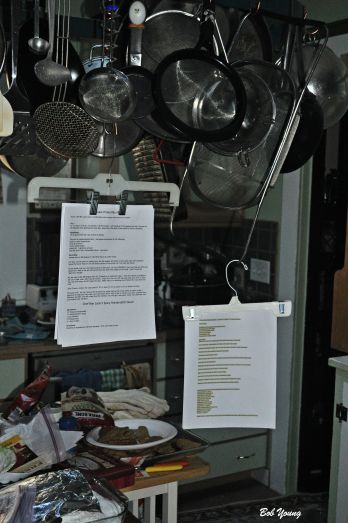
Some where on FaceBook a while ago, I saw this unique idea for holding a recipe “out of the way” while you are trying to create a dish. Easy enough to do and as you can see here, we have more than one in our kitchen. Give it a try. You’ll like it. (Mikey did!)

Recipe holder made from "skirt" hangers. Hang them where you are working and they are out of the way.

Recipe holder made from “skirt” hangers. Hang them where you are working and they are out of the way.

43.624890 -116.214093

Reblog:

  • Click to email a link to a friend (Opens in new window) Email
  • Click to share on Pinterest (Opens in new window) Pinterest
  • Click to share on Facebook (Opens in new window) Facebook
  • Click to print (Opens in new window) Print
  • More
  • Click to share on X (Opens in new window) X
  • Click to share on Instagram (Opens in new window) Instagram
Like Loading...

Tagines and Tagine Cooking

18 Monday Nov 2013

Posted by Bob and Robin in Anthropology of Food, Chicken, Curry, Ethnic Foods, Food Prep, Herbs, Herbs and Spices, Interesting Information, Lamb, Main Dish, Mediterrean Foods, Moroccan Food, Moroccan Spices, Persian Food, Special Information, Spices of Morocco, Tagine, Tagine Cooking, What's For Dinner?

≈ Leave a comment

Tags

chicken tagine, Mediterrean, moroccan cuisine, Morocco, tagine cooking, tagine recipes


/Robin and I like the cuisines of different cultures, as some of you may well know. The cooking traditions of Morocco or of the Mediterrean area, can produce some really wonderful dishes. But to do them, you probably would benefit by using the correct cooking utensil. In this case a tagine, as pictured here.

Tagine is named after the pot [an entree] is cooked in, a thick clay cone resting on a rounded base. While many tagines are ornamental – see the delicate ceramic ones [above], hand-painted carefully – the basic cooking version is unpainted and only occasionally glazed. Practical and durable (except if you drop it, of course), the dish is synonymous with Morocco for good reason: every roadside stall, tourist restaurant and cafe seems to have pots of the stuff simmering all day long. (legalnomads.com)

You can spend a lot of money on a tagine, or not. The ones pictured above, could be rather expensive. The one Robin and I have is an earthen color and can prepare a meal for 6. We bought it online and it was not expensive. A good source for information about Mediterrean cooking and tagines is Legal Nomads. Another good source on Facebook is the group Moroccan Cuisine. There are several articles, and tagine recipes, on this blog. One such article/recipe is Chicken Tagine and Mushrooms with Moroccan Green Olives. On this blog, search on the word tagine, and several articles will be found.
Basically, tagine cooking is defined as:

… By virtue of slow-cooking meat at low temperatures, effectively braising it until tender, a lower quality or tougher meat can be used. And the food cooks with minimum of additional liquid (water is added as it simmers), and no additional fat. The meat browns in the heated clay despite the slow simmer – the heat remains trapped inside the pot by the raised outer ridges on the base of the tagine. [legalnomads.com]

The method of cooking – via a tagine – is partially what makes this cooking style so unique. The other very important ingredient are the spices. Here are some that are used in tagine cooking, and in particular, foods from Morocco. Sweet paprika, good quantity of cumin, Moroccan saffron – if you can find it, turmeric, garlic, freshly chopped parsley, ground ginger, and salt and pepper. In the article, It’s Always Tagine O’Clock in Morocco, you will find more information on tagine cooking as well as recipes for Tagine of Beef, or Chicken or Mutton. Or, if you like shrimp or other shell fish, here is a good recipe for Tagine of Shrimp in Tomato Sauce.

Try this cuisine, you may find you like it. Think slow cooking and low heat. Sound familiar? And remember the tagine spices, and actually the ones I have listed are only a fraction of the spices use, but they are the basic ones. Enjoy!!

43.624890 -116.214093

Reblog:

  • Click to email a link to a friend (Opens in new window) Email
  • Click to share on Pinterest (Opens in new window) Pinterest
  • Click to share on Facebook (Opens in new window) Facebook
  • Click to print (Opens in new window) Print
  • More
  • Click to share on X (Opens in new window) X
  • Click to share on Instagram (Opens in new window) Instagram
Like Loading...
← Older posts
Newer posts →

  • Bob and Robin's avatar Bob and Robin
  • rockinrobin43's avatar rockinrobin43

Meta

  • Create account
  • Log in
  • Entries feed
  • Comments feed
  • WordPress.com

Copyright Notice

Creative Commons License
This blog and all work herein is licensed under a Creative Commons Attribution-Noncommercial-No Derivative Works 3.0 United States License.

The Current Weather at the Captain’s Shack

Click the image to see the very latest and current weather at the Captain's Shack in Boise, Idaho

Enter your email address to follow this blog and receive notifications of new posts by email.

Join 183 other subscribers

Thanks to all of these readers and subscribersz of this blog!

  • 320,226 and 598,479 Folks Reached

Monthly Archives of this Blog

Translate This Page

Assoc of Food Bloggers

Association of Food Bloggers

BFM Drive-Thru

Boise Farmers Market Drive-Thru

Air Fryer Cooking Time and Temperature Conversion Calculator

To convert to the AirFryer

AirFryer Recipes

https://www.airfryerrecipes.com/

Air Fryer Conversions

Rule of 25%. Reduce oven/frying temperature by 25% and time by 25%.

Fork To Spoon – Air Fryer and Instant Pot Recipes

Great resource for AF and IP information and recipes.

AirBnB Buhl, Idaho

Welcome to Mary Anne’s place, a historic cottage in the heart of Kelley’s Canyon Orchard. Just 20 minutes from Twin Falls, unwind in this quiet retreat by enjoying the pleasant sound of a nearby creek and views that look out into the orchard. 4 guests · 2 bedrooms · 3 beds · 1 bath, Wifi · Free parking · Kitchen, Entire House! 1903 River Rd, Filer, Idaho 83328

Bloglovin’

RSS Links

RSS Feed RSS - Posts

RSS Feed RSS - Comments

-----------------------
I Know. Not Idaho Products, But still Worth A Try!
----------------------

Rockin’ Rs

----------------------
Items of Blog Interest.
-----------------------

Member of The Internet Defense League

The History Kitchen

Interesting historical information about food - prep, origins and uses. Written by a kitchen anthropologist!

-----------------------
Of Concern To This Blog
----------------------

Recent Posts

  • Trike Restaurant Finds Worthy of Posting
  • Food Via ETrike
  • An Awesome Chicken Dish
  • Sushi Shack
  • Awesome Oven BBQ Pork Ribs

-----------------------
Think Local!! Buy Local!!

Let them know you saw their logo on this blog. Thanks!
----------------------

Buy Local!

If you are not from Idaho, think about Buying Local in Your area! As for us, we have lived in Idaho since 1982. We Buy Idaho wherever possible.

Chef Jake Sandberg, Crispeats

Food References and Recipes

Buy Local

And it does ... Just Make Sense! Regardless of where you are from.

------------------------
Think Local!! Idaho Products.

Let them know you saw their logo on this blog. Thanks!
-----------------------

The New Boise Farmers Market

Summer and Winter - 1500 Shoreline Dr, Boise (Americana and Shoreline)

Idaho Farmers Markets

A listing of statewide Farmer's Markets with contacts.

Find Your Local Farmers Market

Click on the graphic to find your local farmers market either by city or zip code.

Acme Baked Shop, Boise

Available at the Boise COOP. Some of the best bread in Boise and all local!! They make the bread for the 10 Barrel Brew Pub, Angell's Bar and Grill, Salt Tears, all here in Boise. Awesome rye bread that actually tastes like rye bread. And the baguettes .... Wonderful. (208) 284-5588 or runsvold2000@gmail.com

Brown’s Buffalo Ranch

Give them a call or EMail for awesome buffalo meat.

Desert Mountain Grass Fed Beef (formerly Homestead Natural Beef)

Desert Mountain Grass Fed Beef, with Bob and Jessica Howard of Howard Ranch in Hammett. The company will only sell whole animals to the Boise Co-op and Whole Foods stores in Boise and Utah. They will also be at the Boise Farmers Market.

Falls Brand Pork roducts

Click the image for pork recipes.

Kelley’s Canyon Orchard

1903 River Rd, Filer, ID 83328 Hours: 10am - 6pm, Phone: (208) 543-5330

Malheur River Meats

Matthews Idaho Honey

Matthews All-Natural Meats

Meadowlark Farms

All natural Eggs, Lamb and Chicken

Purple Sage Farms

True Roots Farm

Available at the Boise Farmers Market and online at https://www.trueroots.farm

True Roots is a local produce farm committed to sustainable and chemical-free farming practices. We raise pesticide-free and non-GMO produce fresh from the farm, offering a diverse variety of farm-fresh services to our local community. Since our founding in 2014, our mission has been to provide farm-direct access to clean, reliable, and affordable produce.

Reel Foods Fish Market

1118 Vista Avenue, Boise, ID 83705 (208) 713-8850 Monday-Friday: 10am-6pm, Saturday: 9am-5pm. Sunday: Gone Fishin’

Standard Restaurant Supply

Plenty of items for the home, too. Check them out. 6910 Fairview, Boise 83704 (208) 333-9577

-----------------------
Some Awesome Recipe and Spice Sources. Culturally diverse.

Let them know you saw their logo on this blog. Thanks!
------------------------

Crockpot Recipes

Many good recipes here.

A Taste of France

A collection of French recipes

Basque Recipes

Best Ever Recipes of Mexico

Malaysian Recipes

Awesome Malaysian recipes.

Memorie di Angelina Italian Recipes

My Best German Recipes Web Site

Regional and Oktober Fest Recipes

There are a lot of recipes here.

Sauer Kraut Recipes

Recipes By Robin and Bob

Recipes that we have collected and created throughout the years.

Recipes of Elizabeth W. Young, Bob’s Mother

These are the recipes that my Mother collected over 85 or so years. The photo of my Mother was one of the last I have of her. It was taken in July, 1987.

Recipes From The Mediterranean Area

Soup and Chowder Recipes

Recipes from "My Recipes"

Deep South Dish Recipes

The Recipes of Greece

Tasty Mexican Recipes

The Shiksa In The Kitchen

Great Jewish recipes!

-----------------------
Some Great Boise Restaurants.

Let them know you saw their logo on this blog. Thanks!
-----------------------

Asiago’s – Italian

Bella Aquila, Eagle, ID

775 S Rivershore Ln., Eagle, ID 83616 (208) 938-1900

Bar Gernika – Basque Pub and Eatery

202 S Capitol Blvd, Boise (208) 344-2175 (Checked)

Cottonwood Grille

913 W River St., Boise (208) 333.9800 cg@cottonwoodgrille.com

Enrique’s Mexican Restaurant

482 Main St., Kuna (208) 922-5169 New name. Was El Gallo Giro. Same owners and kitchen. The Best Mexican restaurant in the Boise/Kuna area, bar none!

Flying Pie Pizzaria

Goldy’s Breakfast Bistro

108 S Capitol Blvd., Boise (208) 345-4100

Goldy’s Corner Cafe

625 W Main St., Boise (208) 433-3934

Guanabanas – Island Restaurant and Bar

960 N Highway A1A, Jupiter, FL

Janjou Pâtisserie

Janjou Pâtisserie, 1754 W State St., Boise, Idaho 83702 (208) 297.5853

Mai Thai Asian Cuisine

750 West Idaho Street Boise, ID 83702 (208) 344-8424

Mazzah Grill – Mediterranean and Greek Cuisine

1772 W State St., Boise (208) 333-2566

Richards Inn by Chef Richard Langston

Formerly - Vincino's. New location at 500 S Capitol Blvd., Boise (208) 472-1463. Reservations are highly suggested.

The Orchard House

14949 Sunnyslope Rd., Caldwell (208) 459-8200

The Ravenous Pig

1234 N. Orange Ave. Winter Park, FL

-----------------------
Think Local!! Boise Breweries, Brew Pubs and Wine Bars.
Let them know you saw their logo on this blog. Thanks!
-----------------------

10 Barrel Brewery Boise

830 W Bannock St., Boise (208) 344-5870

Cloud 9 Brewery and Pub

Opening Fall 2013 in the Albertson's Shopping Center, 18th and State in the old Maxi Java

Edge Brewing Company

525 N Steelhead Way, Boise, ID 83704 (208) 323-1116

-----------------------
Miscellaneous Items
-----------------------

Blog Syndication

NetworkedBlogs
Blog:
Boise Foodie Guild
Topics:
Food, Recipes, Cooking
 
Follow my blog

Blog Badge

Local & Regional Food Blogs - BlogCatalog Blog Directory

  • Subscribe Subscribed
    • Boise Foodie Guild
    • Join 72 other subscribers
    • Already have a WordPress.com account? Log in now.
    • Boise Foodie Guild
    • Subscribe Subscribed
    • Sign up
    • Log in
    • Report this content
    • View site in Reader
    • Manage subscriptions
    • Collapse this bar
 

Loading Comments...
 

    %d