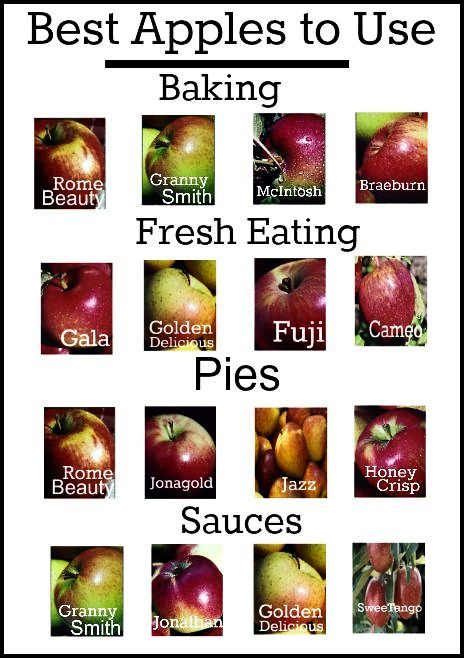
Apple Uses
26 Friday Jul 2013
Posted in Apple, Captain's Shack, Comfort Food, Food Prep, Food Trivia, Fruit, What's For Dinner?
26 Friday Jul 2013
Posted in Apple, Captain's Shack, Comfort Food, Food Prep, Food Trivia, Fruit, What's For Dinner?
20 Saturday Jul 2013
Here is some great information about some of the different garlic varieties that are available at the New Boise Farmer’s Market. There are many, many varieties. This is but a small sampling that is available here in Boise. Enjoy!
Edible Garlic
Note: All of these garlic types are available at the New Boise Farmer’s Market, 10th and Grove. The following information was produced by Glenn’s Farm.
“Hardneck and Softneck garlic are described as some are mild and others are Hot. It is hard to describe the slight differences.”This information is from organic gardening at about.com.
“Hardneck garlic varieties are generally hardier than softneck varieties. They are the best option for northern gardeners. They are also the best option if you want to enjoy garlic scapes in early summer, since hardnecks are the only type that send up a strong central stalk in spring (this is the scape.) Hardneck varieties tend to form fewer cloves per bulb than softneck varieties, but they also are usually a bit larger.Within the hardneck family, there are nine sub-types of garlics: Purple Stripe, Marbled Purple Stripe, Asiatic, Glazed Purple Stripe, Creole, Middle Eastern, Turban, Rocambole, and Porcelain. The Purple Stripe and Rocambole types are the hardiest, best for gardeners who live in the northeastern U.S. and Canada. Gardeners who live in mild climates will have good luck with Porcelain varieties.
Softneck Garlic Varieties (Allium sativum var.sativum)
Softneck garlic varieties are the best ones to grow if you live in a milder climate. They don’t form scapes, and generally form several small cloves per head. They mature quicker than hardneck varieties. Softneck varieties tend to store better than hardneck varieties, so this is the type to grow for long-term storage. Sub-types within the softneck family include Silverskin and Artichoke varieties.”Chinese Pink: The first garlic of the season. Mellow with a pleasing after taste.
Asian Tempest: Asian hardneck. When eaten raw it is breath taking. When baked, the flavor is sweet.
Chesnok Red: Hardneck. All around good for cooking. Full bodied flavor with a delightful aroma. When baked, it holds it’s shape and has a creamy texture.
German Red: (One of my favorites) Hardneck rocambole. Strong, hot and spicy.
German Porcelain: Hardneck. Good, all purpose garlic.
Zemo: Hardneck. Smooth and hot flavor and aftertaste.
Northern: Hardneck. A very pungent and one of the best for baking.
Music: Hardneck. Medium hot with flavor that lasts a long time.
Romaine Red: Porcelain hardneck. Hot with a long lasting bite.
Georgia Crystal: A hot garlic.
Metechi: Very hot when eaten raw.
Siberian: (Another of my favorites) Hardneck with a medium-strong heat. Rich earthy taste. Has a high allicin content. Allicin supports normal cholesterol levels and helps boost the immune system.
Spanish Rojo: Hardneck Rocambole. Rich flavor. Also called Greek Garlic or True Garlic.
Polish Jenn: A medium strength garlic.
Italian: (Another favorite of mine.) Softneck with a great taste and a good cooking garlic. Great to roast.
Silverskin: Softneck with a strong flavor and another great cooking garlic.
Inchillium Red: Softneck garlic with a mild flavor. Great baked and the blended with mashed potatoes.
I hope this clears up some of the mystery of garlic. Or does it just add to the question? Cheers.
19 Friday Jul 2013
Tags
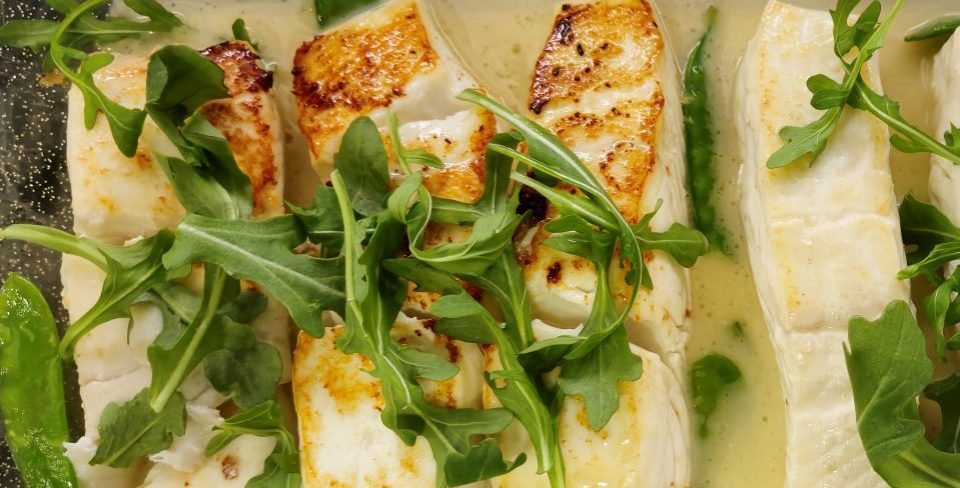
Tilapia. A very mild white fish must be cooked slowly and completely. But not to the point of drying out. Take your time. The tilapia here was cooked about 3 minutes on each side over moderate heat. The fish was cooked in a butter/olive oil/lemon bath. Then the liquid was finished off with whole milk – I didn’t have any cream – a small amount of corn starch and lime zest. Whisk constantly until thickened – about 2 minutes. pour over the fish as pictured here.
The asparagus is steamed in a garlic butter mixture over low heat. Serve on the plate with the tilapia. A glass, or two, of 2011 Canoe Ridge The Expedition Chardonnay goes very well with this dinner. Cheers and enjoy!
19 Friday Jul 2013
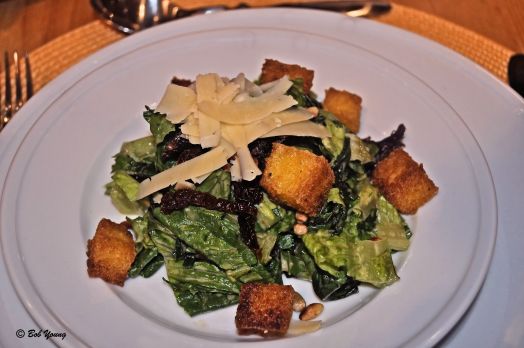
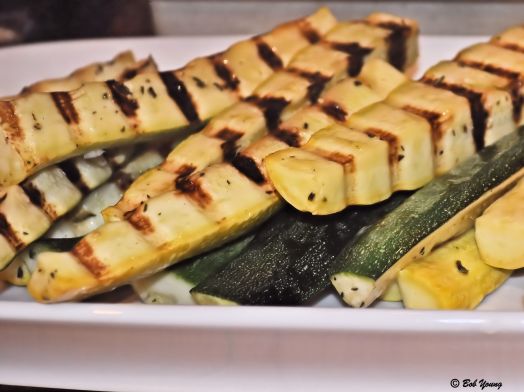
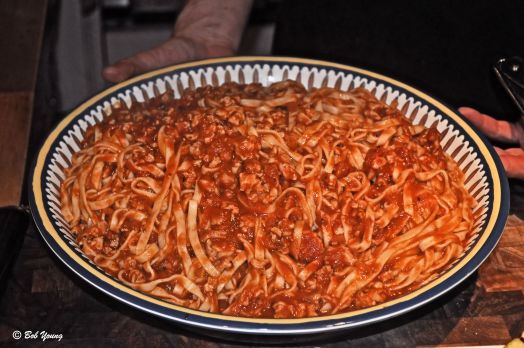
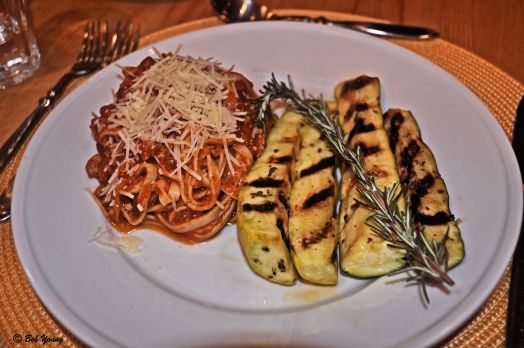
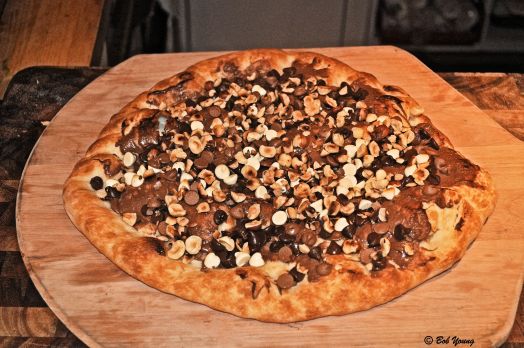
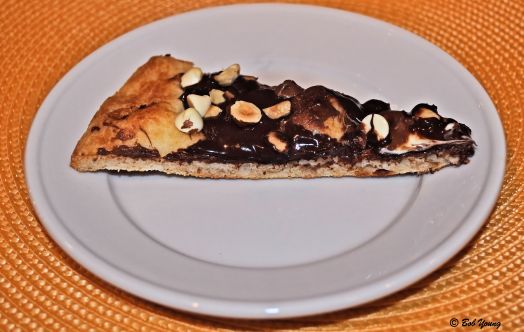
Another good class at the Boise William Sonoma store. This one was about Italian cooking, specifically recipes adapted from Giada deLaurentiis’ book, Giada’s Family Dinners. Good things like Italian Caesar Salad with Polenta Croutons – now there’s a switch and a good one! – or Marinated Zucchini and Summer Squash or Linguine with Chicken Ragu. And to top it all off, a Chocolate Pizza. Yup! That’s right. A chocolate pizza! And it was delicious and very rich. There are photos below. Left-Click any of these photos to see enlarged. Cheers and enjoy!
There were some questions posed by the class and one was, “What is a ragu?” Basically, it is a meat based dish with some type of pasta, traditionally linguine. But a ragu can vary from county to county, city to city or family to family much like the American stew or a Basque paella. Here is what Wikipedia says about ragu.
In Italian cuisine, a ragù (pronounced [raˈɡuː]) is a meat-based sauce, which is commonly served with pasta. The Italian gastronomic society l’Accademia Italiana Della Cucina has documented 14 ragùs.
The commonalities among the recipes are all meat-based and all are to be used as sauces for pasta. Typical Italian ragùs include ragù alla bolognese (Bolognese sauce), ragù alla napoletana (Neapolitan ragù), and ragù alla Barese (sometimes made with horse meat).
In the northern Italian regions, a ragù is typically a sauce of meat, often minced, chopped or ground, and cooked with sauteed vegetables in a liquid. The meats are varied and may include separately or in mixtures of beef, chicken, pork, duck, goose, lamb, mutton, veal, or game, as well as offal from any of the same. The liquids can be broth, stock, water, wine, milk, cream, or tomato, and often includes combinations of these. If tomatoes are included, they are typically limited in quantity relative to the meat. Characteristically, a ragù is a sauce of braised or stewed meat that may be flavoured with tomato, to distinguish it from a tomato sauce that is flavoured with the addition of meat.
In southern Italian regions, especially Campania, ragùs are often prepared from substantial quantities of large, whole cuts of beef and pork, and possibly regional sausages, cooked with vegetables and tomatoes. After a long braise (or simmer), the meats are then removed and may be served as a separate course without pasta. Examples of these styles of ragùs are the well-known ragù alla Napoletana (Neapolitan ragù) and carne a ragù.
Delicious, but I probably would have put more anchovies in it and a little more garlic. Just a personal preference.
I do like like grilled vegetables, especially squash. But not done mushy. It has to have a little crunch to it. This was done perfectly, Chef Chad!
What a delightful, and filling, entree.
So there is how I spent my evening. Robin wants to go to the next class and I have her name on the waiting list. She may go in my place, but it would be fun to do together. Hope you liked this post. Chef Chad Poznick asked if we had any suggestions for these classes to please let him know. I suggested a class using rabbit. Cooking with wine might be another good one.
18 Thursday Jul 2013
Take a hard look at this. A great opportunity. I just received this from Jerri Nelson, Owner of the Idaho Hotel in Silver City, Idaho. If you have never been to Silver, this is a great opportunity. Contact Jerri directly if you are interested. Cheers! The photo here is of the outside of the Idaho Hotel in Silver City, Idaho.
Bob – I know this is extremely short notice, but thought I’d send it anyway. We had several cancellations so I still have room, if you know anyone who might be interested in joining us this Saturday. Here’s the info…
Idaho Hotel – Wine Dinner July 20, 2013 $35.00
A midsummer night’s feast…
Culinary delights matched with wonderful wines.
Enjoy the simple moments of life…Course 1: Aperitif Wine: Zonin Prosecco – Italy (14.70)
Melon wrapped with prosciutto
Beet humus and chipsCourse 2: Wine: Domaine Bila-Haut Rose – France (17.70)
Chilled Red Bell Pepper Shooter
Pistachio Salad with feta, dried cherries, beets raspberry vinaigrette
Bread basket with compound butter cheeseCourse 3: Palette refresher – Lemon-basil sorbet
Course 4 – Main Course:
Walldeaux Smithie NV – Forgeron Winery – Walla Walla, WA (19.50) Marinated Flank Steak
Roasted rosemary smashed parsnips
Fresh garlic green beansCourse 5 – Dessert: Wine: Quinta do Noval Ruby Port – Portugal (17.70)
Macadamia Crusted Chocolate Tart with RaspberriesSpecial thanks to:
Tim Smith, wine educator and Kathy Dutt for presenting and pouring wines!
And
The best staff – Michelle, Richard, Tanya, Christina, Kirstin, Jan and Roger!Jerri Nelson
ph.208.375.8240 Ext. 1013
jerrin@stapley.net
16 Tuesday Jul 2013
Tags
Comfort Food, corn cakes, corn fritter, dinner, food, sawtooth

It may have been National Corn Fritter Day, it really was, but we decided on a family favorite – Corn Pie. Here was our menu:
Scallop Cakes
Sliced Red, Yellow and Zebra Tomatoes
2009 Sawtooth Petite Sirah
This was a YUM dinner! Comfort food. Left-Click to see the photo enlarged. The recipe for the Corn Pie is in the recipe file above. Enjoy!
16 Tuesday Jul 2013
Tags
Robin came across this delightful resource for grains, a Grain Glossary. In part, it says, “Most people know brown rice when they see it, but what about all the other grains? It’s one thing to rattle them off, but it’s an entirely different matter to know their various nutritional profiles and how to cook them. Then there’s the confusion of defining or classifying grains, as some grains that we call grains are not. True grains belong to the cereal grass family; for this glossary, however, I include edible seeds that share the nutritional properties of whole grains (quinoa, buckwheat, wild rice).
The bulk bins can be bewildering; even when you’re familiar with a particular grain, it’s mind-boggling to make sense of all the names it may go by. Groats, grits, steel-cut, rolled, puffed, pearled, cracked, flakes, and flour are the most common references, and all describe how the grain has been processed.” [Culinate (dot) com]
They have listed some of the more popular, and somewhat confusing grain types, in a good chart that also shows you what the grain looks like, much like the photo above from their website. For instance, for polenta they state that, “Polenta
Polenta and grits may sound as disparate as Italy and the South, but they’re both ground corn, as is cornmeal. They differ in how they’re ground (both the method and the fineness of the grind). Avoid de-germinated cornmeal (the germ has been removed to increase its shelf life), as it’s not a whole grain. Polenta makes a delicious base for sauces (ragu, mushroom, gorgonzola) and sausages; it’s also good grilled or layered into lasagne-like dishes.”
There is more listed in the article. A good read! Enjoy the information. Cheers!
16 Tuesday Jul 2013
Robin asked the other night for crab cakes, plus she found a recipe for Maryland Crab Cakes on FB. We did not have any Blue crab in the house, although it is available at Costco. So I asked if it would be OK to try the cakes with bay scallops. The result is what you see here in this photo. They were very good and a nice substitution for crab cakes. Basically the same recipe, but altered in places. Click Here for the recipe in PDF format. Serve these with a nice green salad with fresh tomatoes, homemade tartar sauce and a 2009 Sawtooth Winery Petite Sirah, the wine goes quite well with the scallop cakes. I will also post it in the recipe file on this blog. Cheers and we hope you enjoy these.
The tartar sauce that we make is pretty basic. Here is the recipe.
Homemade Tartar Sauce
Yield: abt 1 1/2 cups
1 c Mayonnaise
3 T Pickle Relish
1/2 c Chili Sauce
2 T Kosher Horseradish
1/4 t Sriracha Chili Sauce, use cautiously … It is hot!!
Juice of 1/2 LemonMix all together and refrigerate for 15 minutes. Serve with these Scallop Cakes, Crab Cakes or most any seafood. Enjoy.
13 Saturday Jul 2013
And we’re off! The start of a beautiful weekend …. Our 30th Wedding Anniversary. Friday night, Robin wanted Cheese Steaks. Make our own. Anyone remember “Steak-Ums”? Can’t get them here in Boise, as far as I know. Are they even made any more? Albertson’s Markets says, “No.” OK. Slice down some bottom round really thin and then chop it. Grill up some onions, and you get what is pictured here on the grill. Left-Click any of these photos to see enlarged. Please VOTE above. Thanks and enjoy!

Saturday morning breakfast. Sauteed Crimini and Royal Trumpet mushrooms with scrambled eggs and Acme Bake Shop toasted rye bread. Add a good glass of orange juice and yum!
Two scrumptious meals. But wait …… There will be more. I promise. Cheers and keep watching!
11 Thursday Jul 2013
Here is another fascinating “spice” article from Malaysian Delacacies on Facebook. (If you look, Facebook does have some interesting posts. But only some.)
Turmeric is named as the ’Golden Spice of Life’.The botanical name is Curcuma longa, and the plant is a member of Zingiberaceae or ginger family. Turmeric has color similar to that of sunlight. Therefore, it is considered to be sacred in India as in ancient times such natural forces were believed to have supernatural powers. It is used in auspicious ceremonies and rituals.
Studies have shown that two teaspoons of turmeric contain 1.88 milligrams of iron, 0.08 milligrams of vitamin B, 0.96 grams of dietary fiber, 114.48 milligrams of potassium and 0.36 grams of manganese.
Turmeric is an essential spice in Indian cuisine. This warm and aromatic spice with bitter undertones is also used extensively in Southeast Asian and Middle-Eastern cuisines. In Indian cuisine turmeric is added to nearly every dish, be it non- vegetarian or vegetarian. Its bright yellow color imparts an orange yellow hue to curries. It is widely used in Moroccan cuisine to spice meat, particularly lamb, and vegetables. It is also used in spice blends in the Caribbean, North Africa, the Middle East, and Indonesia. Turmeric is also used to give a yellow color to some prepared mustards; it gives ballpark mustard its bright yellow color.
Listed above on the graphic, are the benefits of Turmeric. Left-Click to see enlarged.