
• About and Contact
  • Air Fryer Cooking Charts and Conversions
  • Air Fryer Recipes – Update: August 2020 – Chicken Olivia
  • Barcode Country List
  • Boise Foodie Blog Recipes – Updates: Nov 2024 Basic Hollandaise Sauce and Cream of Mushroom Soup
  • Boise Restaurant Guide – 52 Restaurant Choices! Updated: July 2018
  • Companion Garden Planting
  • Instant Pot Recipes – Update August 2020 – IP Chicken with Ketchup, Honey and Soy
  • Recipes from the Captain’s Shack: Dec 2020 – CS Prime Rib

Boise Foodie Guild

~ – Enjoy a meal or a recipe with us! Be sure to check the Sidebar and Menu above. Interesting resources are listed there. Most are hot links. Air Fryer (AF), Instant Pot (IP) and Captain's Shack (CS) recipes now have their own page. Subscribe to the blog. It's still FREE!

Boise Foodie Guild

Category Archives: Recipes

Some Meals We Have Enjoyed

07 Friday Jan 2022

Posted by Bob and Robin in Captain's Shack, Classic Cuisines, Classic Herb Blends, Cooking Styles, Dessert, Dinner At The Captains Shack, Dinner With Family, Egg Noodles, Ethnic Foods, Food - Make Your Own Meals, Food Photos, German Recipes, Herbs, Herbs and Spices, Housemade Soup, Idaho Beef, Main Dish, Morels, Mushrooms, Pasta, Photos By: Bob Young, Recipe - Soup, Recipe By: Captain's Shack, Recipe by: Robin and Bob Young, Recipes, Recipes - Bavarian, Recipes - Dessert, Recipes - Dinner, Recipes - Sauces, Sauces, Spices, What's For Dinner?

≈ 1 Comment

Tags

beef, prime rib, soup


Sorry for the long delay in getting articles or recipes posted. It’s been a crappy Fall, but things are returning to normal now. I will create this post, as I have done in the past with all posts, with a good description of the dish and a link to the recipe that we have created. Most of the recipes, however, are original only to the point that we have altered the original recipe to fit our needs. Most of the recipes presented here and on this blog, have a note attached to them “Source: adapted from (some other recipe)“. At least then, you know where you can find the original recipe. Please, as in the past, feel free to use and try any recipe presented and let us know how it came out and if you liked it or not.

Let’s start with a great soup. Did you ever see the movie Tortilla Soup? Well here is the recipe for that soup, Tortilla Soup http://www.rockinrs.com/Tortilla-Soup.pdf. I’m sorry I don’t have a photo of it. This is fun to make – you can make it as spicy as you want – and great eating. We love it!

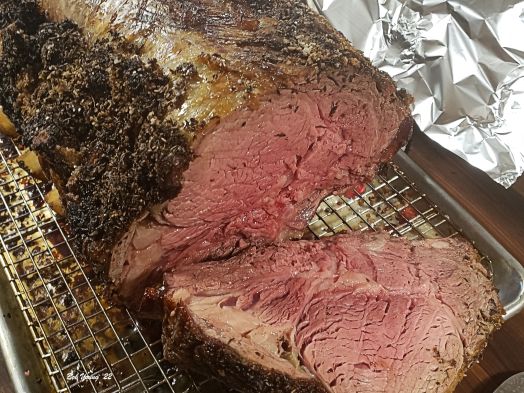
And to start the main course off, how about Roasted Prime Rib of Beef? Really easy to do, but be sure you follow the cooking directions exactly. Recipe – http://www.rockinrs.com/CS-Prime-Rib.pdf. This recipe calls for an herb butter and we used our Herb de Provence, http://www.rockinrs.com/CS-Herbs.pdf. Use it liberally and mix well with room temperature butter. I even went so far as to, after adding the herb butter and salt, to dry brine this in the refrigerator for 24 hours. Came out great!
And here is a great leftover prime rib dish, Leftover Prime Rib Beef Stroganoff. (recipe – http://www.rockinrs.com/Leftover-Beef-Stroganoff.pdf) The original recipe called for Baby Portabella mushrooms, but we had some dried Morel mushrooms collected this past Fall and I reconstituted them in a little vodka and used some of the liquid in the sauce.

Leftover Prime Rib Stroganoff

Total time to make this dish is about 20 minutes, not counting preparing the egg noodles or rice. If you would prefer not to use noodles, you can always use rice. If you use rice, I would probably use Basmati or Jasmin. Either way, we loved this and will make it again. Delicious flavors and easy to do. I even had someone tell me they have made a similar stroganoff with leftover meat loaf.

For the last of the prime rib, you can also make a delicious and scrumptious Prime Rib Soup. This is almost a one pot meal. Hearty with the barley in it. Great on a cold winter day. Just takes some time to make, about 3 hours and 15 minutes. But well worth it. Great herb combination in it. Here is the recipe – http://www.rockinrs.com/Prime-Rib-Soup.pdf
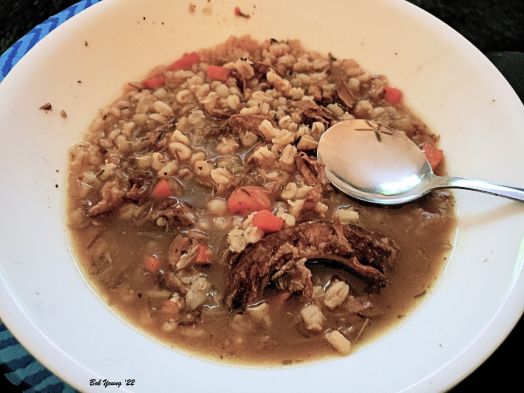
Prime Rib Soup

It takes a little time, but well worth it. The barley is really a great addition. That pretty much uses up the prime rib leftovers. But, there are 3 different meals from this cut of beef.

The last dish is a very German entrée. It is a Spinach Spaetzle with Speck, a German bacon. You can find the recipe here – http://www.rockinrs.com/Spinach-Spaetzle.pdf. Enjoy!

Spinach Spaetzle with Speck

This is a big, hearty meal that will satisfy most big appetites. The speck gives a wonderful flavor the the spaetzle a great texture. We used a store bought spaetzle because I don’t have a spaetzle maker. We bought the spaetzle and the speck from a German shop here in Boise.

But wait! That’s not all! What about dessert? How about some Pecan Shortbread Cookies? http://www.rockinrs.com/CS-Pecan-Shortbread-Cookies.pdf

Pecan Shortbread Cookies

A great shortbread treat full of toasted pecan bits, almond extract and a little rum, that is not in the recipe. I don’t usually do this, but our neighbor has a cookie business and they are good. Her business name is Crumb by devlyn and can be reached at (910) 405-4718 or emailed at crumbbydevlyncookies@gmail.com (No. I made the shortbread cookies!)

Enjoy these dishes. They are all good and worth a try. gutes Essen in German or biadh math is Gaelic. That covers my heritage.

Reblog:

  • Click to email a link to a friend (Opens in new window) Email
  • Click to share on Pinterest (Opens in new window) Pinterest
  • Click to share on Facebook (Opens in new window) Facebook
  • Click to print (Opens in new window) Print
  • More
  • Click to share on X (Opens in new window) X
  • Click to share on Instagram (Opens in new window) Instagram
Like Loading...

Purim and Hamantash Cookies

28 Friday Feb 2020

Posted by Bob and Robin in Comfort Food, Cookies, Cooking Styles, Dessert, Food - Jewish, Fruit, Hamantash Cookies, History of Food, Holiday Picnic Fare, Recipe - Dessert, Recipe - Jewish, Recipes, Recipes - Dessert, What's For Dinner?

≈ 4 Comments

Tags

Hamantash Cookies, Purim


I love it when I hear of a new food item. New to me, at least. Hamantash Cookies is just that. Thanks to my friend Joe Levitch for mentioning them. An so I search.
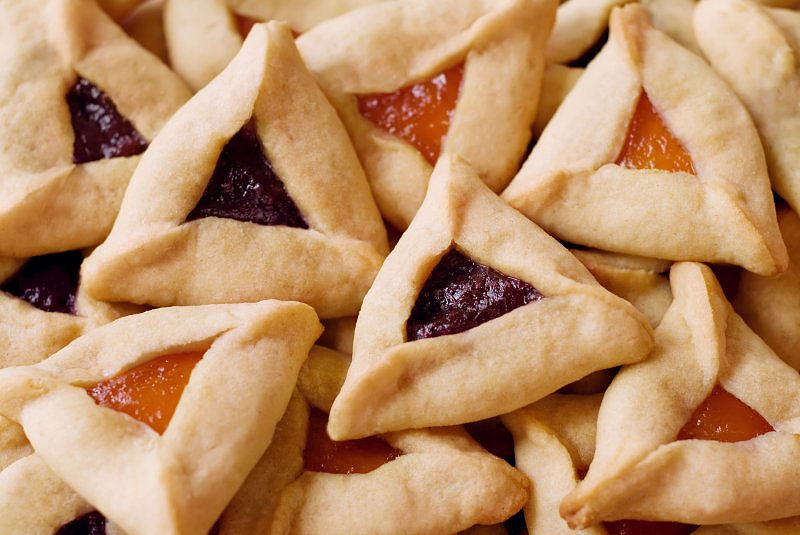
Hamantash cookies are associated with the Jewish Festival Purim. The Purim cookie is, “… all associated with the Purim story involving a bad guy name Haman, a Jewish lady named Esther, and her victory over his plot to destroy the Jewish People. The cookie is shaped to resemble the three corners of Haman’s hat. Purim is the name of the festival and both Hamantaschen and Oznei Haman are derived from his name.” [Veenaazmanov]

Jelly Filled Hamantash Cookies for Purim

And from the NY Times, “Early versions of the cookies were more commonly known as oznei Haman, meaning “Haman’s ears.” The late Jewish food historian Gil Marks’ Encyclopedia of Jewish Food traces that phrase — but not the cookie — to the Roman scholar and poet Immanuel ben Solomon (c.1261-1328) who, thanks to “a misinterpretation arising from the medieval Italian custom of cutting off a criminal’s ear before execution,” argued that Haman’s ears had been cut off after he was hanged, at the end of the Purim story.”
And Purim is, “Purim is one of the most fun holidays celebrated by the Jewish people, but is often under recognized. Purim (held on the 14th day of the Hebrew month of Adar — usually March or April) commemorates the day Esther, Queen of Persia, saved the Jewish people from execution by Haman, the advisor to the Persian king.” Purim this year is March 10, 2020.
Here is a recipe for the cookies. It looks like there are many. Enjoy! Hamantash Cookies

Reblog:

  • Click to email a link to a friend (Opens in new window) Email
  • Click to share on Pinterest (Opens in new window) Pinterest
  • Click to share on Facebook (Opens in new window) Facebook
  • Click to print (Opens in new window) Print
  • More
  • Click to share on X (Opens in new window) X
  • Click to share on Instagram (Opens in new window) Instagram
Like Loading...

10 Items to have In Your Kitchen and How To Make Gravy

23 Sunday Feb 2020

Posted by Bob and Robin in Boise Farmers Market, Boise Foodie Guild, Buy Idaho, Buy Local, Classic Sauces, Comfort Food, Food - Gravy, Food Prep, Homemade Sauce, Housemade Gravy, Recipes, Recipes - Gravy, What's For Dinner?

≈ 1 Comment


As many of you know, I have a lot of resources that I use in this blog – recipes, suggestions, food items, kitchen products, etc. Here is a list of ten items that I always have in my kitchen. This list comes from My Recipes


  • Onion
    White, yellow, or Vidalia, I’ll always have one kicking around. I caramelize them for tarts, build massive pots of black and white beans around them, and throw them into guacamole.
  • Garlic
    Like ebony and ivory, these two (of course!) go together. I love to roast the whole head and use the sweet, smashed cloves on bread or spun into pasta. And in the event that I made too much pasta, I’ll sauté a small smashed clove in butter or olive oil the next day, discarding the clove and tossing leftover noodles quickly in the infused oil, then dolloping the whole shebang with crème fraîche.
  • Lemon
    Ideally one has both limes and lemons, but as bartender Joaquín Simó of New York bar Pouring Ribbons expressed it to me, “Lemons are sour, and limes are tart.” Lemon juice adds a real punch of acidity to a dish, whereas lime sort of nudges it down a tart path. I use lemons to stuff chickens and deglaze their pans for easy gravy. I squeeze them into homemade bourbon sours and over pasta. If a dish is lacking something, I ask myself if it’s lemon.
  • Tuna
    Everyone has their emergency canned protein, and props to those of you who bust out high-quality anchovies and salmon as your go-to snacks, but I always have good tuna on hand, splurging on Genova or Cento packed in olive oil when I can. It makes for instant snacks or—if I have bread—tuna melts when I walk in the door ravenous, and I’ve been playing around with layering it into pasta with olive oil, capers, and roasted garlic. (Yum!)
  • Butter
    I’m a New Englander, and even at my most broke in this life—my pants had holes; I couldn’t afford health insurance—I’d buy good, unsalted, European butter. These days some domestic butters are just as lovely, and the price has gone, blessedly, way down.
  • Olive oil – Greek and Italian
    Yes, this list is heavy on proteins and fats, which testifies to the foods that power me; I’d fight you for cheese, but never for a box of pasta. My belly rumbles when I’ve had biscuits or French toast for breakfast, but not when I’ve wolfed a few tablespoons of cannellini beans sautéed in olive oil with onions and garlic and seasoned with lemon.
  • Salt
    An acquaintance, observing my twitchy salt trigger hand at the table, once joked that I should have a salt lick installed in my home. I’m a big fan. I love that you can season lightly at the beginning of cooking in order to cut down on how much you need later. (Pasta water, for example, should be seasoned with at least a tablespoon.) I always have Kosher and sea salt on hand, and sprinkle the latter liberally on eggs and avocados.
  • Cheese
    It was only when I attended the Vermont cheesemakers’ festival many years ago that I felt truly at home in this world. Here were bearded men holding babies and arguing about the difference between 18-month and 30 month Comté; there were women tipping back beer while debating the merits of Brillat-Savarin and Camembert. I’ll always have a knob of cheddar, some twisty, stringy Oaxacan cheese, or a fresh cheese in my fridge.
  • Coffee
    Because life is short, and it’s best to stay alert to catch it all. I have learned the hard way not to leave the house without coffee, as I am not a good person without it in my system. These days I stock up on locally roasted, chocolatey Ethiopian Forty Weight beans.
  • Beans
    Cheap, cheerful, and plentiful in my Mexican-American neighborhood, beans are a major staple in my home. Ideally I have a bag of cannellini and another of black, which are less expensive and lighter than the heavy pre-soaked, pre-cooked beans, but I like to have those, too, for those hangry, rushed weeknights that sideswipe all of us.

And many readers of this blog have trouble making a good gravy. Even I do, at times. Here, from the same source is how to make gravy.

  1. Step One: Choose Your Gravy Style
    As much as we absolutely sympathize with the urge to guzzle gravy by itself, it is admittedly a finishing sauce, not a complete meal on its own. Therefore, it’s important to consider what style of gravy you’d like to go for; that means, ultimately, considering what kind of foods the gravy will be topping. It also means considering whether you have the ingredients on hand to make the base flavor behind most gravies. For white gravy, you’ll want butter, milk, ample salt and pepper, and possibly pork fat. For brown gravies, you’ll want some sort of stock, and ideally, fat drippings and browned bits from recently cooked meat. If you or your dinner guests are vegetarian, you can use vegetables that impart a good bit of umami flavor, like mushrooms or onions. Those ingredients can also be used to amplify your meaty gravies.
    You’ll also want to think about whether you want a smooth finish to your gravy, or if you’re fine with meaty bits in the sauce. If you’d rather a gravy that mimics store bought, you’ll need to use a sieve to strain out any pieces of meat, onion, or mushroom that might be roughing up the gravy’s finish.
  2. Step Two: Make Your Roux
    Making roux is the most critical step to making a good gravy. To many home cooks, it’s also the most nerve-wracking; though it’s not nearly as intimidating a process as it might seem at first. Once you master it, you’ll open yourself up to a lot of other culinary possibilities, like bechamel and hearty stews. To make a roux, you’ll need two things: fat and some sort of thickening agent. Usually, that agent is flour, but cornmeal or cornstarch can also be used, as demonstrated in Uncle Ellis’ recipe listed above. You can also use seeds and nuts (like pine nuts) to thicken your roux, as long as you grind them into a paste first. This method may still require some flour, however.
    To make a roux, warm a couple of tablespoons of butter, bacon drippings, or some other form of fat into a pan over medium-high heat. Once the fat is warm, add in your thickening agent, one tablespoon at a time. Stir the mixture until it begins to brown. If you’re making a country or white gravy, you’ll want it to just barely change colors; it’ll smell slightly nutty and have the texture of wet sand. If you’re making a brown gravy, let the roux cook for a little longer. Just don’t let it get too brown; the more a roux cooks, the less thickening power it has. Dark brown roux is best used in dishes with thinner sauces, like gumbo.
  3. After you’ve cooked your roux, slowly add in your liquid. For white gravies, this would be milk; for brown, this would usually be a stock of some sort. Make sure to add your liquid slowly—less than a quarter of a cup at a time is fine. Stir constantly while you’re adding it, too; if possible, you might even want someone else to slowly pour while you stir. The goal is to emulsify the liquid with the hot roux for a smooth gravy that has minimal lumps. If the liquid is added too quickly, the gravy won’t thicken properly.
  4. If something is going wrong with your roux or you’re feeling a little nervous about making one, check out this troubleshooting guide. It’ll take you through the most common mistakes. Adding hot liquid to a hot roux (or cold liquid to a cold roux), for example, will result in a lumpy mess, which is why you want to use cold liquids when using the stovetop roux-making method. And if roux-making ends up becoming one of your most-hated kitchen activities, it’s worth mentioning that roux can absolutely be made up ahead of time. Just keep it in a container in the fridge, and make sure only to add it to hot liquids so that you’re spared the lumpy gravy that results from the temperature mistake mentioned above.
  • How to Make Brown Gravy
    Brown gravy is one of the most universally applicable forms of gravy. For this recipe, you’ll want to gather fat drippings; these can be collected (and stored for later use) the next time you make a roast, cook a turkey, or simply fry up some bacon in the morning. If you don’t have enough (or any) animal fat, you can also, of course, just use butter. It won’t be quite as flavorful as drippings, but it will absolutely still do the job.
    Once you’ve made your roux, you’ll want to add your liquid to finish your brown gravy. Oftentimes, this will be the stock or any thinner drippings you may have still from your roast, but you can also use canned or boxed stock to finish off your gravy. Add the liquid to your pan slowly, and stir constantly until the sauce coats the back of your spoon. After about three to five minutes, your gravy should be ready to serve.
  • How to Make Mushroom Gravy
    Mushroom gravy follows almost exactly the same process as brown gravy. After adding a chicken (or vegetable) stock and thickening the gravy, however, you will want to add sauteed mushrooms and shallots to the sauce. If you’re looking for even more flavor (and you’re using meat products), consider sauteeing the mushrooms and shallots in your pan drippings before you make your roux. Remove them from the pan, and then proceed to the next step. You’ll come out with an even more full-bodied gravy that’s perfect for your next steak or stroganoff.
  • How to Make Onion Gravy
    As with mushroom gravy, onion gravy is yet another variation on the classic brown finishing sauce. With this variation, however, it’s worth considering whether you’d like a creamier consistency; as noted in the Caramelized Onion Gravy recipe above, milk makes for a great addition to this gravy variant. If you’re looking for an even easier way to incorporate onions into your gravy, sprinkle them with flour after softening them in the pan, and then proceed to make your roux. The flour-covered onions will help you get your gravy to the dinner table even faster.
  • How to Make Fruit-Infused Gravy
    We know—the idea of fruit-flavored gravy might sound bizarre. But when paired with the right entree, it can be the perfect accompaniment. For this variation, you’ll want to cook a fruit base that compliments your final dish; apple cider can be reduced into a great gravy, but tangerines, cherries, and cranberries would also be a delicious accents to a holiday feast. Once you’ve made a fruit juice that suits your taste, combine with stock, if desired, and add to your roux.
  • How to Use Beer, Wine, or Spirits to Make Gravy
    Whiskey, sherry, wine, and beer can all make for fantastic gravy flavors. And if you’re ambitious, they can also do the duel job of serving as a marinade for your meat. To incorporate alcohol into your gravy, decide whether you would like to add it cold to an already finished gravy, or whether you would like to use it as a cooking liquid first. If the former, make roux as described above and slowly whisk in a quarter cup to a 1 ½ cups of your desired brew. If you’d like to use your gravy as a marinade first, however, cook your meat (either in a slow cooker or on the stove) until tender in a mixture of your chosen alcohol and stock. Remove the meat and strain out any bits that may still remain in the sauce; add the alcohol and stock mixture to a pot, heat it up, and stir in flour a tablespoon at a time. Soon, you’ll have a custom gravy that highlights the flavors you initially imparted into your entree.
  • How to Make Tomato Gravy
    If you love tomatoes, then you’ll adore a gravy that incorporates the sweet, acidic fruit. For this gravy, add tomatoes to your drippings and cook them thoroughly. If they’re whole tomatoes, make sure the skin blisters before breaking them open. Then, once your tomatoes are cooked down and seasoned, add in flour to thicken your sauce. Serve over burgers, pork chops, biscuits, or anything else that you’d prefer topped with tomato-y goodness.
  • How to Make Redeye Gravy
    Redeye gravy is a Southern delight that doesn’t get its due. The caffeine-infused sauce is great when served over country ham and biscuits, and it’s also a great alternative topper for country-fried steak. To make redeye gravy, cook chopped up bacon and ham in butter, along with some onion and garlic, if desired. Add flour and cook your roux, then slowly mix in milk, broth, and cooled, already brewed coffee. Pepper to taste, and feel free to add in some chopped chives or cayenne if you like.
  • How to Make Egg Gravy
    Another Southern staple, giblet gravy is great when dripped over mashed potatoes or bits of turkey. The addition of hard-boiled egg also adds intrigue and flavor to this gravy variation. For this recipe, make gravy using chopped up turkey giblets and turkey neck. Leave these bits in, if desired, once the gravy has thickened. Slice and stir in a hard-boiled egg before serving.
  • How to Make Country Gravy
    Sausage gravy is a comforting treat that every home cook should learn how to make. For great, at-home sawmill gravy, brown some sausage (or use a plant-based meat or textured vegetable protein). If needed or desired, add some butter for extra fat. Then, add some flour to the pan, cooking your roux while adding salt and pepper. Next, slowly stir in milk to finish the gravy off. Cook until thick, and serve over biscuits, mashed potatoes, country-fried steaks, or whatever else you think could use a savry, decadent topping. If you like a little extra spice with your gravy, consider stirring in a can of Ro-Tell tomatoes for an even tastier treat.
  • How to Make Gravy with Chocolate
    Appalachian readers may already be familiar with chocolate gravy—a sweet, thickened sauce that’s sometimes served over biscuits. But if you haven’t had a chance to try it yourself, there’s no time like the present. For this recipe, melt butter in a pan and then whisk in flour, sugar, salt and cocoa powder. Then, slowly add in milk once the roux has cooked. You’ll end up with a thick, chocolatey sauce that’s obviously different from the gravies you may be accustomed to, but no less delicious.
    If you’re a fan of Mexican food, then you may prefer a mole inspired version of gravy. For this recipe, you’ll want to make a turkey giblet stock that incorporates toasted chiles (preferably ancho chiles, but use whatever you like best). Once you make a stock using turkey fat, or some other available fat, pour in some of your chile-infused broth, thicken the gravy, and stir in about two ounces of dark chocolate after removing your pan from the heat, along with about a tablespoon of balsamic vinegar. Serve and enjoy.
  • How to Make Gravy Even Easier
    Gravy isn’t exactly time-consuming to make, but if you need to whip up a delicious gravy at the last minute, we have a few hacks for you. For one thing, you can dissolve a bouillon cube in water and use that for stock, if you’re out of the real thing. You can also use poultry seasoning to punch up a gravy made without drippings. And if you’ve got some extra biscuits around, but no time to make a true sawmill gravy, then add some crumbled up biscuits, hot sauce, and seasonings to a blender. Heat up about a cup of milk for each biscuit you use, then add that hot liquid to a blender, cover the top with a towel, throw in some butter, and hit puree. You’ll have an instant gravy that you can immediately serve over your entree.
  • Reblog:

    • Click to email a link to a friend (Opens in new window) Email
    • Click to share on Pinterest (Opens in new window) Pinterest
    • Click to share on Facebook (Opens in new window) Facebook
    • Click to print (Opens in new window) Print
    • More
    • Click to share on X (Opens in new window) X
    • Click to share on Instagram (Opens in new window) Instagram
    Like Loading...

7 Tips for Cooking At Home

11 Tuesday Feb 2020

Posted by Bob and Robin in Beef, Buy Idaho, Buy Local, Chef Jacques Pépin, Classic Cuisines, Classics, Classis Sauces, Cooking Styles, Educational, Ethnic Foods, Recipes, What's For Dinner?

≈ 1 Comment


There are many times when I get ideas/suggestions from the food blogs that I subscribe to. One such reference is Foodie Crush. Recently they offered suggestions on tips to make superb meals at home. (It’s not difficult!)
I will list the headings here and then you can read the entire – it’s not long – article by using the link above, “7 Easy Tips to Cook More at Home“. Enjoy!

  1. Start with favorite recipes and organize your list.
  2. Prep ahead of time.
  3. Keep staples stocked.
  4. Whip up one-sheet or one-pot meals.
  5. Host more dinner parties.
  6. Invest in equipment you’ll love and use.
  7. Make now, freeze for later.

And then try this recipe adapted from Chef Jacques Pépin. Great for Valentines Dinner coming up.

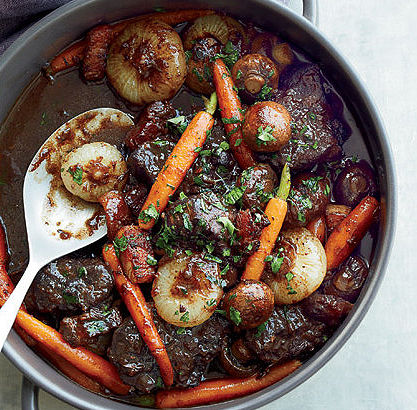
Beef Stew in Red Wine Sauce

Source: adapted from Chef Jacques Pépin
Active Time: 1 hr
Total Time: 2 hr 40 min
Serves: 4
 
Ingredients:
1 T unsalted Butter
2 T Olive Oil
2 lbs trimmed Beef Flatiron Steak, Beef Cheeks or Chuck, cut into 8 pieces
Celtic Sea Salt and fresh ground Tellicherry Black Pepper to taste
1 c finely chopped Onion
1 T finely chopped Garlic
1 T All-Purpose Flour
750-ml bottle dry Red Wine – Cab Sauvignon, Merlot, Pinot Noir, Syrah or Zinfandel
2 Bay Leaves
1 med Thyme sprig
5 oz Pancetta
15 Pearl or small Cipollini Onions, peeled
15 Crimini Mushrooms
15 Heirloom Baby Carrots, peeled
Sugar
Chopped fresh Italian Parsley, for garnish

Directions:
1) Preheat the oven to 350° F. In a large enameled cast-iron casserole, melt the butter in 1 tablespoon of the olive oil. Arrange the meat in the casserole in a single layer and season with salt and pepper. Cook over moderately high heat, turning occasionally, until browned on all sides, 8 minutes. Add the chopped onion and garlic and cook over moderate heat, stirring occasionally, until the onion is softened, 5 minutes. Add the flour and stir to coat the meat with it. Add the wine, bay leaves and thyme, season with salt and pepper and bring to a boil, stirring to dissolve any brown bits stuck to the bottom of the pot.
2) Cover the casserole and transfer it to the oven. Cook the stew for 1½ hours, until the meat is very tender and the sauce is flavorful.
3) Meanwhile, in a saucepan, cover the pancetta with 2 cups of water and bring to a boil. Reduce the heat and simmer for 30 minutes. Drain the pancetta and slice it ½ inch thick, then cut the slices into 1-inch-wide lardons.
4) In a large skillet, combine the pancetta, pearl onions, mushrooms and carrots. Add the remaining 1 tablespoon of olive oil, ¼ cup of water and a large pinch each of sugar, salt and pepper. Bring to a boil, cover and simmer until almost all of the water has evaporated, 15 minutes. Uncover and cook over high heat, tossing, until the vegetables are tender and nicely browned, about 4 minutes.
5) To serve, stir some of the vegetables and lardons into the stew and scatter the rest on top as a garnish. Top with a little chopped parsley and serve.

Reblog:

  • Click to email a link to a friend (Opens in new window) Email
  • Click to share on Pinterest (Opens in new window) Pinterest
  • Click to share on Facebook (Opens in new window) Facebook
  • Click to print (Opens in new window) Print
  • More
  • Click to share on X (Opens in new window) X
  • Click to share on Instagram (Opens in new window) Instagram
Like Loading...

Stroganoff. What Is It?

15 Tuesday Oct 2019

Posted by Bob and Robin in 5-Stars, Beef, Boise Farmers Market, Captain's Shack, Carrots, Classic Cuisines, Classic Sauces, Egg Noodles, Ethnic Foods, Food - Russian, Food - Slavic, Heirloom Carrots, Herbs and Spices, History of Food, Housemade Sauces, Idaho Beef, Local Farmers Markets, Mushrooms, Onion, Petit Syrah, Photos, Photos By: Bob Young, Recipe by: Robin and Bob Young, Recipes, Recipes - Dinner, Recipes - Russian, Recipes - Sauces, Russian Food - Stroganoff, Special Dinners, What's For Dinner?, Wine and Food

≈ 1 Comment

Tags

Hoisin, Stroganoff


Not long ago, we made a Mahogany Beef Stroganoff and it was surprisingly good. Even with some totally different ingredients. Hoisin Sauce for one. But there were two questions: (1) What makes it mahogany? and (2) Is it Russian or Italian or French? Well, the answer to the first question is sort of easy. The mahogany color comes from the addition of the Hoisin Sauce, a Chinese BBQ sauce. Question #2. The short answer is “Yes”. Wikipedia says,

The dish is named after one of the members of the influential Stroganov family. Elena Molokhovets’s classic Russian cookbook “A Gift to Young Housewives” gives the first known recipe for Govjadina po-strogonovski, s gorchitseju, “Beef à la Stroganov, with mustard” [typically French], in its 1871 edition. The recipe involves lightly floured beef cubes (not strips) sautéed, sauced with prepared mustard and broth, and finished with a small amount of sour cream: no onions, no mushrooms and no alcohol. A competition purported to have taken place in 1890 is sometimes mentioned in the dish’s history, but both the recipe and the name existed before then. Another recipe, this one from 1909, adds onions and tomato sauce, and serves it with crisp potato straws, which are considered the traditional side dish for beef Stroganoff in Russia. The version given in the 1938 “Larousse Gastronomique” includes beef strips, and onions, with either mustard or tomato paste optional.

Mahogany Beef Stroganoff

Sautéing of beef Stroganoff
After the fall of Tsarist Russia, the recipe was popularly served in the hotels and restaurants of China before the start of World War II. Russian and Chinese immigrants, as well as US servicemen stationed in pre-Communist China, brought several variants of the dish to the United States, which may account for its popularity during the 1950s. It came to Hong Kong in the late fifties, with Russian restaurants and hotels serving the dish with rice but not sour cream.

And from Cooksinfo, we learn,

There are at least two popular theories about how Beef Stroganoff originated.
One is that it was created in 1891 in St. Petersburg, Russia, by Charles Brière, a cook who worked for Count Pavel Alexandrovich Stroganov. Brière reputedly submitted the recipe in that year to “l’Art Culinaire” (presumably the magazine whose full name was “La Revue de l’Art Culinaire”.) This is the version proposed in the 2001 version of the English language “Larousse Gastronomique”. If this is so, it would seem to be just about Brière’s only claim to fame. His recipe called for shallots (now onions are used.)
The second is that it was created by an unknown cook for Count Grigory Stroganov (1770-1857), because the Count had lost his teeth and couldn’t chew meat. Beef Stroganoff, though, is probably just a more refined version of similar, pre-existing recipes…The last prominent scion of the dynasty, Count Pavel Stroganoff, was a celebrity in turn-of-the-century St. Petersburg, a dignitary at the court of Alexander III, a member of the Imperial Academy of Arts, and a gourmet. It is doubtful that Beef Stroganoff was his or his chef’s invention since the recipe was included in the 1871 edition of the Molokhovets cookbook…which predates his fame as a gourmet. Not a new recipe, by the way, but a refined version of an even older Russian recipe, it had probably been in the family for some years and became well known through Pavel Stroganoff’s love of entertaining.

There are also variations made with chicken or pork, which to me, looses the original likeness. I have made it with chicken, but always go back to beef. You be the judge. And just to note: we served this with a 2002 Ridge Vineyards Dynamite Hills Petite Syrah and I marinated the beef cubes in a little Hoisin Sauce, garlic powder and Worcestershire Sauce for several hours before browning it off. The marinating really made it rich. We also had it over medium wide egg noodles and topped the dish with sour cream and chopped parsley. Delicious!

Reblog:

  • Click to email a link to a friend (Opens in new window) Email
  • Click to share on Pinterest (Opens in new window) Pinterest
  • Click to share on Facebook (Opens in new window) Facebook
  • Click to print (Opens in new window) Print
  • More
  • Click to share on X (Opens in new window) X
  • Click to share on Instagram (Opens in new window) Instagram
Like Loading...

Because Inquiring Minds Need to Know

23 Saturday Feb 2019

Posted by Bob and Robin in Food - Japanese, Japanese Food, Recipes, Recipes - Japanese, Sake, Salmon, Seafood, Soup, Special Events, Special Information, Sushi, What's For Dinner?

≈ 1 Comment

Tags

Hina Matsuri, Japanese recipes


I found this to be interesting. That’s probably because of my Cultural Anthropology background.

Hina Matsuri in Japan

Source: https://matcha-jp.com/en/753
Although it is not a national holiday, March 3rd is a special day for girls. Families who don’t have young daughters might not do anything special on this day.
March 3rd is Japanese Girls’ Day or Hinamatsuri. Ornate dolls are displayed in the family home to mark the beginning of spring and to wish good health and good fortune for all of the girls in the family.
However, a tradition of this festival is still passed down until now. Actually, how people celebrate Hina Matsuri is different from place to place. We will introduce here what the Japanese people usually do on this day.
Hina Dolls represent what the imperial family was like in the ancient times. The dolls on the top tire of the platforms represent the emperor and the empress. The rest of the dolls are three court ladies, five musicians and the minister of the Right and Left who used to support the government in the old days. There are some decorations such as Gissha (oxcarts), small cupboards, Japanese paper lamps called “Bonbori”, and orange and peach tree branches displayed on the tire of platforms.
The facial expressions and costumes of each doll are also different depending on their personality and position.
The special meals for Hina Matsuri are Amazake (sweet drink), Chirashizushi (a style of sushi) and Hina Arare (sweet colorful rice crackers).
Amazake is a traditional Japanese sweet and thick drink made from fermented glutinous rice. Amazake literally means “sweet alcohol” but it has less than 1 percent of Shirozake alcohol in it. So children are also able to drink it.

Shirozake

Drinking Shirozake, which is a traditional sweet sake, was one of the customs to get rid of bad things out from your body. But Shirozake is an alcoholic drink, so Amazake was made with the children in mind.
Hina Arare are colorful and cute small rice crackers. The colors of these rice crackers have meanings. White represents the earth of the winter, pink and red represent life, while green represents the green shoots in the spring. Hina Arare is a snack showing our expectations toward the arrival of spring after the long cold winter. People also say that you will live healthy for this coming year if you eat each color of Hina Arare.
Chirashizushi is a type of Sushi which has lotus roots, shrimp and thinly shredded egg omelet on the top of vinegar rice. It has been a dish enjoyed widely at celebrations.
The ingredients in Chirashizushi have meanings as well. The lotus root is said to give one the power to see what will happen in the future, shrimps are a symbol of longevity and so on.

Source: https://www.thespruceeats.com/japanese-girls-day-hinamatsuri-party-dishes-2031057
As with almost all holidays, food and drink play a role on Girls’ Day, with rice wine and rice cakes taking center stage, along with flower blossoms. Hinamatsuri is also called Momo no Sekku, which means a festival of peach blossoms. Peach blossoms, shiro-zake (white fermented rice wine) and hishi-mochi (diamond-shaped rice cakes) are placed on the stand with the hina dolls. Hishi-mochi are colored pink representing peach flowers, white representing snow, and green representing new growth.
Traditionally, girls in Japan invited their friends to a home party to celebrate this festival. Many people prepare a special meal for girls on this day, including savory dishes such as chirashi, which is sugar-flavored, vinegared sushi rice with raw fish on top; clam soup served in the shell; and edamame maze-gohan, mixed rice usually consisting of brown rice and soybeans.
Other popular dishes to serve at a Girl’s Day celebration are inari sushi—rice-stuffed tofu pockets—with miso grilled salmon and cabbage ramen salad. Sweets are on the menu as well, incorporating a feminine shade of pink, like chi chi dango, which are pink pillows of mochi (glutinous rice flour and coconut milk), a favorite among children, and sakura-mochi, a pink, sweet rice cake. Some families include an impressive edible centerpiece, such as the layered chirashi sushi cake.

Some recipes for Hina Matsuri
(The recipes listed below can be found at the link above.)

Chirashizuchi

Easy Seafood Chirashizushi: Use a shortcut of packaged sushi seasoning to quickly season steamed rice and add pre-cooked gomoku vegetables for this delectable dish. Add your favorite toppings of choice.
Edamame Maze-Gohan (Mixed Rice): Is easy to prepare, especially for large crowds. Steamed rice is mixed with furikake seasoning, bottled nametake (seasoned mushrooms), and shelled edamame for a delicious rice dish.
Inari Sushi: Preparing a dish for a large crowd doesn’t need to be complicated. Find out the secrets of making quick inari sushi with impressive results.
Cabbage Ramen Salad: This spin on the traditional Chinese chicken salad recipe uses crunchy dried ramen noodles, cabbage, and shredded chicken to create a zesty Japanese-fusion salad.
Slow Cooker Teriyaki Chicken Wings: Let your slow cooker do all the work to whip-up a batch of delicious teriyaki chicken wings with just a few ingredients, and use the free time to prepare a few other dishes.

Miso Ginger Marinated Grilled Salmon

Miso Grilled Salmon: Miso-grilled salmon can easily be prepared by making the marinade ahead of time and then letting the salmon marinade for a few days in the fridge. All you need is an oven or a grill to cook up delicious fillets in under 40 minutes.
Clam Soup: A traditional soup that is often enjoyed on Hinamatsuri is clam soup. This clear style soup is known as sumashijiru and is simply seasoned from the broth of the clams.
Chi Chi Dango: These pillowy soft bites of mochi are made of glutinous rice flour and coconut milk. These pink, soft mochi are an absolute favorite among children.
Sakura Mochi: Sakura mochi is a glutinous rice dish that is often enjoyed during Hinamatsuri. This slightly sweetened, pink mochi is filled with sweet red beans (koshian) and wrapped in a salted sakura (young cherry blossom) leaf.

Reblog:

  • Click to email a link to a friend (Opens in new window) Email
  • Click to share on Pinterest (Opens in new window) Pinterest
  • Click to share on Facebook (Opens in new window) Facebook
  • Click to print (Opens in new window) Print
  • More
  • Click to share on X (Opens in new window) X
  • Click to share on Instagram (Opens in new window) Instagram
Like Loading...

Celebrating Valentines Week

16 Saturday Feb 2019

Posted by Bob and Robin in 5-Stars, Acme Bake Shop Breads, Baking, Breakfast At The Captains Shack, Captain's Shack, Cookies, Crab, Dessert, Dinner At The Captains Shack, Dinner For Robin, Eggs Omelets, Food Photos, Food Prep, Greens, Herbs, Hollandaise Sauce, Homemade Sauce, Housemade Hollandaise Sauce, Housemade Sauces, Housemade Soup, Idaho Eggs, Idaho Greens, Idaho Potatoes, Lobster, Lunch For Robin, Omelet, Photos, Photos By: Bob Young, Potatoes, Recipe By: Captain's Shack, Recipe by: Robin and Bob Young, Recipes, Recipes - Dinner, Recipes - Sauces, Salad, Sea Scallops, Seafood, Special Dinners, Vegetables, Watercress, What's For Dinner?, Wines - Idaho

≈ 1 Comment

Tags

crab omelet, Eggs Benedict


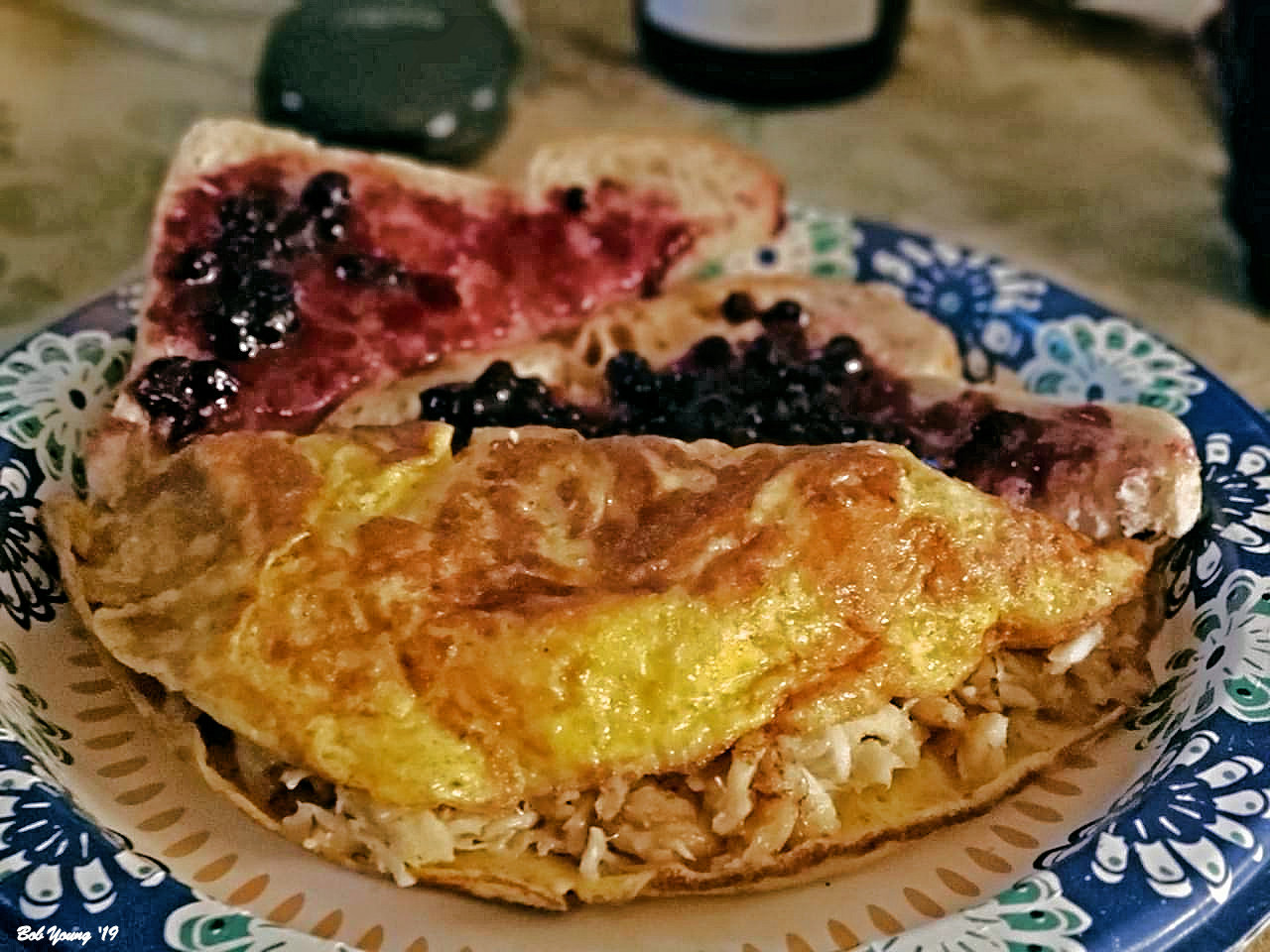
This week in mid February, 2019, was dedicated to the one I love. (There ought to be a song written to that phrase!) A week in the kitchen. Planning. Finding. Testing and tasting. Preparing. Serving. It was an exciting week and very fulfilling. I know she liked the meals – they are all gone! That’s always a good sign. Here are some of the dishes we had. And to answer the question – someone did ask – yes I did make all of this. There are recipe links where available. Enjoy! (Left-Click any of these photos to see them enlarged.)

Eggs Benedict are always liked. Especially on a Sunday morning.

Crab Louie salad is awesome.

Or maybe a Crab Omelet one weekday morning.

Scallop and Watercress Salad makes a great dinner.

The absolute best meal, and the one that took the most time, patience and tasting, was this one. The sides that Robin wanted are checked in red. The salad and the entree are fixed.

Valentines Day Dinner Menu
We had a 2014 Indian Creek Winery (ID) Chardonnay with this dinner

Caprese Salad

Stuffed Lobster with Crab
Brussels Sprouts in Balsamic Reduction
Parsley Potatoes

Two sauces were made for the entree – Lemon Butter Sauce for the lobster, and Brandy Mayonnaise Sauce for the crab.

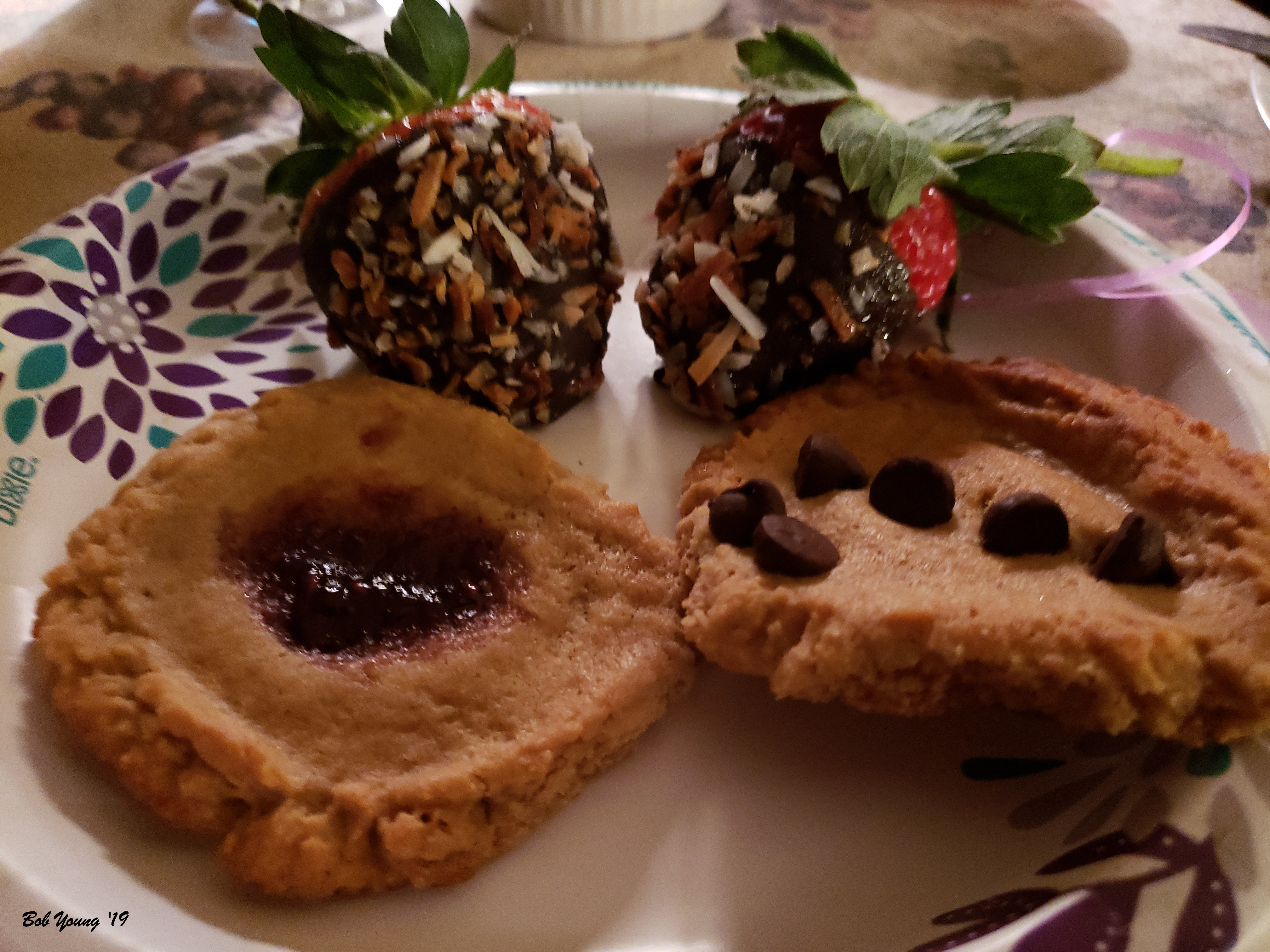
Chocolate Dipped Strawberries
Peanut Butter Cookies

After all of these delicious seafood meals and all, we had to make something, well ………. more subtle. Like some Robin’s Vegetable Soup. But this is not your standard peas, corn, tomato, etc soup. Try some leek, celery, turmeric, etc soup. It is delicious!!

Robin’s Vegetable Soup

So there it is – Our Valentines Day (Week) in the kitchen. Nothin’ says lovin’ like something from the kitchen! Cheers and enjoy the recipes.

Reblog:

  • Click to email a link to a friend (Opens in new window) Email
  • Click to share on Pinterest (Opens in new window) Pinterest
  • Click to share on Facebook (Opens in new window) Facebook
  • Click to print (Opens in new window) Print
  • More
  • Click to share on X (Opens in new window) X
  • Click to share on Instagram (Opens in new window) Instagram
Like Loading...

Your New Favorite Toy

08 Friday Feb 2019

Posted by Bob and Robin in AirFryer, AirFryer Recipes, Interesting Information, Recipes, What's For Dinner?

≈ 1 Comment

Tags

air fryer resources


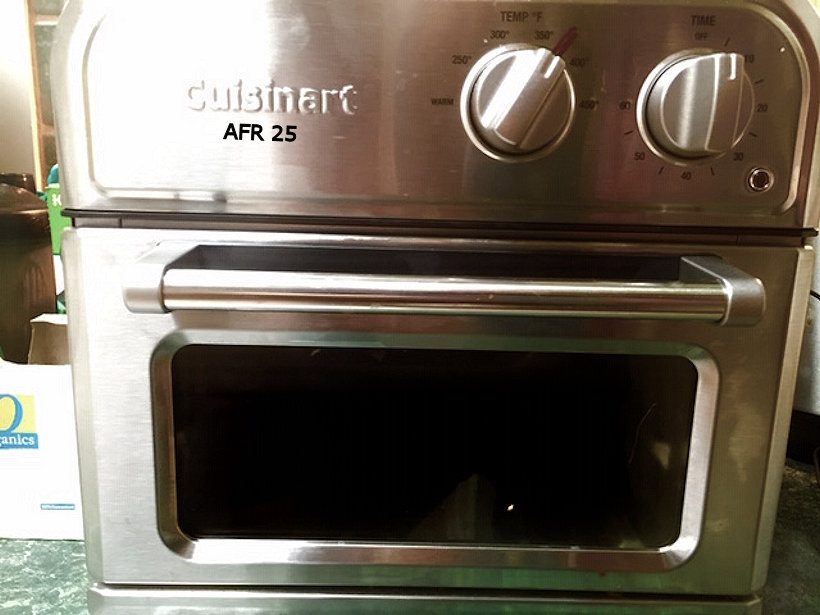
This is the AirFryer we have. Under $100 online.

… Could Be and Air Fryer. The other day while waiting for our favorite Dental Hygienist of over 30 years, Nancy Huff, she presented me with an article in our local newspaper, the Idaho Statesman, called “Your new favorite toy could be an air fryer” by Jill Warren Lucas of the News & Observer, Raleigh, NC. The link to the article is Here, and well worth the time to read it. Great information and suggestions for the fryer to fill your needs. (The one pictured here is the one we have. A 5 quart capacity.)

The article suggests sizes to look at, cook books to get for your air fryer, Air Fry Everyday: 75 Recipes to Fry by Ben Mims and has some recipes to try, like Gooey “Spoon” Brownies or Caramelized Eggplant with Harissa Yogurt.

BEN MIMS is the former test kitchen director at Lucky Peach and food editor of Saveur, as well as an associate food editor at Food & Wine. He has developed recipes for, written for, and consulted for outlets such as Buzzfeed/Tasty, Food Network Magazine, Rachael Ray Every Day, Food52.com, Bake from Scratch, Epicurious.com, and Jarry, and for cookbooks by Vice/Munchies and Dovetail Press. He is also the author of Sweet & Southern: Classic Desserts with a Twist (Rizzoli, 2014) and Short Stacks: Coconut (Dovetail Press, 2017). He currently lives in Manhattan.

So if you’re looking to buy one, or you want some recipes for the one you already have or you just want a good resource, this article is for you. Have fun and cook much!

Reblog:

  • Click to email a link to a friend (Opens in new window) Email
  • Click to share on Pinterest (Opens in new window) Pinterest
  • Click to share on Facebook (Opens in new window) Facebook
  • Click to print (Opens in new window) Print
  • More
  • Click to share on X (Opens in new window) X
  • Click to share on Instagram (Opens in new window) Instagram
Like Loading...

What is this thing called …. Borscht?

19 Friday Oct 2018

Posted by Bob and Robin in 5-Stars, Boise Food Adventures, Buy Idaho, Captain's Shack, Ethnic Foods, Food - Slavic, Food Photos, Photos By: Bob Young, Recipes, Recipes - Russian, What's For Dinner?

≈ Leave a comment

Tags

borsch, borscht, Ethnic Foods


I’m not sure that Cole Porter or Ella Fitzgerald would approve of the title, but I think it is appropriate. Keep reading.

“Borscht (English: /ˈbɔːrʃ, ˈbɔːrʃt/ ) is a sour soup commonly consumed in Eastern Europe. The variety most often associated with the name in English is of Ukrainian origin, and includes beetroots as one of the main ingredients, which gives the dish its distinctive red color. It shares the name, however, with a wide selection of sour-tasting soups without beetroots, such as sorrel-based green borscht, rye-based white borscht and cabbage borscht … Borscht derives from an ancient soup originally cooked from pickled stems, leaves and umbels of common hogweed (Heracleum sphondylium), a herbaceous plant growing in damp meadows, which lent the dish its Slavic name. With time, it evolved into a diverse array of tart soups, among which the beet-based red borscht has become the most popular. It is typically made by combining meat or bone stock with sautéed vegetables, which – as well as beetroots – usually include cabbage, carrots, onions, potatoes and tomatoes. Depending on the recipe, borscht may include meat or fish, or be purely vegetarian; it may be served either hot or cold; and it may range from a hearty one-pot meal to a clear broth or a smooth drink.” [Wikipedia] And “those other sour soups” that are cousins to borscht may come from day Lithuania and Belarus, the Ashkenaz Jews, Romanian and Moldovan cuisines, Poland, Armenia and even Chinese cuisine, a soup known as luó sòng tāng, or “Russian soup”, is based on red cabbage and tomatoes, and lacks beetroots altogether; also known as “Chinese borscht”. Wow! There are many varieties of borscht.

But there is only one original or authentic borscht. Borscht derives from a soup originally made by the Slavs from common hogweed (Heracleum sphondylium, also known as cow parsnip), which lent the dish its Slavic name. Growing commonly in damp meadows throughout the north temperate zone, hogweed was used not only as fodder (as its English names suggest), but also for human consumption – from Eastern Europe to Siberia, to northwestern North America.
And what is generally served with borscht? “Pirozhki, or baked dumplings with fillings as for uszka, are another common side for both thick and clear variants of borscht. Polish clear borscht may be also served with a croquette or paszteciki. A typical Polish croquette (krokiet) is made by wrapping a crêpe (thin pancake) around a filling and coating it in breadcrumbs before refrying; paszteciki (literally, ‘little pâtés’) are variously shaped filled hand-held pastries of yeast-raised or flaky dough. An even more exquisite way to serve borscht is with a coulibiac, or a large loaf-shaped pie. Possible fillings for croquettes, paszteciki and coulibiacs include mushrooms, sauerkraut and minced meat.” [The Book of Tasty and Healthy Food, Anastas Mikoyan]

So. What is borscht usually made of? What are the components? Ingredients? Borscht is seldom eaten by itself. Buckwheat groats or boiled potatoes, often topped with pork cracklings, are other simple possibilities, but a range of more involved sides exists as well.
In Ukraine, borscht is often accompanied with pampushky, or savory, puffy yeast-raised rolls glazed with oil and crushed garlic. In Russian cuisine, borscht may be served with any of assorted side dishes based on tvorog, or the East European variant of farmer cheese, such as vatrushki, syrniki or krupeniki. Vatrushki are baked round cheese-filled tarts; syrniki are small pancakes wherein the cheese is mixed into the batter; and a krupenikis a casserole of buckwheat groats baked with cheese.

But please note, your borscht may be different from your neighbors. There are cultural differences in the borscht. Ingredients may include,beet juice, beet root, veal, ham, crayfish, beef, pork, sour cream, buttermilk, yogurt, cucumbers, radishes, green onion, hard-boiled egg halves, dill weed, leafy vegetables, sorrel, spinach, chard, nettle, dandelion, cabbage, tomatoes, corn, squash, to name a few.

Our Borscht

So whatever inspired me to write this post? Well, we made a borscht and I posted a photo of it (the one pictured here actually) and I got comments. One of them in particular, from a Ukrainian lady, and she said,”That’s not real Russian Borsch (smiley face). It’s beet soup (smiley face). My mom makes the best, she is a Gourmet Chef for over 50yrs, and specializes in Jewish Cuisine.” [Mara Rizzio] I spoke to Mara – she makes awesome pirogies – and it was a good discussion. Thank-You Mara for “setting” me straight. Thus, this blog post. Cheers. And here is a recipe for Borscht that I found in the internet, from NPR, that includes various ingredients. Have fun! Borscht Recipe.

Reblog:

  • Click to email a link to a friend (Opens in new window) Email
  • Click to share on Pinterest (Opens in new window) Pinterest
  • Click to share on Facebook (Opens in new window) Facebook
  • Click to print (Opens in new window) Print
  • More
  • Click to share on X (Opens in new window) X
  • Click to share on Instagram (Opens in new window) Instagram
Like Loading...

Instant Pot Ideas

10 Wednesday Oct 2018

Posted by Bob and Robin in Instant Pot Recipes, Recipes, What's For Dinner?

≈ Leave a comment

Tags

Instant Pot, Instant Pot Recipes


Robin and I have bought an Instant Pot. The one pictured here. It is really fun to use. And the different cooking methods available are amazing. Enlarge (Left Click) the photo and you will see what methods are available. Because we are using the equipment sort of regular, I am going to add a section in the recipe file (Boise Foodie Guild Recipes) called Instant Pot. The recipes will have a prefix of IP so you can search on it. I do hope you look at the section and the recipes.

Reblog:

  • Click to email a link to a friend (Opens in new window) Email
  • Click to share on Pinterest (Opens in new window) Pinterest
  • Click to share on Facebook (Opens in new window) Facebook
  • Click to print (Opens in new window) Print
  • More
  • Click to share on X (Opens in new window) X
  • Click to share on Instagram (Opens in new window) Instagram
Like Loading...
← Older posts
Newer posts →

  • Bob and Robin's avatar Bob and Robin
  • rockinrobin43's avatar rockinrobin43

Meta

  • Create account
  • Log in
  • Entries feed
  • Comments feed
  • WordPress.com

Copyright Notice

Creative Commons License
This blog and all work herein is licensed under a Creative Commons Attribution-Noncommercial-No Derivative Works 3.0 United States License.

The Current Weather at the Captain’s Shack

Click the image to see the very latest and current weather at the Captain's Shack in Boise, Idaho

Enter your email address to follow this blog and receive notifications of new posts by email.

Join 183 other subscribers

Thanks to all of these readers and subscribersz of this blog!

  • 320,253 and 598,479 Folks Reached

Monthly Archives of this Blog

Translate This Page

Assoc of Food Bloggers

Association of Food Bloggers

BFM Drive-Thru

Boise Farmers Market Drive-Thru

Air Fryer Cooking Time and Temperature Conversion Calculator

To convert to the AirFryer

AirFryer Recipes

https://www.airfryerrecipes.com/

Air Fryer Conversions

Rule of 25%. Reduce oven/frying temperature by 25% and time by 25%.

Fork To Spoon – Air Fryer and Instant Pot Recipes

Great resource for AF and IP information and recipes.

AirBnB Buhl, Idaho

Welcome to Mary Anne’s place, a historic cottage in the heart of Kelley’s Canyon Orchard. Just 20 minutes from Twin Falls, unwind in this quiet retreat by enjoying the pleasant sound of a nearby creek and views that look out into the orchard. 4 guests · 2 bedrooms · 3 beds · 1 bath, Wifi · Free parking · Kitchen, Entire House! 1903 River Rd, Filer, Idaho 83328

Bloglovin’

RSS Links

RSS Feed RSS - Posts

RSS Feed RSS - Comments

-----------------------
I Know. Not Idaho Products, But still Worth A Try!
----------------------

Rockin’ Rs

----------------------
Items of Blog Interest.
-----------------------

Member of The Internet Defense League

The History Kitchen

Interesting historical information about food - prep, origins and uses. Written by a kitchen anthropologist!

-----------------------
Of Concern To This Blog
----------------------

Recent Posts

  • Trike Restaurant Finds Worthy of Posting
  • Food Via ETrike
  • An Awesome Chicken Dish
  • Sushi Shack
  • Awesome Oven BBQ Pork Ribs

-----------------------
Think Local!! Buy Local!!

Let them know you saw their logo on this blog. Thanks!
----------------------

Buy Local!

If you are not from Idaho, think about Buying Local in Your area! As for us, we have lived in Idaho since 1982. We Buy Idaho wherever possible.

Chef Jake Sandberg, Crispeats

Food References and Recipes

Buy Local

And it does ... Just Make Sense! Regardless of where you are from.

------------------------
Think Local!! Idaho Products.

Let them know you saw their logo on this blog. Thanks!
-----------------------

The New Boise Farmers Market

Summer and Winter - 1500 Shoreline Dr, Boise (Americana and Shoreline)

Idaho Farmers Markets

A listing of statewide Farmer's Markets with contacts.

Find Your Local Farmers Market

Click on the graphic to find your local farmers market either by city or zip code.

Acme Baked Shop, Boise

Available at the Boise COOP. Some of the best bread in Boise and all local!! They make the bread for the 10 Barrel Brew Pub, Angell's Bar and Grill, Salt Tears, all here in Boise. Awesome rye bread that actually tastes like rye bread. And the baguettes .... Wonderful. (208) 284-5588 or runsvold2000@gmail.com

Brown’s Buffalo Ranch

Give them a call or EMail for awesome buffalo meat.

Desert Mountain Grass Fed Beef (formerly Homestead Natural Beef)

Desert Mountain Grass Fed Beef, with Bob and Jessica Howard of Howard Ranch in Hammett. The company will only sell whole animals to the Boise Co-op and Whole Foods stores in Boise and Utah. They will also be at the Boise Farmers Market.

Falls Brand Pork roducts

Click the image for pork recipes.

Kelley’s Canyon Orchard

1903 River Rd, Filer, ID 83328 Hours: 10am - 6pm, Phone: (208) 543-5330

Malheur River Meats

Matthews Idaho Honey

Matthews All-Natural Meats

Meadowlark Farms

All natural Eggs, Lamb and Chicken

Purple Sage Farms

True Roots Farm

Available at the Boise Farmers Market and online at https://www.trueroots.farm

True Roots is a local produce farm committed to sustainable and chemical-free farming practices. We raise pesticide-free and non-GMO produce fresh from the farm, offering a diverse variety of farm-fresh services to our local community. Since our founding in 2014, our mission has been to provide farm-direct access to clean, reliable, and affordable produce.

Reel Foods Fish Market

1118 Vista Avenue, Boise, ID 83705 (208) 713-8850 Monday-Friday: 10am-6pm, Saturday: 9am-5pm. Sunday: Gone Fishin’

Standard Restaurant Supply

Plenty of items for the home, too. Check them out. 6910 Fairview, Boise 83704 (208) 333-9577

-----------------------
Some Awesome Recipe and Spice Sources. Culturally diverse.

Let them know you saw their logo on this blog. Thanks!
------------------------

Crockpot Recipes

Many good recipes here.

A Taste of France

A collection of French recipes

Basque Recipes

Best Ever Recipes of Mexico

Malaysian Recipes

Awesome Malaysian recipes.

Memorie di Angelina Italian Recipes

My Best German Recipes Web Site

Regional and Oktober Fest Recipes

There are a lot of recipes here.

Sauer Kraut Recipes

Recipes By Robin and Bob

Recipes that we have collected and created throughout the years.

Recipes of Elizabeth W. Young, Bob’s Mother

These are the recipes that my Mother collected over 85 or so years. The photo of my Mother was one of the last I have of her. It was taken in July, 1987.

Recipes From The Mediterranean Area

Soup and Chowder Recipes

Recipes from "My Recipes"

Deep South Dish Recipes

The Recipes of Greece

Tasty Mexican Recipes

The Shiksa In The Kitchen

Great Jewish recipes!

-----------------------
Some Great Boise Restaurants.

Let them know you saw their logo on this blog. Thanks!
-----------------------

Asiago’s – Italian

Bella Aquila, Eagle, ID

775 S Rivershore Ln., Eagle, ID 83616 (208) 938-1900

Bar Gernika – Basque Pub and Eatery

202 S Capitol Blvd, Boise (208) 344-2175 (Checked)

Cottonwood Grille

913 W River St., Boise (208) 333.9800 cg@cottonwoodgrille.com

Enrique’s Mexican Restaurant

482 Main St., Kuna (208) 922-5169 New name. Was El Gallo Giro. Same owners and kitchen. The Best Mexican restaurant in the Boise/Kuna area, bar none!

Flying Pie Pizzaria

Goldy’s Breakfast Bistro

108 S Capitol Blvd., Boise (208) 345-4100

Goldy’s Corner Cafe

625 W Main St., Boise (208) 433-3934

Guanabanas – Island Restaurant and Bar

960 N Highway A1A, Jupiter, FL

Janjou Pâtisserie

Janjou Pâtisserie, 1754 W State St., Boise, Idaho 83702 (208) 297.5853

Mai Thai Asian Cuisine

750 West Idaho Street Boise, ID 83702 (208) 344-8424

Mazzah Grill – Mediterranean and Greek Cuisine

1772 W State St., Boise (208) 333-2566

Richards Inn by Chef Richard Langston

Formerly - Vincino's. New location at 500 S Capitol Blvd., Boise (208) 472-1463. Reservations are highly suggested.

The Orchard House

14949 Sunnyslope Rd., Caldwell (208) 459-8200

The Ravenous Pig

1234 N. Orange Ave. Winter Park, FL

-----------------------
Think Local!! Boise Breweries, Brew Pubs and Wine Bars.
Let them know you saw their logo on this blog. Thanks!
-----------------------

10 Barrel Brewery Boise

830 W Bannock St., Boise (208) 344-5870

Cloud 9 Brewery and Pub

Opening Fall 2013 in the Albertson's Shopping Center, 18th and State in the old Maxi Java

Edge Brewing Company

525 N Steelhead Way, Boise, ID 83704 (208) 323-1116

-----------------------
Miscellaneous Items
-----------------------

Blog Syndication

NetworkedBlogs
Blog:
Boise Foodie Guild
Topics:
Food, Recipes, Cooking
 
Follow my blog

Blog Badge

Local & Regional Food Blogs - BlogCatalog Blog Directory

  • Subscribe Subscribed
    • Boise Foodie Guild
    • Join 72 other subscribers
    • Already have a WordPress.com account? Log in now.
    • Boise Foodie Guild
    • Subscribe Subscribed
    • Sign up
    • Log in
    • Report this content
    • View site in Reader
    • Manage subscriptions
    • Collapse this bar
 

Loading Comments...
 

    %d