~ – Enjoy a meal or a recipe with us! Be sure to check the Sidebar and Menu above. Interesting resources are listed there. Most are hot links. Air Fryer (AF), Instant Pot (IP) and Captain's Shack (CS) recipes now have their own page. Subscribe to the blog. It's still FREE!
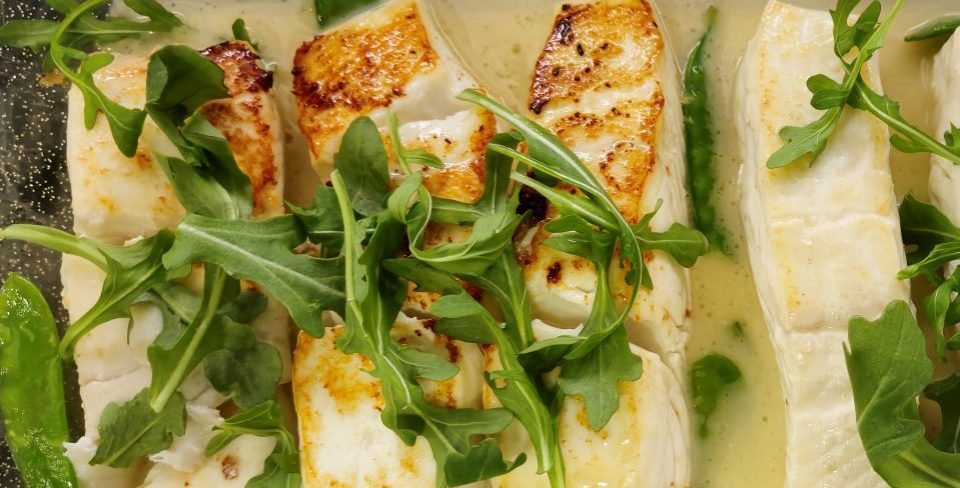
As you can see, I have changed the opening graphic. I was playing around with AI and came up with several of these. It fits with the Captain’s Shack. Robin and I thoroughly like scallops, especially sea scallops – the larger ones. We also enjoy brazing them, over medium low heat, and that is important. Here is the recipe. I know, there are several recipes available for a Viognier Sauce, but this one is one I came up with. https://www.rockinrs.com/CS-Scallops-Viognier.pdf. The recipe is scaled for 2, but you can easily adjust the recipe to suit your needs without adjusting the sauce.
Braised Scallops with Viognier Sauce
Notice the light braise on the scallops and it is served with Creamed Spinach. A good combination. I always put fresh grated nutmeg in all by white sauces and a cream sauce is a white sauce. If you make these, and it is not difficult, just watch the heat and cook 2-3 minutes per side, and let us know how you liked them.
I have had several questions about the difference between crab back fin and claw meat. Are they not from the same animal? Yes they are, but like different cuts of beef, they come from different parts of the crab. I hope this short discussion will clarify the question. I prefer to use Blue Crab over any other type. Here is a recipe for Crab Cakes. http://www.rockinrs.com/CS-Crab-Cakes.pdf (Tartar Sauce – https://www.rockinrs.com/CS-Tartar-Sauce-Best.pdf)
Crab meat can be found in different parts of the crab, and each type has distinct characteristics. Here are the key differences between claw meat and back fin meat:
Crab Cakes
Claw Meat
Texture: Claw meat is typically firmer and more fibrous than back fin meat. This is because the claws are used for defense and feeding, requiring stronger muscle fibers. Color: It often has a darker color compared to back fin meat, with a slightly reddish-brown hue. Flavor: Claw meat tends to have a stronger, more pronounced flavor, which can be slightly sweeter. This makes it a favorite for dishes where a robust crab taste is desired. Use: It’s commonly used in dishes where the crab flavor needs to stand out, such as crab cakes, soups, and stews.
Back Fin Meat
Texture: Back fin meat, also known as lump or body meat, is usually flakier and more delicate than claw meat. It comes from the crab’s body and the area where the back fins attach. Color: It is typically whiter and more translucent compared to claw meat. Flavor: The flavor is milder and less pronounced than claw meat. This subtle taste makes it ideal for dishes where a delicate crab flavor is preferred. Use: Back fin meat is often used in salads, cocktails, and more refined dishes where the presentation and texture of the crab meat are important.
Each type of crab meat has its own culinary uses and can be chosen based on the desired texture and flavor profile of the dish being prepared. The crab cakes pair well with a Parma Ridge Winery Avielle.
I have been thinking about this post for quite a while, And as most of you know, if in season, I definitely choose local foods, i.e., local farmer’s markets and stands. In season, I try to stay away from processed foods. But I had a comment the other day that there is no difference between local farmer’s markets products and the mega conglomerate grocery stores. I find that to be a ridiculous comparison and do not accept it. So I have been searching the web for some information on processed foods and why to stay away from them as much as possible. In season, I prepare and eat from local farmers. Here is some information on processed foods.
You can’t really avoid it, and that’s not necessarily a bad thing. Processed food is food that’s changed in any way from its natural state. That includes washing, canning, freezing, or adding ingredients to it. Baking, cooking, or preparing it counts as processing, too.
Canning or freezing some fruits and vegetables can help them stay fresh for a long time. Pasteurizing milk and cheese lengthens their shelf life. Similarly, vacuum-packing can keep meat from spoiling. All of these also help cut down on waste.
In addition to fruits and vegetables, other processed foods that can be part of a healthy diet include tuna and salmon in cans or ready-to-eat pouches, yogurt, cottage cheese, and roasted nuts.
Heavily — or ultra — processed foods have unhealthy ingredients added to make them more appealing or make them last longer. Those ingredients include things like salt, sugar, artificial colors, flavorings, and preservatives. One study found that ultra-processed foods make up about 60% of the calories in the American diet. These ultra-processed foods are packed with additives like oil, fat, sugar, starch, proteins and sodium. In the production process, they are stripped of the nutrients that help our bodies feel good and stay healthy. These ultra-processed foods are linked to weight gain, and health issues including heart disease, dementia, type 2 diabetes and cancer.
Read the labels and ingredients list! When you spot a shelf-stable option, check the ingredients list and the “best if used by” date. If there are lots of ingredients you don’t recognize, or a “best if used by” date that is years in the future, consider other options like whipping up a vinaigrette for your salad at home.
Here are some natural foods you might incorporate into your diet: Fruits and vegetables (fresh or frozen, without added salt or sugar) Nut butters such as peanut, almond and cashew butters (without added sugar or oil) Nuts and seeds (unsalted and unsweetened) Frozen meat or fish (without added salt or preservatives) Canned tuna (in water) Low sodium or No Salt Added canned/jarred vegetables, beans and tomatoes Low sodium or No Salt added broth with minimal additives.
Other fish that are not processed are: Sardines are one of the healthiest fish to eat because they’re very high in omega-3s, mackerel is a good source of omega-3 fatty acids, Anchovies, Salmon, Herring, Trout and Tuna (packed in water, not oil)
In general, be aware of what you are eating and read the labels! And to be even safer, make your own meals. Cut out the fast foods. This information came from WebMD, UCLA Healthy eating, Dr Anderson, MD website among others.
If you ar e in the Boise or plan to visit Boise, I highly recommend you go to Alyonka Russian Cuisine for a delightful and delicious meal. It is well worth the trip, time and experience and that is why I rate it a 5-Star restaurant. Their website and other information can be found at https://alyonkarussiancuisine.com/. Robin and I went there the other day, we have been there before, and the following photos are what we had for lunch. I do hope you enjoy these photos.
Let’s start with an Apfelwein Hard Cider. This one is really good. Sweet. Not sour or sharp.
Shuba. Layered salad – smoked salmon, potatoes, carrots, beets, with mayo touch
Borscht. Traditional Russian soup made of beets and garden vegetables served with sour cream and toast
Pelmeni. Handmade Russian style dumplings with seasoned ground beef filling, served with sour cream
Salmon Benedict on a Spinach Bed and Fresh Idaho BFM Fruit – Israli Melon
There are several differednt types of Eggs Benedict that one can make. In fact, You can really make them any way you want. The key is in the Hollandaise Sauce, not the eggs combinations. Here are the 3 basic types.
BasIC Eggs Benedict is with ham’ Canadian Bacon or pancetta. Eggs Florentine is with sauteed spinach. Eggs Royale is with smoked salmon. All three breakfasts are created the same, starting with a toasted English muffin, poached eggs and topped with hollandaise sauce. Here is the recipe for Hollandaiuse Sauce that I make from scratch and we love. https://www.rockinrs.com/CIA-Basic-Hollandaise.pdf It may take some practice, but it’s worth it. Just don’t let the temperature get above 130 degrees F.
Recently, 20 April, while at the BFM (Boise Farmers Market) I was asked by a local Chef why I prefer locally produced farm raised over comercially raised beef. And I suppose he meant pork and chicken too, over comercially raised. As most of you can surmise, I am adament about supporting local farmers and ranchers. That just might be my main reason. But let’s take a look.
The main differences between locally farm-raised and commercially-raised beef often lie in several factors including farming practices, scale of production, animal welfare standards, environmental impact, and often, the flavor and quality of the meat. Here’s a breakdown:
Farming Practices:
Locally farm-raised beef typically involves smaller-scale operations where farmers may employ more traditional or sustainable farming practices.
Commercially-raised beef often involves large-scale operations that may prioritize efficiency and output over traditional or sustainable methods.
Animal Welfare:
Local farm-raised beef may involve higher standards of animal welfare, with animals often having more space to roam and access to pasture.
Commercially-raised beef may involve more confined spaces and intensive feeding practices, potentially leading to lower animal welfare standards.
Environmental Impact:
Local farm-raised beef often has a lower environmental impact as smaller-scale operations may use sustainable farming methods and have less reliance on resources like water and feed.
Commercially-raised beef, especially from large-scale feedlots, can have a higher environmental impact due to issues such as water pollution, greenhouse gas emissions, and deforestation for feed production.
Quality and Flavor:
Locally farm-raised beef is often prized for its flavor and quality, as animals may be raised on diverse diets, allowed to graze on pasture, and have lower stress levels.
Commercially-raised beef may sometimes be perceived as lower quality in terms of flavor and texture due to factors such as limited diet variety and higher stress levels in animals.
Traceability and Transparency:
Local farm-raised beef often offers better traceability and transparency as consumers may have direct access to the farm and the farming practices.
Commercially-raised beef may have less transparent supply chains, making it more difficult for consumers to know the origin and production methods of the meat they’re purchasing.
Overall, while both locally farm-raised and commercially-raised beef have their pros and cons, consumers often choose locally farm-raised beef for its perceived superior quality, animal welfare standards, and environmental sustainability. However, it’s essential to note that not all commercially-raised beef is of lower quality, and some producers prioritize sustainable and ethical practices even on a larger scale. I do hope that this answers his question.
I have received many requests for my recipes for CS Bread Braid (Challah) and CS Pot Roast. (https://www.rockinrs.com/CS-Bread-Braid.pdf and https://www.rockinrs.com/CS-Pot-Roast.pdf) The bread braid I added a little sourdough starter, but you don’t have to0, just add the amount of starter you would as water to the water amount in the recipe. But we liked the slight tinge of sourdough in the breade. And to the pot roast I added some button mushrooms quartered. You can use any mushrooms you want.These recipes were fun to develop and are very good, IMNSHO (In My Not So Humble Opinion).If you try them, let us know what you think, or what you changed. And it is perfectly OK to say that you didn’t like it, just tell my why. Here are the photos of the final products.
CS Bread Braid. Great toasted or as French Toast.
French Toast using the Bread Braid I made
CS Pot Roast on Black Truffle Oil Mashed Potatoes and a Fresh Green Salad with Grapes and Mic5ro Greens
It isn’t often that I write about a new restaurant and the By Invite Only dinner – pre opening – to “show off” their menu. But Coa Del-Mar, 2121 E Riverside Dr, Eagle, Idaho is one that I feel compelled to write about. It is well worth it. From their website, “… The nearly 10,000-square-foot restaurant includes a large patio that overlooks a pond.The restaurant will welcome customers on Monday, April 15. It has started to accept reservations on the Resy platform… The Latin and seafood-inspired restaurant will share similarities to both Barbacoa and co-owner Nikolai Castoro’s other restaurant in downtown Boise Coa De Jima. We’re going to bring hot rocks and icetinis and steak options, but the focus is on ceviches and fish options. We’re working to get seafood flown in fresh daily from Hawaii…In addition to its stunning artwork, Coa Del Mar boasts an impressive menu curated by Chef Enrique Martinez, featuring fresh seafood flown in daily and innovative takes on Latin-inspired dishes. From signature ceviches to Barbacoa’s famous “hot rock steak,” there’s something to delight every palate.”
It is large, spacy and can be rather loud due to the crowds of people. The art in the restaurant is all by local artists and it is beautiful. Prices are definitely high end but definitely worth it, and it would be a perfect place for that special dinner, for that special event, for that special person. Here are some photos of the restaurant. Thank you Joe Levitch for letting me join you for this event. I greatly appreciate it.
When you enter the restaurant, this is the artwork that greets you, less Joe Levitch.
The main dining room will keep you in awe with this beautiful Chihuly style glass work. It is huge and beautiful. That’s the inside. Now for some of the food and how each plate is presented.
Making guacamole at your table.
Fresh made guacamole
The Beef Taco plate is beautiful and the meat is extremely tender and well prepared.
The Seafood Platter has lobster, scallops and shrimp on a Truffle Whipped Potato bed. Delicious! Some of the other entrees follow.
The folks sitting at the next table, were kind enough to let me photograph their dinners. These are Crab Cakes and they look delicious and not over stuffed with filler.
Coconut Shrimp
Lobster and Mussels
Seafood Paella
Key Lime Dessert
Creme Brule
So there you have a small sample of the dishes they offer. They are delicious. I hope if you are in the area, you call for reservations starting Monday April 15. You may not get a seat if you don’t call. There is a complete wine and liquor menu.
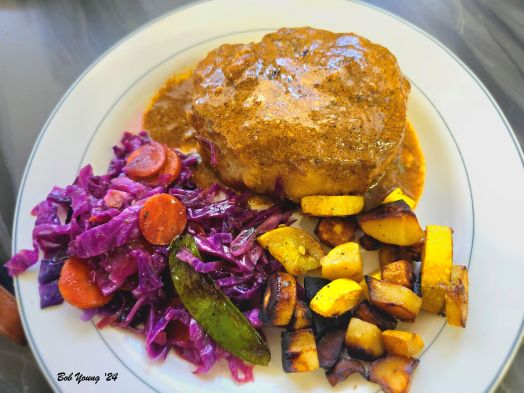
I do like pork! But I really need to change my preparation of the meat. If not the preparation, then the plating of it. What to serve with it? Sauerkraut is a pretty standard plating. But I wanted to change that, And o I came up with this. I used red cabbage, snow peas and carrot rounds, to sweeten it a little, and a little balsamic glaze to soften the cabbage flavor. I brazed it with just a little Aleppo pepper. The combination worked well and folks enjoyed it. Then I took parsnips and chunk diced them and braised them also.
The pork. Braised it over medium heat so not to burn it. Initially and before cooking I used our Pork Rub, (https://www.rockinrs.com/CS-Pork-Rub.pdf) all over the tenderloin and did not “skimp” on the amount. Then pat it into the meat and let it sit for about 30 minutes. The 2020 Parma Ridge Winery Boys Blend was superb with this dinner!
After braising the pork, I removed them from the heat and deglazed the pan (cast-iron skillet) with about 2 ounces of Tarragon Vinegar that we made a while back.Then a little butter in the drippings and some flour. Brought the roux together and added whole milk and about 2 T of Plochman’s mustard and stirred to combine and thicken. I then returned the tenderloin to the pan and spooned some of the sauce over it. After plating, I added a little more if it was needed. Everyone seemed to enjoy it – there is none left!







 Boise Foodie Guild