• About and Contact
  • Air Fryer Cooking Charts and Conversions
  • Air Fryer Recipes – Update: August 2020 – Chicken Olivia
  • Barcode Country List
  • Boise Foodie Blog Recipes – Updates: Nov 2024 Basic Hollandaise Sauce and Cream of Mushroom Soup
  • Boise Restaurant Guide – 52 Restaurant Choices! Updated: July 2018
  • Companion Garden Planting
  • Instant Pot Recipes – Update August 2020 – IP Chicken with Ketchup, Honey and Soy
  • Recipes from the Captain’s Shack: Dec 2020 – CS Prime Rib

Boise Foodie Guild

~ – Enjoy a meal or a recipe with us! Be sure to check the Sidebar and Menu above. Interesting resources are listed there. Most are hot links. Air Fryer (AF), Instant Pot (IP) and Captain's Shack (CS) recipes now have their own page. Subscribe to the blog. It's still FREE!

Boise Foodie Guild

Category Archives: History of Food

Shepherd’s Pie

27 Wednesday Mar 2024

Posted by Bob and Robin in 5-Stars, Aleppo pepper, Baking, Buy Idaho, Buy Local, Carrots, Classics, Cooking Styles, Corn, Dinner At The Captains Shack, Dinner With Friends, Dinner With Robin, Ethnic Foods, Food - Make Your Own Meals, Food Photos, Garlic, Green Peas, Herbs, Herbs and Spices, History of Food, Idaho Lamb, Idaho Potatoes, Idaho's Bounty, Photos, Photos By: Bob Young, Potatoes, Recipe: Bob and Robin Young, Recipes - Dinner, Shepherd's Pie, Support Local Businesses, What's For Dinner?, Wines - Idaho

≈ Leave a comment

Tags

beef, cooking, Cottage Pie, recipes, shepards pie, Shepherd's Pie


I love a good Shepard’s (Shepherd’s) Pie! Much better than a Cottage Pie. Maybe that’s because I do like good lamb. And as a side point, lamb is one year old or younger, while mutton is older than a year, just in case you were wondering. But also, it intrigues me as to the origin of these dishes. I always thought it originated in the Basque country of Spain. But after researching for this article, I am wrong!

Shepherd’s Pie: This dish is believed to have originated in Scotland or northern England (Ireland) during the late 1700s to early 1800s. It was initially made with leftover roasted lamb or mutton, and the term “shepherd” in its name reflects the traditional use of lamb meat.

Cottage Pie is thought to have originated in England, particularly in the Midlands or northern regions, around the same time period as shepherd’s pie. It traditionally uses minced beef, and the term “cottage” likely refers to the modest dwellings of the rural working class, who would have commonly prepared this dish. The cottage pie was the precursor to shepherd’s pie, which was coined in the middle of the 19th century. For a while it was used interchangeably with cottage pie. However, as time went on, a distinction was made: shepherd’s pie referred to a dish made with lamb (because sheep are tended to by shepherds!), and cottage pie referred to a dish made with beef.

This is a Shepherd’s Pie that I made this past week. And I think it was really good. Good robust herb and vegetable flavors. And the ground lamb was awesome with no “wild” taste that you can get with mutton. And it was from a very local farmer. Meadowlark Farms in Nampa, Idaho to be exact. The crust was a combination of Russet (Idaho) potato and Red Potato. I did not have and Harvest Gold potatoes so I made my own! The browning on the top was from a combination of the potatoes and Parmesan cheese. So, if you are interested, here is the recipe I came up with. Feel free to try it. Just let me know how it came out and how much you loved it! https://www.rockinrs.com/CS-Shepards-Pie.pdf

Reblog:

  • Click to email a link to a friend (Opens in new window) Email
  • Click to share on Pinterest (Opens in new window) Pinterest
  • Click to share on Facebook (Opens in new window) Facebook
  • Click to print (Opens in new window) Print
  • More
  • Click to share on X (Opens in new window) X
  • Click to share on Instagram (Opens in new window) Instagram
Like Loading...

Penne Pasta in Vodka Sauce

26 Friday Jan 2024

Posted by Bob and Robin in 5-Stars, Classic Herb Blends, Classic Sauces, Cooking Styles, Cream Sauces, Dinner At The Captains Shack, Food - Make Your Own Meals, Food Photos, History of Food, Homemade Sauce, Housemade Sauces, Italian Food, Passata, Pasta, Photos, Photos By: Bob Young, Recipe By: Captain's Shack, Recipes - Italian, Sauces, Scallops, Seafood, Shrimp, What's For Dinner?, Zucchini

≈ Leave a comment

Tags

penne pasta, vodka


I have been wanting to try this pasta for quite a while now and finally got up the nerve to try and make some. I think it came out very well. Originally, the sauce does not include any vegetables or protein. I changed that and used some large dice zucchini, shrimp, scallops and quartered crimini mushrooms. I like those additional items as it gives the pasta a good texture and mouth feel. Vodka Sauce is a popular Italian-American pasta sauce known for its rich and creamy texture. The exact origins of vodka sauce are unclear. One popular belief is that vodka sauce originated in Italian-American restaurants in the United States during the mid-20th century, more than likely in the 1970’s. Vodka was added to tomato sauce as a way to enhance the flavors of the ingredients. Vodka is thought to interact with the fat in the cream and the acid in the tomatoes, creating a smooth and balanced sauce. Here is a link to the recipe. Enjoy. https://www.rockinrs.com/CS-Penne-Pasta.pdf

Reblog:

  • Click to email a link to a friend (Opens in new window) Email
  • Click to share on Pinterest (Opens in new window) Pinterest
  • Click to share on Facebook (Opens in new window) Facebook
  • Click to print (Opens in new window) Print
  • More
  • Click to share on X (Opens in new window) X
  • Click to share on Instagram (Opens in new window) Instagram
Like Loading...

What Is A Mirepoix?

08 Monday Jan 2024

Posted by Bob and Robin in Food, Herbs, Herbs and Spices, History of Food, Mirepoix, Recipes, What's For Dinner?

≈ Leave a comment

Tags

mirepoix


I have had several questions on what is a mirepoix. I found this explanation and several variations of mirepoix. I hope this discussion helps. Just don’t forget the ratio of the 3 or so ingredients. 2:1:1. Basically, it is from French cuisine with variations for different cultures, adjusted to their particular needs, availibilty of product and wants. Here is how you prep and cook the mireepoiox.

Gather and Prepare Ingredients: Dice the carrots, leave the peel on. Peel and dice the onions. The size of the dice depends on your preference and the intended use of the mirepoix. dice the carrots. Again, consider the size of the dice based on your preference. Wash and dice the celery. Ensure that you include both the stalks and the leaves for added flavor.

Heat the Pan: Place the saute pan or pot over medium heat. Add a small amount of oil (such as olive oil or vegetable oil) to coat the bottom of the pan.

Add Onions: Once the oil is hot, add the diced onions to the pan. Stir and cook until the onions become translucent and slightly caramelized. This process can take about 5-7 minutes.

Add Carrots and Celery: Add the diced carrots and celery to the pan with the onions. Stir the vegetables to combine and cook for an additional 5-7 minutes or until the carrots begin to soften.

Seasoning: Season the mirepoix with a pinch of salt and pepper. You can also add herbs like thyme or bay leaves for extra flavor.

Use as a Base: Your mirepoix is now ready to be used as a base for soups, stews, sauces, and other dishes. It adds depth and aromatic complexity to your recipes.

Here are 12 common variations of mirepoix:
 
Classic Mirepoix: 2 parts onions, 1 part carrots, 1 part celery,
White Mirepoix: 2 parts onions, 1 part leeks, 1 part celery
Red Mirepoix: 2 parts red onions, 1 part carrots, 1 part celery
Cajun Trinity: Equal parts onions, celery, and green bell peppers
Spanish Sofrito: 2 parts onions, 1 part tomatoes, 1 part green peppers
Italian Soffritto: 2 parts onions, 1 part carrots, 1 part celery
German Suppengrün: 2 parts leeks, 1 part carrots, 1 part celeriac (celery root)
Asian Mirepoix: 2 parts onions or scallions, 1 part carrots, 1 part celery or Chinese celery
Creole Holy Trinity: Equal parts onions, celery and green bell peppers
Mushroom Mirepoix: 2 parts onions, 1 part carrots, 1 part celery, Add mushrooms for an earthy flavor
Mexican: 2 parts poblano or jalapeno, 1 part onion, 1 part tomato
Persian: 2 parts onion, 1 part tomato, 1 part tumeric
 
These variations allow for flexibility in flavor profiles, depending on the cuisine and the specific dish being prepared. Experimenting with different combinations can add depth and uniqueness to your cooking.


Reblog:

  • Click to email a link to a friend (Opens in new window) Email
  • Click to share on Pinterest (Opens in new window) Pinterest
  • Click to share on Facebook (Opens in new window) Facebook
  • Click to print (Opens in new window) Print
  • More
  • Click to share on X (Opens in new window) X
  • Click to share on Instagram (Opens in new window) Instagram
Like Loading...

Tarragon, A Special Herb

04 Thursday Jan 2024

Posted by Bob and Robin in Herbs, Herbs and Spices, History of Food, tarragon, What's For Dinner?

≈ Leave a comment

Tags

tarragon


One of my favorite herbs is tarragon. Thyme and basil come in as a close second. I love it for it’s anise, licorice flavor that goes extremely well with fish, especially salmon, in soups and stews and in sauces. Here is some information on tarragon. I hope you find it useful and interesting.

Tarragon, scientifically known as Artemisia dracunculus, is a perennial herb that has been used for culinary and medicinal purposes for centuries. Its history is rich and diverse, with various mentions in different cultures around the world. Here’s a history of tarragon:

  1. Ancient Roots: Tarragon’s history can be traced back to ancient times. It is believed to have originated in Siberia or the Caspian Sea region. The ancient Greeks and Romans were familiar with tarragon and used it both for its culinary and medicinal properties.
  2. Middle Ages: Tarragon gained popularity in medieval Europe, particularly in France. Charlemagne, the Holy Roman Emperor, ordered the cultivation of tarragon in his herb gardens in the 9th century. It was during this time that tarragon started to be used as a flavoring herb in various dishes.
  3. Medicinal Uses: Tarragon has a history of use in traditional medicine. It was believed to have medicinal properties, including the ability to alleviate digestive issues and reduce toothaches. In medieval times, it was also used to treat snake bites.
  4. Renaissance and Culinary Uses: Tarragon continued to be cultivated and used in European kitchens during the Renaissance. Its distinctive flavor made it a favorite among chefs, and it became a staple in French cuisine. Tarragon vinegar, a popular condiment, was developed during this period.
  5. Russian Tarragon vs. French Tarragon: There are two main varieties of tarragon: Russian (Artemisia dracunculoides) and French (Artemisia dracunculus var. sativa). French tarragon is the preferred culinary variety due to its superior flavor, while Russian tarragon lacks the same intensity.
  6. Spread to North America: Tarragon was brought to North America by early European settlers. It found its way into colonial gardens and was incorporated into American cuisine.
  7. Modern Usage: Tarragon continues to be a popular herb in modern kitchens, particularly in French and Mediterranean cuisines. It is commonly used to flavor sauces, dressings, and various meat and vegetable dishes. Tarragon is also a key ingredient in the French herb blend fines herbes.
  8. Cultivation and Varieties: Tarragon is primarily grown through cuttings or division, as growing from seeds is often unreliable. French tarragon is a sterile hybrid, meaning it doesn’t produce viable seeds, while Russian tarragon can be grown from seeds.
  9. Health Benefits: While tarragon is mostly used for its culinary appeal, it is also believed to have health benefits. It contains compounds with potential antioxidant and anti-inflammatory properties.

In summary, tarragon’s history is a fascinating journey through different cultures and time periods, showcasing its evolution from a medicinal herb to a beloved culinary ingredient. Its unique flavor continues to be appreciated worldwide, making it a staple in many kitchens.

Reblog:

  • Click to email a link to a friend (Opens in new window) Email
  • Click to share on Pinterest (Opens in new window) Pinterest
  • Click to share on Facebook (Opens in new window) Facebook
  • Click to print (Opens in new window) Print
  • More
  • Click to share on X (Opens in new window) X
  • Click to share on Instagram (Opens in new window) Instagram
Like Loading...

3 Delicious Meals

05 Thursday Jan 2023

Posted by Bob and Robin in 5-Stars, Appetizers, Bacon, Blue Crab, Buy Local, Captain's Shack, Celebrations, Classic Cuisines, Comfort Food, Cooking Styles, Corn Bread, Crab, Ethnic Foods, Food - Jewish, Food Photos, Food Trivia, Ham, Hanukkah, Healthy Eating, History of Food, Housemade Soup, Idaho Potatoes, Jewish Food, Main Dish, Party Time, Photos By: Bob Young, Recipe - Jewish, Recipe - Soup, Recipe By: Captain's Shack, Recipe: Bob and Robin Young, Recipes, recipes appetizers, Rice, Special Information, What's For Dinner?

≈ 1 Comment

Tags

Blue Crab, chard, Crab Dip, hoppin' John, Latkes


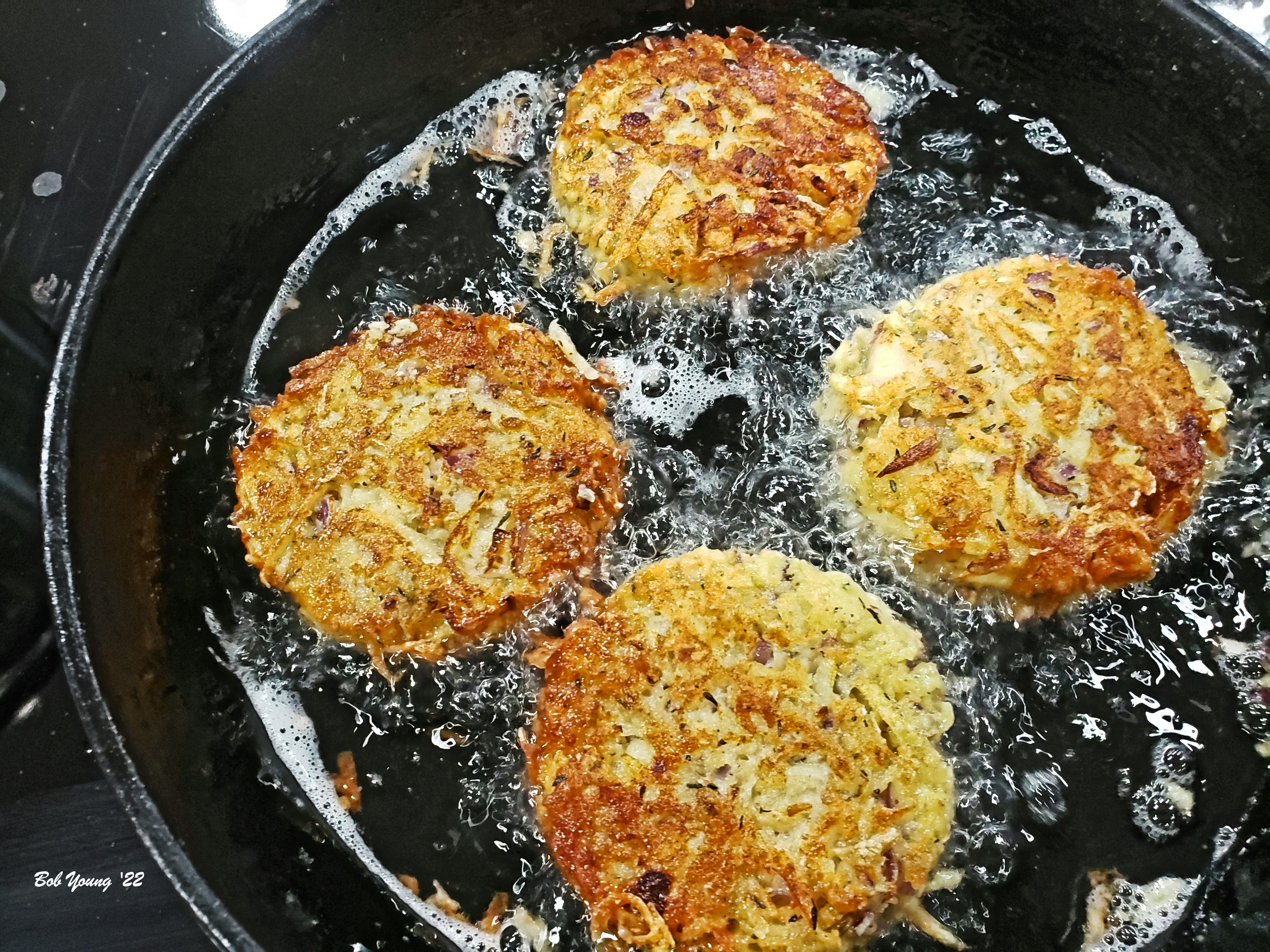
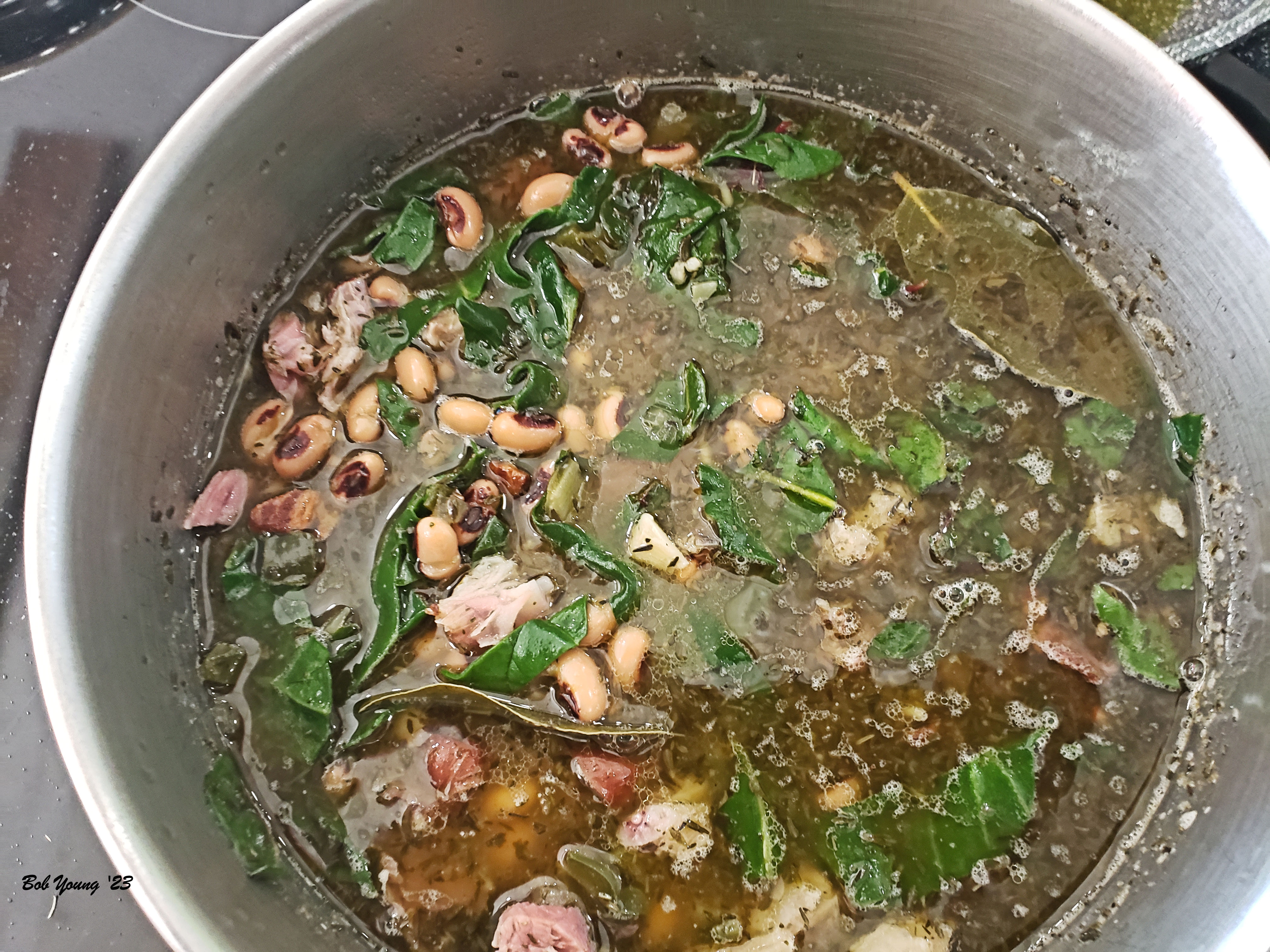
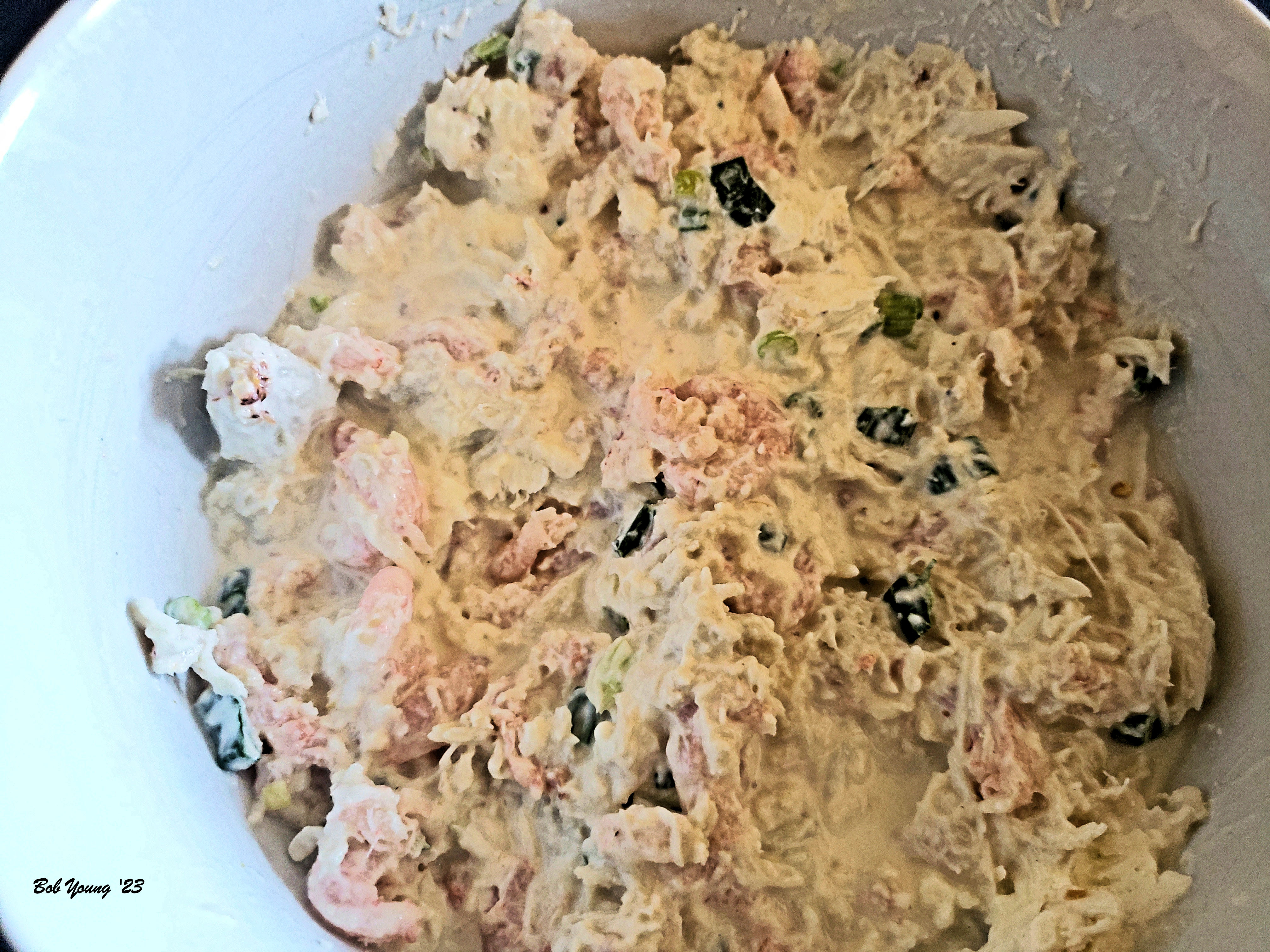
captains-shack-pipe-signed-Walkway-LMPOver the past several weeks, we have made some really good meals. Potato Latkes for one (https://www.rockinrs.com/CS-Latkes.pdf), Hopping John, aka Hoppin’ John, (http://www.rockinrs.com/CS-Hopping-John.pdf) and an East Coast style Crab Dip (http://www.rockinrs.com/Marges-Crab-Dip.pdf). Potato latkes are a traditional Chanukah dish,Hoppin’ John is a traditional southern, New Year’s Day meal with ham hocks and black eyed peas (cow peas) and a superb East coast style crab dip. I do hope you enjoy these.

30Dec2022_1_Captains Shack_Latkes Frying

From Chabad.com we learn that,

“Latke (pronounced LOT-keh, LOT-kah or LOT-kee) is Yiddish for “pancake.” On Chanukah, it is traditional to serve latkes (most often potato) fried in oil to celebrate the Chanukah miracle, which involved the oil of the Temple menorah lasting for eight days instead of just one. Those of the Jewish faith, eat foods that reflect the significance of a holiday—such as matzah on Passover and apples dipped in honey on Rosh Hashanah and Chanukah is no exception. For at least the last thousand years, Jews have traditionally eaten oily foods on Chanukah.” In other words, it’s tradition.

5Jan2023_1_Captains Shack_Hoppin John Cooks

Hoppin’ John, on the other hand, is a traditional southern United States dish that is usually eaten on New Year’s Day to bring good luck. The recipe, although not totally like this one, dates back to the early 1800s and is made with ham, or ham hocks, black eyed peas (cow peas), rice, bacon and collard greens, or if you want spinach or rainbow chard. The first written recipe appeared in “the Carolina Housewife” in 1847. It was written by Charlestonian Sarah Rutledge.

5Jan2023_1b_Captains Shack_Marge Crab Dip


This third dish is actually an appetizer. We originally had it at the home of my brother and his wife. I love it! Full of blue crab and I have added the salad shrimp and green onion. It is probably best to make it and then refrigerate it for a while so as to let all the flavors “marry”. Chilling after making, brings out the sweetness and flavor of the blue crab. Chilling brings out the Taste of The Sea, Goût de la mer.

I hope you try some, or all, of these recipes. All are good and fun to prepare, even though the Hoppin’ John is a little involved to make, but not impossible.

Reblog:

  • Click to email a link to a friend (Opens in new window) Email
  • Click to share on Pinterest (Opens in new window) Pinterest
  • Click to share on Facebook (Opens in new window) Facebook
  • Click to print (Opens in new window) Print
  • More
  • Click to share on X (Opens in new window) X
  • Click to share on Instagram (Opens in new window) Instagram
Like Loading...

Purim and Hamantash Cookies

28 Friday Feb 2020

Posted by Bob and Robin in Comfort Food, Cookies, Cooking Styles, Dessert, Food - Jewish, Fruit, Hamantash Cookies, History of Food, Holiday Picnic Fare, Recipe - Dessert, Recipe - Jewish, Recipes, Recipes - Dessert, What's For Dinner?

≈ 4 Comments

Tags

Hamantash Cookies, Purim


I love it when I hear of a new food item. New to me, at least. Hamantash Cookies is just that. Thanks to my friend Joe Levitch for mentioning them. An so I search.
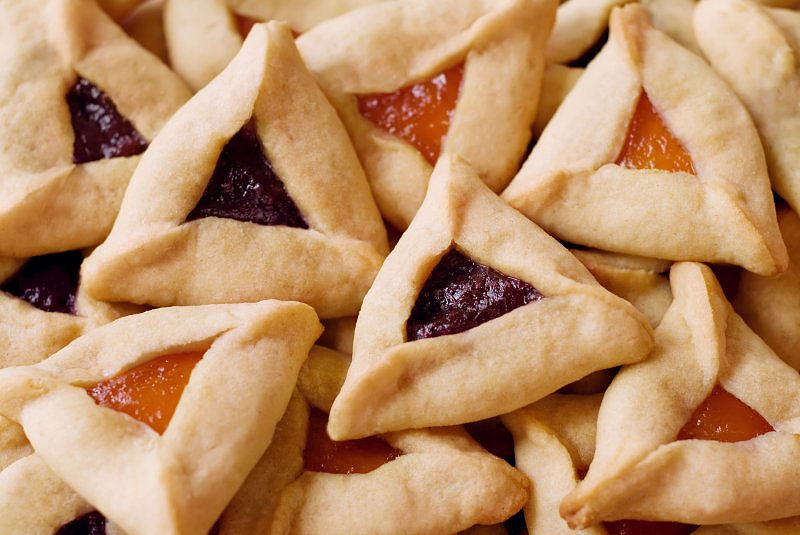
Hamantash cookies are associated with the Jewish Festival Purim. The Purim cookie is, “… all associated with the Purim story involving a bad guy name Haman, a Jewish lady named Esther, and her victory over his plot to destroy the Jewish People. The cookie is shaped to resemble the three corners of Haman’s hat. Purim is the name of the festival and both Hamantaschen and Oznei Haman are derived from his name.” [Veenaazmanov]

Jelly Filled Hamantash Cookies for Purim

And from the NY Times, “Early versions of the cookies were more commonly known as oznei Haman, meaning “Haman’s ears.” The late Jewish food historian Gil Marks’ Encyclopedia of Jewish Food traces that phrase — but not the cookie — to the Roman scholar and poet Immanuel ben Solomon (c.1261-1328) who, thanks to “a misinterpretation arising from the medieval Italian custom of cutting off a criminal’s ear before execution,” argued that Haman’s ears had been cut off after he was hanged, at the end of the Purim story.”
And Purim is, “Purim is one of the most fun holidays celebrated by the Jewish people, but is often under recognized. Purim (held on the 14th day of the Hebrew month of Adar — usually March or April) commemorates the day Esther, Queen of Persia, saved the Jewish people from execution by Haman, the advisor to the Persian king.” Purim this year is March 10, 2020.
Here is a recipe for the cookies. It looks like there are many. Enjoy! Hamantash Cookies

Reblog:

  • Click to email a link to a friend (Opens in new window) Email
  • Click to share on Pinterest (Opens in new window) Pinterest
  • Click to share on Facebook (Opens in new window) Facebook
  • Click to print (Opens in new window) Print
  • More
  • Click to share on X (Opens in new window) X
  • Click to share on Instagram (Opens in new window) Instagram
Like Loading...

Aebleskiver. What?

16 Thursday Jan 2020

Posted by Bob and Robin in Aebleskiver, Apple, Banana, Blueberries, Boise Foodie Guild, Brunch, Comfort Food, Cooking Styles, Ethnic Foods, Food - Danish, Food - Make Your Own Meals, Food Photos, Fruits, History of Food, Idaho Polenta Floriani, Idaho Polenta Roys Calais, Photos By: Bob Young, What's For Dinner?

≈ 3 Comments

Tags

Aebleskiver, idaho polenta, Make Your Own, polenta


OK. What is an Aebleskiver?

Aebleskivers are a type of pancake cooked in a special stove-top pan with half-spherical molds. The center is soft and fluffy, almost creamy. The crust is crisp and browned. In Denmark, aebleskivers are traditionally plated in threes, dusted with powdered sugar, topped or filled with tart jams of Nordic berries and served with mellow Scandinavian coffee. There, aebleskivers ( may be pronounced as “eb-el-ski-ver” , “a-bla-ski-va”, “eb-el-sku-wyr” , “ebb-ull-skee-vers” or “able-skEEvers”) have typically not been served in restaurants or for breakfast, but rather at the family table for afternoon coffee breaks. On long and cold Nordic winter evenings, they are served with glögg. In the wintertime, aebleskivers are often sold by street vendors. A symbol of community and hospitality, they are very popular at Scandinavian charity and open-air events.
​ There are many recipes for the batter, but they generally fall into two categories: those made with baking soda (or baking powder) as a leavening agent, or those made with yeast. The batters vary in texture and flavor — and yeasted batters take a bit more patience to prepare and will expand more in the pan — and which you prefer is a matter of personal taste … Here’s a little of Aebleskiver history:…. During that time of the Vikings, when they roamed the coastal waters of England and the Atlantic, one band of these rough Vikings was hard hit in battle. As they returned to their ship with dented horn helmets and shields, they made pancakes to regain their strength. They didn’t have proper cookware so they greased their dented shields and poured the batter on them over a fire. The first aebleskivers were born. (So they say:)…) [http://www.aebleskivers.com/history.html]

Cast Iron Aebleskiver Pan and Turners


Aebleskivers in Coeur D’Alene, ID describe these treats as Danish meaning apple slices. These are traditional Danish pancakes in a distinctive shape of a sphere. Maybe a cross between a Beignet and a Funnel Cake, without all the grease! So maybe all of this will convince you to try these sweet treats. If so, here is the recipe we use. Enjoy! CS Danish Aebleskiver.

Here is our first try. Homemade Huckleberry and Raspberry Jams. Scrambled eggs, too.


And if you want some great polenta recipes – Idaho grows awesome polenta – look here: 17 Polenta Recipes.

Reblog:

  • Click to email a link to a friend (Opens in new window) Email
  • Click to share on Pinterest (Opens in new window) Pinterest
  • Click to share on Facebook (Opens in new window) Facebook
  • Click to print (Opens in new window) Print
  • More
  • Click to share on X (Opens in new window) X
  • Click to share on Instagram (Opens in new window) Instagram
Like Loading...

Stroganoff. What Is It?

15 Tuesday Oct 2019

Posted by Bob and Robin in 5-Stars, Beef, Boise Farmers Market, Captain's Shack, Carrots, Classic Cuisines, Classic Sauces, Egg Noodles, Ethnic Foods, Food - Russian, Food - Slavic, Heirloom Carrots, Herbs and Spices, History of Food, Housemade Sauces, Idaho Beef, Local Farmers Markets, Mushrooms, Onion, Petit Syrah, Photos, Photos By: Bob Young, Recipe by: Robin and Bob Young, Recipes, Recipes - Dinner, Recipes - Russian, Recipes - Sauces, Russian Food - Stroganoff, Special Dinners, What's For Dinner?, Wine and Food

≈ 1 Comment

Tags

Hoisin, Stroganoff


Not long ago, we made a Mahogany Beef Stroganoff and it was surprisingly good. Even with some totally different ingredients. Hoisin Sauce for one. But there were two questions: (1) What makes it mahogany? and (2) Is it Russian or Italian or French? Well, the answer to the first question is sort of easy. The mahogany color comes from the addition of the Hoisin Sauce, a Chinese BBQ sauce. Question #2. The short answer is “Yes”. Wikipedia says,

The dish is named after one of the members of the influential Stroganov family. Elena Molokhovets’s classic Russian cookbook “A Gift to Young Housewives” gives the first known recipe for Govjadina po-strogonovski, s gorchitseju, “Beef à la Stroganov, with mustard” [typically French], in its 1871 edition. The recipe involves lightly floured beef cubes (not strips) sautéed, sauced with prepared mustard and broth, and finished with a small amount of sour cream: no onions, no mushrooms and no alcohol. A competition purported to have taken place in 1890 is sometimes mentioned in the dish’s history, but both the recipe and the name existed before then. Another recipe, this one from 1909, adds onions and tomato sauce, and serves it with crisp potato straws, which are considered the traditional side dish for beef Stroganoff in Russia. The version given in the 1938 “Larousse Gastronomique” includes beef strips, and onions, with either mustard or tomato paste optional.

Mahogany Beef Stroganoff

Sautéing of beef Stroganoff
After the fall of Tsarist Russia, the recipe was popularly served in the hotels and restaurants of China before the start of World War II. Russian and Chinese immigrants, as well as US servicemen stationed in pre-Communist China, brought several variants of the dish to the United States, which may account for its popularity during the 1950s. It came to Hong Kong in the late fifties, with Russian restaurants and hotels serving the dish with rice but not sour cream.

And from Cooksinfo, we learn,

There are at least two popular theories about how Beef Stroganoff originated.
One is that it was created in 1891 in St. Petersburg, Russia, by Charles Brière, a cook who worked for Count Pavel Alexandrovich Stroganov. Brière reputedly submitted the recipe in that year to “l’Art Culinaire” (presumably the magazine whose full name was “La Revue de l’Art Culinaire”.) This is the version proposed in the 2001 version of the English language “Larousse Gastronomique”. If this is so, it would seem to be just about Brière’s only claim to fame. His recipe called for shallots (now onions are used.)
The second is that it was created by an unknown cook for Count Grigory Stroganov (1770-1857), because the Count had lost his teeth and couldn’t chew meat. Beef Stroganoff, though, is probably just a more refined version of similar, pre-existing recipes…The last prominent scion of the dynasty, Count Pavel Stroganoff, was a celebrity in turn-of-the-century St. Petersburg, a dignitary at the court of Alexander III, a member of the Imperial Academy of Arts, and a gourmet. It is doubtful that Beef Stroganoff was his or his chef’s invention since the recipe was included in the 1871 edition of the Molokhovets cookbook…which predates his fame as a gourmet. Not a new recipe, by the way, but a refined version of an even older Russian recipe, it had probably been in the family for some years and became well known through Pavel Stroganoff’s love of entertaining.

There are also variations made with chicken or pork, which to me, looses the original likeness. I have made it with chicken, but always go back to beef. You be the judge. And just to note: we served this with a 2002 Ridge Vineyards Dynamite Hills Petite Syrah and I marinated the beef cubes in a little Hoisin Sauce, garlic powder and Worcestershire Sauce for several hours before browning it off. The marinating really made it rich. We also had it over medium wide egg noodles and topped the dish with sour cream and chopped parsley. Delicious!

Reblog:

  • Click to email a link to a friend (Opens in new window) Email
  • Click to share on Pinterest (Opens in new window) Pinterest
  • Click to share on Facebook (Opens in new window) Facebook
  • Click to print (Opens in new window) Print
  • More
  • Click to share on X (Opens in new window) X
  • Click to share on Instagram (Opens in new window) Instagram
Like Loading...

Edible Flowers For Dinner?

01 Saturday Jun 2019

Posted by Bob and Robin in Cooking Safety, Cooking Styles, Edible Flowers, History of Food, Interesting Information, Photos, Photos By: Bob Young, What's For Dinner?

≈ 3 Comments

Tags

edible flowers


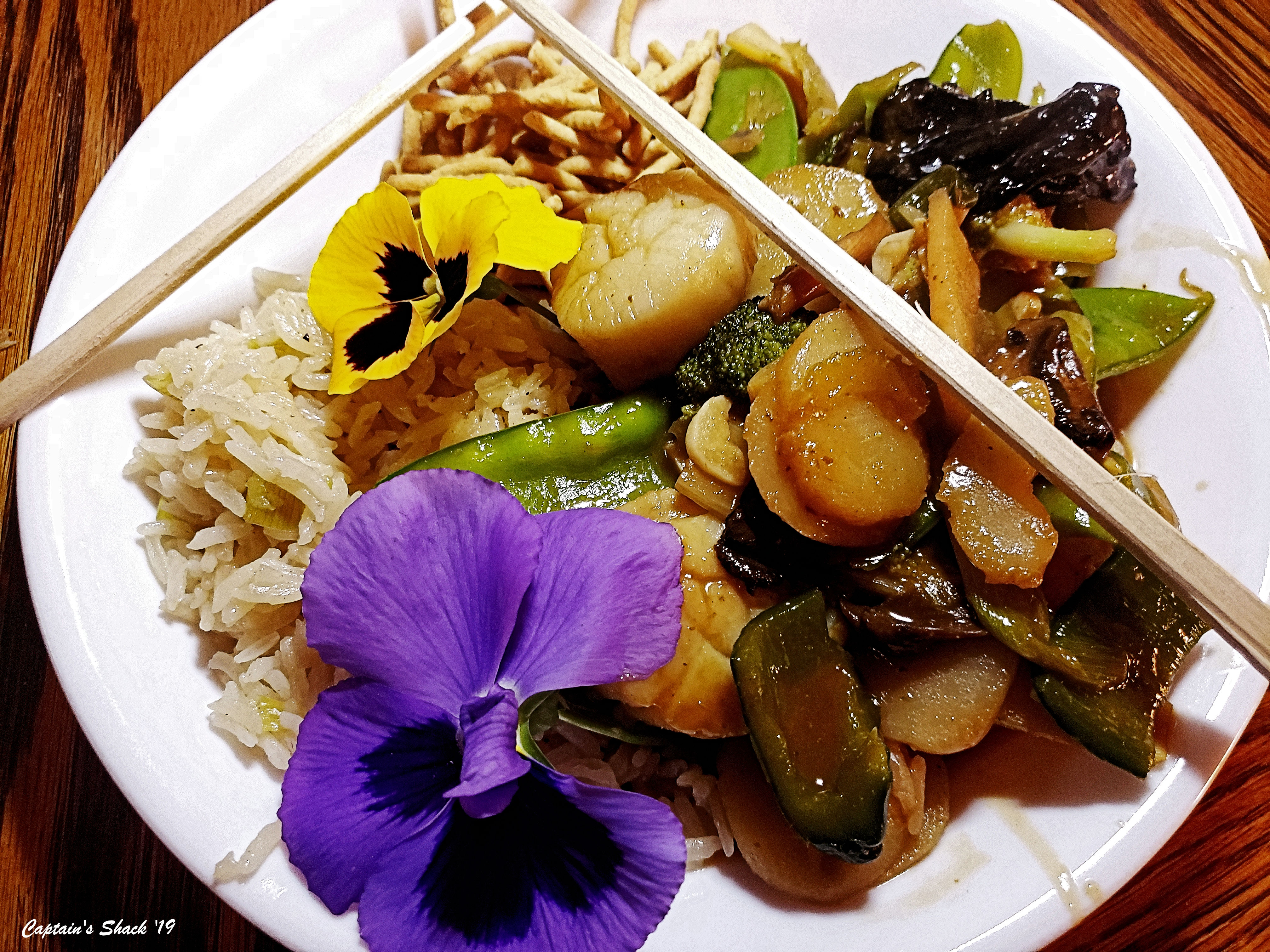
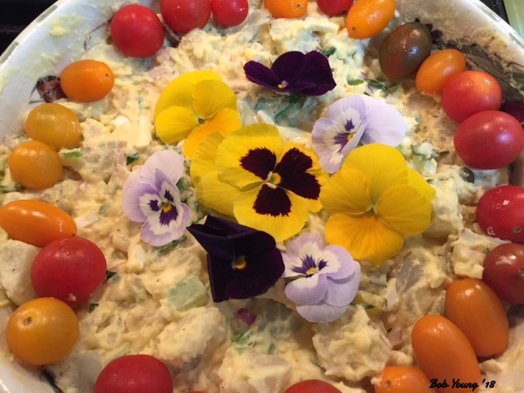
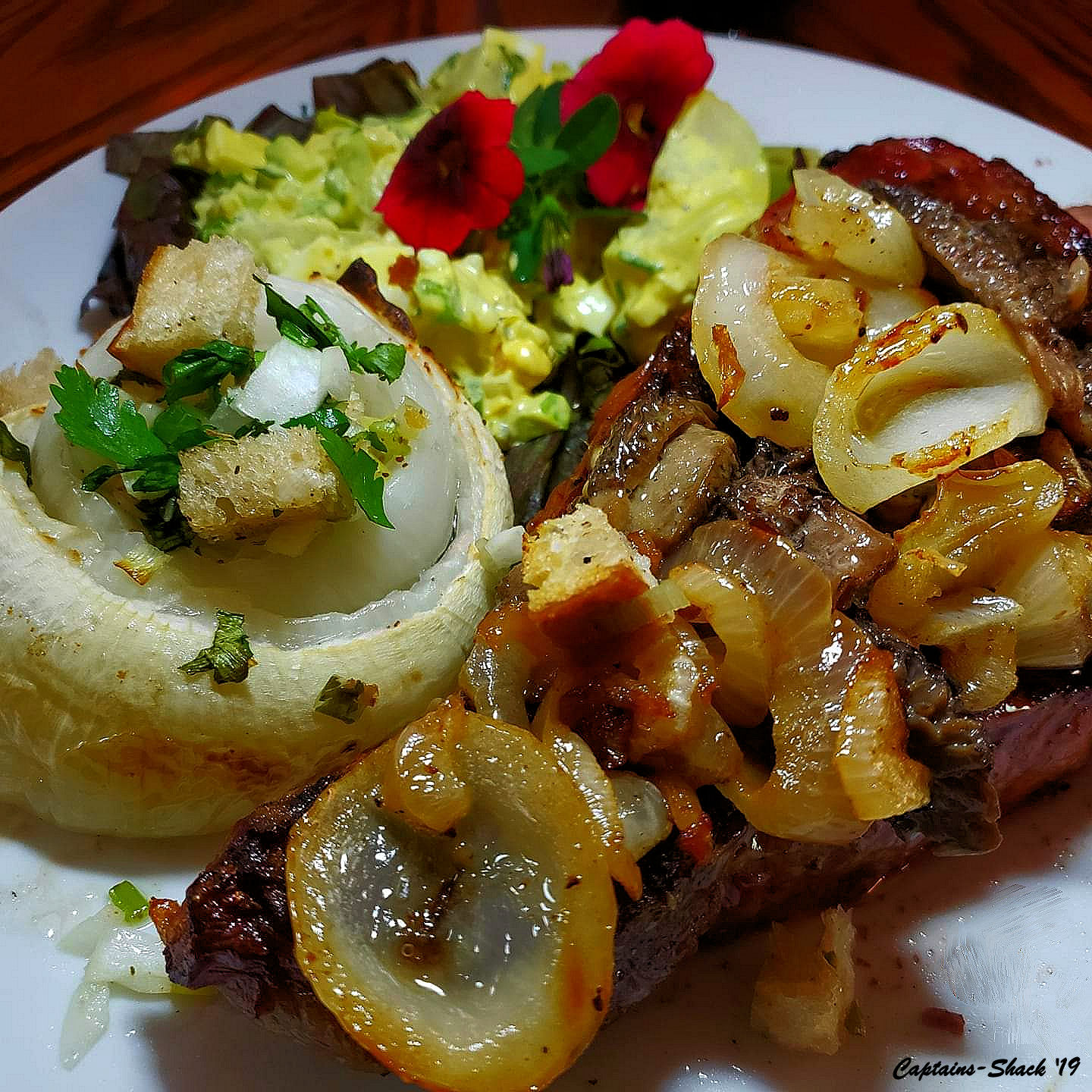
OK. Flowers on a plate make for great “eye candy”. Flowers in a salad can really spice it up. Like in these photos below. But a word of caution – Know what you are eating. Not everything on a plate is edible – although it should be: If it’s not edible, don’t put it on a plate! Ask if it is edible. If the kitchen or Wait Staff don’t know, it might be time to find another restaurant. Just use caution and be smart. Know your edible plants. Left-Click the photos to see enlarged.

Deviled Eggs with Pansy Decorations

Seafood Stir Fry with Flower Decoration

Edible Pansy in a Potato Salad

Buffalo Ribeye, Baked Onion and Potato Salad and Red Pansy

But, diner beware!

“Ten Rules of Edible Flowers
by Sherry Rindels, Department of Horticulture

The culinary use of flowers dates back thousands of years to the Chinese, Greek and Romans. Today there is a resurgence of interest in edible flowers. Are all flowers that aren’t poisonous edible? Definitely not. Listed below are a few simple rules to follow before sampling flowers.

Eat flowers only when you are positive they are edible. If uncertain, consult a good reference book on edible flowers prior to consumption.

Just because flowers are served with food does not mean they are edible. It’s easy and very attractive to use flowers for garnish on plates or for decoration, but avoid using non-edible flowers this way. Many people believe that anything on the plate can be eaten. They may not know if the flower is edible or not and may be afraid to ask.

If pesticides are necessary, use only those products labeled for use on edible crops.
Do not eat flowers from florists, nurseries or garden centers. In many cases these flowers have been treated with pesticides not labeled for food crops.
Do not eat flowers picked from the side of the road. Once again, possible herbicide use eliminates these flowers as a possibility for use.
Remove pistils and stamens from flowers before eating. Eat only the flower petals for most flowers.

Different flavors occur in plants when grown in different locations because of soil types, fertilization, and culture. Environmental conditions play a big role as well. What has excellent flavor at one time may taste different at the end of the season or the next year.
Introduce flowers into your diet in small quantities one species at a time. Too much of a good thing may cause problems for your digestive system.
If you have allergies, introduce edible flowers gradually, as they may aggravate some allergies.
Enjoy the different flavors and colors that edible flowers add to many foods.

Collect flowers at the optimum time. Pick fully open flowers in the cool of the day. Flowers that are not fully open (unless buds are desired) or those starting to wilt should be avoided. Sample a flower or two for flavor before harvesting. Remove the pistils and stamens because the pollen can detract from the flavor of the flower as well as cause allergic reactions in susceptible individuals. After harvest, place long-stemmed flowers in water and then in a cool location. Short stemmed flowers should be placed between layers of damp paper toweling or in a plastic bag in the refrigerator. Immediately before using, gently wash the flowers to remove dirt and check for insects. Before washing, test one flower for colorfastness. Some tend to discolor in water.

Only the petals of some flowers such as rose, tulip, yucca and lavender are edible. Separate the flower petals from the rest of the flower just prior to use to keep wilting to a minimum. Roses, dianthus, English daisies, and marigolds have a bitter white area at the base of the petal where it was attached to the flower. Break or cut off this portion before using.” [hortnews.extension.IAState.edu]
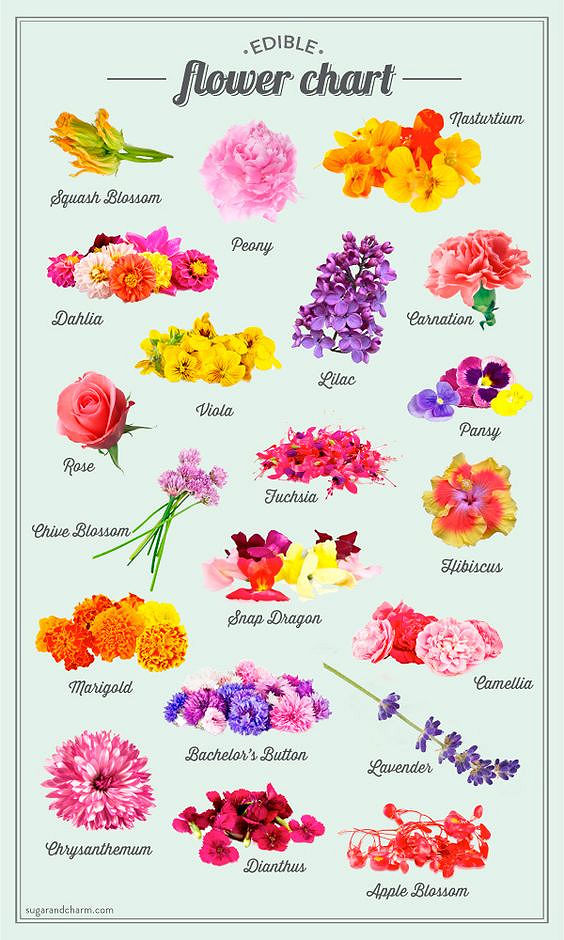
Here are some edible flower charts. Print them out if you wish.

Enjoy your dinner. Eat wisely!

Reblog:

  • Click to email a link to a friend (Opens in new window) Email
  • Click to share on Pinterest (Opens in new window) Pinterest
  • Click to share on Facebook (Opens in new window) Facebook
  • Click to print (Opens in new window) Print
  • More
  • Click to share on X (Opens in new window) X
  • Click to share on Instagram (Opens in new window) Instagram
Like Loading...

What’s This Cougar Gold Cheese?

30 Thursday Nov 2017

Posted by Bob and Robin in Appetizers, Cheese, Corti Brrothers, Cougar Gold, Ethnic Foods, History of Food, Interesting Information, What's For Dinner?, WSU

≈ 1 Comment

Tags

cheddar cheese, Corti Brothers, Cougar Gold


It’s probably one of the greatest cheddar cheeses you could EVER eat! And it’s a cheese in a can! Not aerosol driven. So it is not Cheeze Whiz. Nor is it Velveeta! It’s pure, fantastic, fresh cows milk cheese.
Corti Brothers Store, 5810 Folsom Blvd, Sacramento, CA 95819 916-736-3800, is probably one of the most fun grocery stores you will ever enter and they have some great information on this cheese! “…Frank Corti And Gino Corti started Corti Brothers in 1947…” and it has been open ever since. Darrell Corti, who Robin knows quite well and who I met several years ago, is the son of Frank Corti. From their website, Corti Brothers,

…Darrell, whose encyclopedic knowledge of food and wine attracts queries from around the world. As told by Ruth Reichel in her memoir Comfort Me With Apples, Colman Andrews described Darrell to her as the man “who knows more about food and wine than anyone else in the world.”
In 1967, using his role as an insider’s insider, he reached out to the rest of the country with a newsletter, featuring rare, high quality food items and wines discovered during his travels in Europe and Asia. After forty plus years of continuous publication, it is still prized for its wealth of information, including essential details about a product’s history, modes of production, uses, and occasional esoteric bits that ‘foodies’ adore. Never dull, Darrell is known for free expression of his wide ranging opinions, which are often iconoclastic and seldom sugar-coated.
Darrell’s contribution to the food and wine literacy of his friends, associates, and customers has been considerable. He played a large role in the development of wine production in Amador County. He was made a Cavaliere, the Italian equivalent of knighthood, by the Italian government for his efforts in promoting Italian products, not the least of which was the almost single-handed introduction of Aceto Balsamico Tradizionale to America. Darrell, an early champion of local olive production, has seen his efforts bear fruit as chairman of the Los Angeles County Fair’s International Extra Virgin Olive Oil Competition.

So when I say that Darrell Corti knows his cheeses and he likes to share his knowledge, here is what he says about Cougar Gold.
“COUGAR GOLD CHEESE is the result of war! In fact it may the only good thing ever to have come out of war. During World War II, it was created by Washington State University to be used as military rations. It is the only cheese that I know of that is made and aged in a tin can. Normally, one does not think of cheese aged in a can, but Cougar Gold has become famous for this methodology. It is a “cheddar” like cheese that I think is possibly the best cheese to accompany wine. It has very low acidity, which does not change the taste of wine, and does have the clean sharpness of an aged cheese. Unique, it is made only at Pullman, Washington, and deserves to be better known.

It is also an easy to care for cheese. Just buy several tins and put them in your refrigerator and turn them from time to time. They just sit there getting better and better. It is also a cheese that is firm, with a crumbly texture, a pale yellow color and it will have specks of tyrosomine on it. Once the can is opened, wrap the cheese in waxed paper and then film and enjoy it until it’s gone. I think it is perfect with an old Cabernet or Vintage Port, perhaps not rich enough for Burgundy. If you like cheese and have not had Cougar Gold, you owe it to yourself to try it. It is hard to resist. By the way, when was the last time you had a 10 year old cheese? COUGAR GOLD CHEESE 30 oz tin.” [Corti Brothers website]

Here is what the WSU Creamery says about Cougar Gold.
“Our most famous & popular cheese! Winner of several national and international awards. A rich, white cheddar with a smooth, firm texture. This unique cheddar has a depth and intensity that most people have never before experienced. Its creamy, lingering flavor will leave you wanting for more! Our current stock of Cougar Gold is just over one year in age. Buy 2 and store one for aging, as it becomes more sharp and crumbly with age, developing crystals throughout, which can give it kind of a crunch…Purchasing cheese from the WSU Creamery helps support student employees of Washington State University by providing competitive wages and valuable work experiences…In May of 1992, the Creamery moved from its old home in Troy Hall to a fantastic and modern new location in the Food Quality Building. This new facility allows the Creamery to be at the forefront of research in cheese production. It allows WSU students to gain work experience directly applicable to the work they may be doing in the Food Science field upon graduating… A portion of the revenue from the sale of WSU Creamery products is used for educational support of Food Science students.”

You can purchase it from Corti Brothers, see the link above, or you can purchase it directly from the Washington State Creamery at WSU Creamery. We usually send some to our family and friends at Christmas. But be aware, they do run out of it and then you will have to wait until early Spring or so to get some. And it ages very well. WSU claims that one of their customers had a tin of Cougar Gold for 25 years! And when they opened it, it was awesome. Robin and I have 1 tin of Cougar Gold produced in 2009. All tins come date stamped and who produced it.
Reblog:

  • Click to email a link to a friend (Opens in new window) Email
  • Click to share on Pinterest (Opens in new window) Pinterest
  • Click to share on Facebook (Opens in new window) Facebook
  • Click to print (Opens in new window) Print
  • More
  • Click to share on X (Opens in new window) X
  • Click to share on Instagram (Opens in new window) Instagram
Like Loading...
← Older posts

  • Bob and Robin's avatar Bob and Robin
  • rockinrobin43's avatar rockinrobin43

Meta

  • Create account
  • Log in
  • Entries feed
  • Comments feed
  • WordPress.com

Copyright Notice

Creative Commons License
This blog and all work herein is licensed under a Creative Commons Attribution-Noncommercial-No Derivative Works 3.0 United States License.

The Current Weather at the Captain’s Shack

Click the image to see the very latest and current weather at the Captain's Shack in Boise, Idaho

Enter your email address to follow this blog and receive notifications of new posts by email.

Join 183 other subscribers

Thanks to all of these readers and subscribersz of this blog!

  • 320,160 and 598,479 Folks Reached

Monthly Archives of this Blog

Translate This Page

Assoc of Food Bloggers

Association of Food Bloggers

BFM Drive-Thru

Boise Farmers Market Drive-Thru

Air Fryer Cooking Time and Temperature Conversion Calculator

To convert to the AirFryer

AirFryer Recipes

https://www.airfryerrecipes.com/

Air Fryer Conversions

Rule of 25%. Reduce oven/frying temperature by 25% and time by 25%.

Fork To Spoon – Air Fryer and Instant Pot Recipes

Great resource for AF and IP information and recipes.

AirBnB Buhl, Idaho

Welcome to Mary Anne’s place, a historic cottage in the heart of Kelley’s Canyon Orchard. Just 20 minutes from Twin Falls, unwind in this quiet retreat by enjoying the pleasant sound of a nearby creek and views that look out into the orchard. 4 guests · 2 bedrooms · 3 beds · 1 bath, Wifi · Free parking · Kitchen, Entire House! 1903 River Rd, Filer, Idaho 83328

Bloglovin’

RSS Links

RSS Feed RSS - Posts

RSS Feed RSS - Comments

-----------------------
I Know. Not Idaho Products, But still Worth A Try!
----------------------

Rockin’ Rs

----------------------
Items of Blog Interest.
-----------------------

Member of The Internet Defense League

The History Kitchen

Interesting historical information about food - prep, origins and uses. Written by a kitchen anthropologist!

-----------------------
Of Concern To This Blog
----------------------

Recent Posts

  • Trike Restaurant Finds Worthy of Posting
  • Food Via ETrike
  • An Awesome Chicken Dish
  • Sushi Shack
  • Awesome Oven BBQ Pork Ribs

-----------------------
Think Local!! Buy Local!!

Let them know you saw their logo on this blog. Thanks!
----------------------

Buy Local!

If you are not from Idaho, think about Buying Local in Your area! As for us, we have lived in Idaho since 1982. We Buy Idaho wherever possible.

Chef Jake Sandberg, Crispeats

Food References and Recipes

Buy Local

And it does ... Just Make Sense! Regardless of where you are from.

------------------------
Think Local!! Idaho Products.

Let them know you saw their logo on this blog. Thanks!
-----------------------

The New Boise Farmers Market

Summer and Winter - 1500 Shoreline Dr, Boise (Americana and Shoreline)

Idaho Farmers Markets

A listing of statewide Farmer's Markets with contacts.

Find Your Local Farmers Market

Click on the graphic to find your local farmers market either by city or zip code.

Acme Baked Shop, Boise

Available at the Boise COOP. Some of the best bread in Boise and all local!! They make the bread for the 10 Barrel Brew Pub, Angell's Bar and Grill, Salt Tears, all here in Boise. Awesome rye bread that actually tastes like rye bread. And the baguettes .... Wonderful. (208) 284-5588 or runsvold2000@gmail.com

Brown’s Buffalo Ranch

Give them a call or EMail for awesome buffalo meat.

Desert Mountain Grass Fed Beef (formerly Homestead Natural Beef)

Desert Mountain Grass Fed Beef, with Bob and Jessica Howard of Howard Ranch in Hammett. The company will only sell whole animals to the Boise Co-op and Whole Foods stores in Boise and Utah. They will also be at the Boise Farmers Market.

Falls Brand Pork roducts

Click the image for pork recipes.

Kelley’s Canyon Orchard

1903 River Rd, Filer, ID 83328 Hours: 10am - 6pm, Phone: (208) 543-5330

Malheur River Meats

Matthews Idaho Honey

Matthews All-Natural Meats

Meadowlark Farms

All natural Eggs, Lamb and Chicken

Purple Sage Farms

True Roots Farm

Available at the Boise Farmers Market and online at https://www.trueroots.farm

True Roots is a local produce farm committed to sustainable and chemical-free farming practices. We raise pesticide-free and non-GMO produce fresh from the farm, offering a diverse variety of farm-fresh services to our local community. Since our founding in 2014, our mission has been to provide farm-direct access to clean, reliable, and affordable produce.

Reel Foods Fish Market

1118 Vista Avenue, Boise, ID 83705 (208) 713-8850 Monday-Friday: 10am-6pm, Saturday: 9am-5pm. Sunday: Gone Fishin’

Standard Restaurant Supply

Plenty of items for the home, too. Check them out. 6910 Fairview, Boise 83704 (208) 333-9577

-----------------------
Some Awesome Recipe and Spice Sources. Culturally diverse.

Let them know you saw their logo on this blog. Thanks!
------------------------

Crockpot Recipes

Many good recipes here.

A Taste of France

A collection of French recipes

Basque Recipes

Best Ever Recipes of Mexico

Malaysian Recipes

Awesome Malaysian recipes.

Memorie di Angelina Italian Recipes

My Best German Recipes Web Site

Regional and Oktober Fest Recipes

There are a lot of recipes here.

Sauer Kraut Recipes

Recipes By Robin and Bob

Recipes that we have collected and created throughout the years.

Recipes of Elizabeth W. Young, Bob’s Mother

These are the recipes that my Mother collected over 85 or so years. The photo of my Mother was one of the last I have of her. It was taken in July, 1987.

Recipes From The Mediterranean Area

Soup and Chowder Recipes

Recipes from "My Recipes"

Deep South Dish Recipes

The Recipes of Greece

Tasty Mexican Recipes

The Shiksa In The Kitchen

Great Jewish recipes!

-----------------------
Some Great Boise Restaurants.

Let them know you saw their logo on this blog. Thanks!
-----------------------

Asiago’s – Italian

Bella Aquila, Eagle, ID

775 S Rivershore Ln., Eagle, ID 83616 (208) 938-1900

Bar Gernika – Basque Pub and Eatery

202 S Capitol Blvd, Boise (208) 344-2175 (Checked)

Cottonwood Grille

913 W River St., Boise (208) 333.9800 cg@cottonwoodgrille.com

Enrique’s Mexican Restaurant

482 Main St., Kuna (208) 922-5169 New name. Was El Gallo Giro. Same owners and kitchen. The Best Mexican restaurant in the Boise/Kuna area, bar none!

Flying Pie Pizzaria

Goldy’s Breakfast Bistro

108 S Capitol Blvd., Boise (208) 345-4100

Goldy’s Corner Cafe

625 W Main St., Boise (208) 433-3934

Guanabanas – Island Restaurant and Bar

960 N Highway A1A, Jupiter, FL

Janjou Pâtisserie

Janjou Pâtisserie, 1754 W State St., Boise, Idaho 83702 (208) 297.5853

Mai Thai Asian Cuisine

750 West Idaho Street Boise, ID 83702 (208) 344-8424

Mazzah Grill – Mediterranean and Greek Cuisine

1772 W State St., Boise (208) 333-2566

Richards Inn by Chef Richard Langston

Formerly - Vincino's. New location at 500 S Capitol Blvd., Boise (208) 472-1463. Reservations are highly suggested.

The Orchard House

14949 Sunnyslope Rd., Caldwell (208) 459-8200

The Ravenous Pig

1234 N. Orange Ave. Winter Park, FL

-----------------------
Think Local!! Boise Breweries, Brew Pubs and Wine Bars.
Let them know you saw their logo on this blog. Thanks!
-----------------------

10 Barrel Brewery Boise

830 W Bannock St., Boise (208) 344-5870

Cloud 9 Brewery and Pub

Opening Fall 2013 in the Albertson's Shopping Center, 18th and State in the old Maxi Java

Edge Brewing Company

525 N Steelhead Way, Boise, ID 83704 (208) 323-1116

-----------------------
Miscellaneous Items
-----------------------

Blog Syndication

NetworkedBlogs
Blog:
Boise Foodie Guild
Topics:
Food, Recipes, Cooking
 
Follow my blog

Blog Badge

Local & Regional Food Blogs - BlogCatalog Blog Directory

  • Subscribe Subscribed
    • Boise Foodie Guild
    • Join 72 other subscribers
    • Already have a WordPress.com account? Log in now.
    • Boise Foodie Guild
    • Subscribe Subscribed
    • Sign up
    • Log in
    • Report this content
    • View site in Reader
    • Manage subscriptions
    • Collapse this bar
 

Loading Comments...
 

    %d