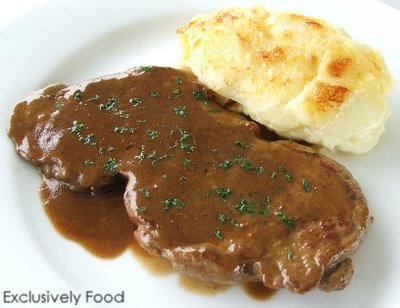
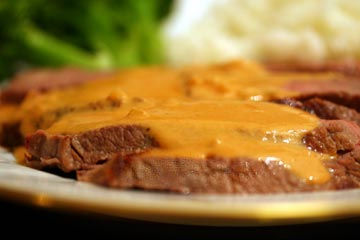
"Steak Diane"


OK, so it’s a nice “fall” day outside – 83 degrees, 25% RH and 4mph winds – and I’m sorta kinda looking forward to the fall temperatures. And with those temperatures comes fall foods. How about Steak Diane, originally made with wild game. From the website, Simply Recipes, we find this description of the restaurant favorite,

Steak Diane is traditionally made with a thinly pounded steak, and a cognac, butter, and shallot sauce that is flambéed right before serving to great dramatic effect… the “Diane” part refers to Diana, the Greco-Roman goddess of the hunt, and “a la Diane” sauces were typically served with venison and game meat in centuries past. It was probably New York hotels that popularized the flambéed steak version.

But I found and altered several recipes for Steak Diane and you can see it at Steak Diane and the recipe for a side of Individual Potato Gratin with Sun Dried Tomato. Again, the side is altered from a combination of several recipes. So, think about these two dishes when you need something special for dinner. Having people over? Try the Steak Diane and your guests will probably be “Wow’ed!”. A nice light red wine, like a Pinot Noir or a Petit Verdot (my “White-Out” editor caught this one). Or maybe a good German Riesling will work also. Boy! This sounds like party time! Geno and Deb – you gotta come home! Cheers and Goot Essen!

Boise Beer Fest, August 2009


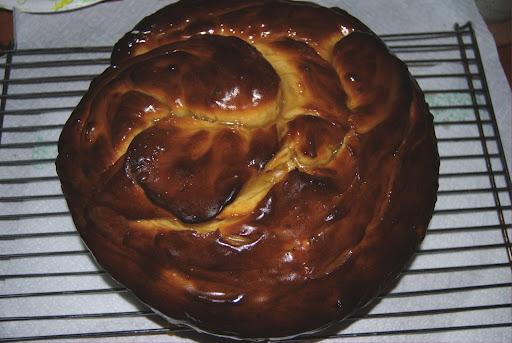
Well really, it does have something to do with food! Beer does have grain in it. And vegetables. And it is cooked. And it is persevered. I guess that makes it a “one pot meal”. So, this afternoon, Mac calls me and asks, “Do you want to go to the Beer Festival at Ann Morrison Park this afternoon?” Who am I to turn down a crafted beer. But, I had to explain to him that I had an Apple Honey Challah to bake – pictured here – and that I probably could not go before early afternoon. He said that was Ok. I had to hurry to get the second and third rises done; the bread baked and cooled and coated with a honey/butter mixture. (I never said it was low calorie) OK, I made it! The bread was complete and 8 minutes before I was to meet him, I was on the way. I should have taken some with me … it would have gone quite well with some of the beers, and there were a lot of them. Here are some photos. Enjoy!

Cheers!

Apple Honey Challah


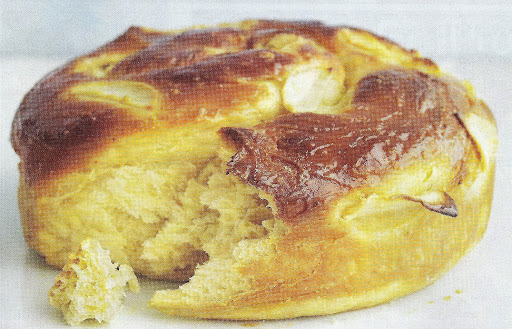
From Martha Stewart Living, September 2009, page 176, we get an awesome challah, the Jewish celebration bread! This is not extremely hard to do, let’s just say moderately difficult. But it does take time. You might want to look at Apple Honey Challah for the slightly modified recipe. In the article, we learn that, “Apples and honey, Rosh Hashanah’s symbols of a sweet new year, are perfect additions to a loaf of challah.” I have made several challah’s before, but not one with apples in it. I am using Pink Lady’s – that’s what I have – but the recipe calls for “… tart green apples, preferably Granny Smith …”. The sweetness of the Pink Lady and the red blush should be an interesting colorful streak of red.

Be adventuresome and try this bread. It is a real treat for the family and definitely a celebration bread. If anyone wants to comment on this bread and the tradition(s) behind it, please do. Can you add anything about the tradition of challah? I’d love to hear it. Cheers!

Tips On Making The Perfect Jam!


Here is some information gleaned from a BBC cooking program. Enjoy!

Jam, Jellies and Chutneys


Whether it is jams, jellies or chutney, preserved fruit brightens up all manner of breakfasts, lunches and dinners. Here we have all you need to know about preserving fruit, from must-knows to recipes and equipment.
Salting was one of the earliest methods of preserving foods, and from there preserving with sugar and acids developed. All inhibit growth of the micro-organisms which cause food to rot.
Jams and jellies set because of the action of pectin, a substance in fruit that, when cooked with sugar and acid (from the fruit), thickens and gels the preserve. In chutneys the main preserving agent is vinegar. Chutneys are usually made with vegetables, although orchard fruits are also used. Always take care when preparing jams and chutneys to do as the recipe states and sterilize and prepare equipment as directed to minimize the risk of food poisoning.

Types of jams

A traditional jam is fruit cooked, usually to a pulp, with sugar to set. Sometimes the fruit is cooked to a pulp and then sieved before the sugar is added, to get rid of excessive pips. A jelly is fruit cooked, usually with water, to a pulp. It is then dripped through a bag and the resulting juice (not pulp) is simmered with sugar until setting point is reached. A conserve could loosely be described as a very rich type of jam, sometimes with the addition of alcohol. Usually the whole fruit – raspberries, strawberries, blackcurrants, etc. – are preserved in heavy syrup rather than being cooked to a pulp.

Successful Jam Making

· Always use fruit that is in peak condition, preferably slightly under ripe – the pectin content will be at its best. Over-ripe or damaged fruit is not ideal – the pectin has begun to change to pectose and the jam will not set well. The result is likely to deteriorate rapidly.
· Jam jars need to be very clean. To sterilize jars, wash in soapy water, rinse well and then place in a cool oven – 130C/250F/Gas ½ – for 15-20 minutes.
· Use the correct amount of sugar as indicated. The sugar reacts with the pectin to set the jam.
· The amount of sugar you need depends on the amount of pectin in a fruit, but generally, the fruit to sugar ratio for traditional jams is 450g (1lb) sugar to 450g (1lb) fruit. The sugar content is sometimes a little higher or lower depending on pectin and acid content. Very acidic fruits such as blackcurrants have good pectin content – these can take an extra 50 to 100g of sugar to get a really juicy jam. Fruit such as strawberry – lower in pectin, but also much sweeter – can take the usual amount or possibly a little less.
· Use coarse-grain sugar such as preserving or granulated – this ensures a good clear jam. Coarse grains dissolve more slowly and evenly giving a better result. Fine sugars dissolve less easily and are usually more expensive too.
· Don’t add water when cooking fruits already high in sugar, such as strawberries, raspberries and blackberries.
· Don’t over boil the preserve. Once the sugar is added it usually takes a fairly short period of time to reach setting point, as long as the pectin content is good. To test for setting, put a spoonful of the jam on a cool plate and put into the fridge for a few minutes. After that time the jam or jelly will form a wrinkly skin if it is ready.
· Always cover the jam immediately it has been poured into the jars as this gives a good seal and prevents mildew appearing on the surface.
· Always store preserves in a cool, dry area, away from direct sunlight, and use within the year.

Know the pectin content of the fruit used – the higher the pectin content, the better the set. If you use fruit with low pectin content, try adding some fruit with high pectin content such as apples, damsons or redcurrants to give a good result. Alternatively, commercial pectin can be added to low-pectin fruits to ensure a good set. Pectin is best added to the fruit before the addition of the sugar.

High-pectin fruits: blackcurrants, redcurrants, cooking apples, damsons, quinces, gooseberries and some plums.
Low-pectin fruits: blackberries, cherries, elderberries, pears, rhubarb, strawberries and medlars.

So there you have some good tips for making jams. Let’s share some. Here’s a recipe. Cheers!

Victoria Plum Jam

3⅓ lbs Victoria plums
Cup of Water
2¾ lbs Caster Sugar
Juice of one lemon
· Put the whole plums and the water in a large stainless steel pan and bring to the boil. Reduce the heat slightly and bubble away for 30 minutes.
· Add the sugar and lemon juice and stir well. Continue to bubble for another 20 minutes or until setting point.
· Pass the mixture through a sieve to remove the stones and pour into sterilized jars.

Mango Peach Reduction


Mango Peach Reduction

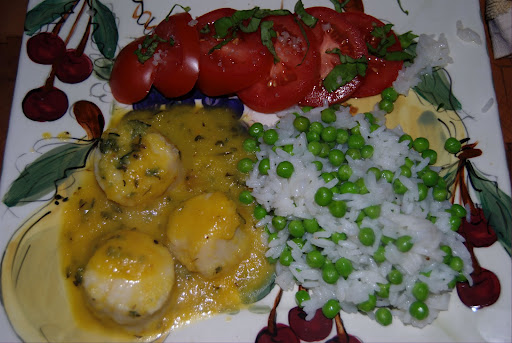
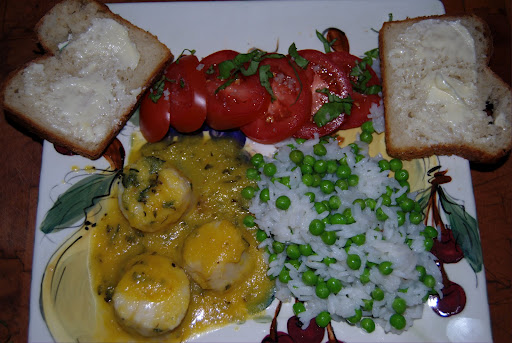
If you look at the previous post – or at the photo to the left – , you will see that I made Robin Scallops with a Mango Peach Reduction. This is not difficult to make and the recipe can be found at Click Here. We had it with seafood, but try it with anything that may need or call for a fruity and naturally sweet sauce. You can probably use any herb you want, but we like tarragon with most seafoods and with pork. But use your imagination. Have fun with this recipe and get inventive with it. If you come up with anything, please let us know. Cheers!!

Robin’s Dinner


Robin’s First Real Dinner after her surgery, was fun to make. No Chef Boy-R-D here! Starting at the top – Sliced Tomato with Basil, Rice and Peas and then Braised Scallops in a Mango-Peach Reduction. And to help smooth it out, homemade Sourdough Bread. I think better than Denny’s. Cheers!

News From The Davis Creek Winery


I received this from Davis Creek today. Good information to a fantastic winery.

August 2008 August and September Events at Davis Creek Cellars

Dear Bob & Robin,
As the summer comes to a close and with harvest just around the corner, we are coming up on events season. Davis Creek will be at multiple tastings and celebrations during the months of August and September so check out a few of them if you can. If you are unable to attend, you can still find us at the Capital City Public Market in downtown Boise on Saturdays, Evenings at Edwards on Tuesday nights off Hill Road in Boise, and of course at our tasting room in Marsing. We will also be having a release party for our new vintage of Tempranillo and Malbec August 28-30. We will be releasing our UP A CREEK! Syrah in September, but that date is yet to be decided. Watch our website for the UP A CREEK! release date! Cheers! from the Davis’s at Davis Creek Cellars

Basque Wine Fest: August 14 from 5:30 to 9pm

Hosted by the Basque Museum and Cultural Center, this annual tasting events takes place on Grove Street between Capital and 6th Street. Tastes wines from local wineries and distributors as well as various tapas from restaurants on the Basque Block. Contact the Basque Museum and Cultural Center for tickets and details at 343-1285.

Eagle Food and Wine Fest: August 21 and 22

Gala Dinner and Tasting at Stueckle Sky Center, August 21 from 6:30-11:00pm: Enjoy an evening at the BSU Stueckle Sky Center featuring 6 local wineries (including Davis Creek), a live and silent auction with proceeds to benefit Meals on Wheels and The Landing Community Youth Programs, and a dinner featuring Idaho wines. Food and Wine Festival at Merrill Park, August 22 from Noon-6pm:Wine tasting, Live Music, and a Chef’s tent featuring local wines and restaurants in Merrill Park in Eagle. For tickets and information visit http://www.eaglechamber.com or call 208-939-4222

New Release Weekend: August 28-30

Time to come out and taste our latest vintage of Tempranillo and Malbec!!!Our 2007 Tempranillo is sold out and the 2007 Malbec is not far behind it! We will be pouring our 2008 Two Vineyard Cuvee Tempranillo and our 2008 Pontin Vineyard Malbec for the first time! Come out have taste of our newest wines and enjoy light appetizers at the tasting room all weekend.

Basque Cooking Class at the Orchard House: August 30

A cooking class featuring Davis Creek Cellars 2008 Tempranillo (among other wines) and the Basque Market of Boise. Enjoy wine tasting while learning how to make various tapas and paella from the pros.Contact Kris and Sherry at the Orchard House for details and reservations at 208-459-8200.
(Note: Any of the Boise Foodie Guild interested in this? A great opportunity and we might be able to get a couple of tables!!)

Chefs’ Affaire: September 10 from 6:30-11pm

A Chefs’ Affaire takes place at the Centre on the Grove featuring local wineries and chefs. The evening concludes with a lively auction of local dining packages. Each package is different, but many of them include having a chef come to you home and prepare a dinner for you and you friends! The proceeds from the event go to the Idaho Food Bank. For tickets, call 208-336-9643.

Taste of Idaho at Qwest Area: September 12 from 10am-5pm

Enjoy wine and food sampling from local wineries and restaurants. Since this is an Idaho Preferred event, all food and wine must be from Idaho! There will be an Idaho Chef Competition and cooking demo’s going on during the event as well. This is a great event to sample the bounty of Idaho Agriculture! Tickets will be available at the door.

Davis Creek Cellars, 429 Main Street, Suite 101, Marsing, ID 83639
Trivia to Ponder


Thanks to Kate and Paul Sudmeier for these pieces of trivia. Interesting.

The next time you are washing your hands and complain because the water temperature isn’t just how you like it, think about how things used to be. Here are some facts about the 1500s:

1. In those old days, they cooked in the kitchen with a big kettle that always hung over the fire. Every day they lit the fire and added things to the pot. They ate mostly vegetables and did not get much meat. They would eat the stew for dinner, leaving leftovers in the pot to get cold overnight and then start over the next day. Sometimes stew had food in it that had been there for quite a while. Hence the rhyme: Peas porridge hot, peas porridge cold, peas porridge in the pot nine days old.

2. Sometimes they could obtain pork, which made them feel quite special. When visitors came over, they would hang up their bacon to show off. It was a sign of wealth that a man could, “bring home the bacon.” They would cut off a little to share with guests and would all sit around and chew the fat.

3. Those with money had plates made of pewter. Food with high acid content caused some of the lead to leach onto the food, causing lead poisoning death. This happened most often with tomatoes, so for the next 400 years or so, tomatoes were considered poisonous.

4. Bread was divided according to status. Workers got the burnt bottom of the loaf, the family got the middle, and guests got the top, or the upper crust.

And just for fun ……
Houses had thatched roofs-thick straw-piled high, with no wood underneath. It was the only place for animals to get warm, so all the cats and other small animals (mice, bugs) lived in the roof. When it rained it became slippery and sometimes the animals would slip and fall off the roof. Hence the saying “It’s raining cats and dogs.”

Interesting. Cheers!

Bacon Fest, Nampa, Idaho


Yup! There really is a Bacon Fest! This one was held at Brick 29 in Nampa, Idaho. (If you have never eaten here, absolutely don’t miss it!!) But this was a special event and I think sponsored by Vande Rose Farms, Iowa Duroc Heritage Breed Pork. You can reach them, and order products, from their website, Vande Rose Farms. Bacon, bacon, bacon! A bacon lovers event. You can try bacon any way you can think of it.

Eggs and Bacon on Bread Triangles
Bacon Stuffed Mushrooms
Bacon Dip
Bacon Wrapped Mushrooms
Bacon Wrapped Jalapeno
Bread stuffed with Swiss Cheese and Wrapped in Bacon
Bacon, Lettuce, Tomato Sandwiches (BLT)
Chocolate Covered Bacon

And then there is Bakon Vodka. Yup! You have not read it wrong … Bakon Vodka. This vodka is from New West Spirits. The original spelling of bacon came from the “… Old German (bakkon) and Old French (bako). “Bacon” or “bacoun” first appeared in the English language around the twelfth century, initially to describe pork in general”. (2009 Lauer, pg 20) So, what do you do with Bakon Vodka besides mix it with eggs and then scramble them? Try one of these:

1. Bakon Apple Martini
(Apple, Bakon and Rum)
2. Luau Martini
(Bakon, Pineapple and Butterscotch)
3. Irish Boar Martini
(Bakon, Kahlua, Baileys, Hazelnut and a splash of Cream)
4. Bakon Mary
(Killer Bloody Mary with Bakon)
5. Pemican Martini
(Bakon and Huckleberry Vodka. Robin came up with this one!)

It was nice to meet Heather Lauer author of Bacon: A Love Story and to have her sign her book. And there are some really nice looking recipes in the book like Bacon Frittata, page 116, and Hana Beach Breakfast Sandwich, page 118. But the book is not all recipes. There is really some delightful discussions of bacon folklore. And some lyrics from Bacon Love Songs, like in chapter 5, page 88. “A little bit of bacon, A little bit of life.” Or, “Beer and bacon waitin’ for my friends, They ain’t comin’ over, but I’m not stayin sober.” But I know, you’re waiting for a recipe. Well try this and it too, is a song lyric. “Bacon, lettuce and tomato … Try it with some Mayo … Fry it up, put the oil in a cup. Bacon.” And, as Ms Lauer states in the header of her first chapter in Bacon: A Love Story, let us not forget that “On the eigth day, God created bacon.” Hmmmm. Now, where is the corn?

I know. Waaaay too much fun! But then good food, good drink and warm friends make it that way. Cheers all! (Oh. I almost forgot. I do have some photos coming after a while. My camera is in the shop – too many falcon photos – so one of the waiters at Brick 29 who was taking photos said he would send some.)

Herbal Pickles


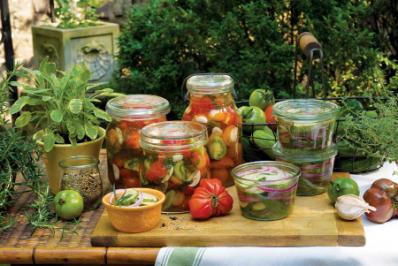
From Herb Companion we can find some good Herbal Pickles for that over abundance of cukes in your garden. Here is what they say about the pickles. “The pleasure of late summer is the burgeoning abundance of available fresh herbs—whether plucked from your own garden or obtained from your local farmers’ market. A good way to savor these herbal treasures is by using them to make quick pickled vegetables, which can be ready in about an hour or so.

Unlike traditional canning methods, these easy-to-prepare recipes take just 10 to 20 minutes to assemble. Then all you need to do is chill the jar in the refrigerator for about an hour, until cold. The pickles do need to be refrigerated, however, so if you want basement shelves full of pickles, you’ll need to take the longer, more involved canning route.”

Make lots of pickles from these four recipes. Good luck! Cheers!