Rudy’s Food Trivia


Many thanks to Rudy’s – Cooks Paradise in Twin Falls for sending the food trivia. Lots of fun!

This Week in the History of Food and Drink

March 8: National Farmer’s Day

March 9, 1839: The Great Pastry War ended this day. A conflict began on November 30, 1838, between Mexico and France caused by a French pastry cook who claimed that some Mexican Army soldiers had damaged his restaurant. The Mexican government refused to pay for damages. Several other countries had asked the Mexican government for similar claims in the past due to civil unrest in Mexico, without any resolution. France decided to do something about it, and sent a fleet to Veracruz and fired on the fortress outside the harbor. They occupied the city on April 16, 1838, and through the mediation of Great Britain were promised payment of 600,000 pesos for the damages. They withdrew on March 9, 1839.

March 10, 1867: Lillian D. Wald was born. She was a scientist and nurse, and among her activities, she helped initiate the enactment of pure food laws in the U.S

March 11, 1853: Self rising flour was invented by Henry Jones.

March 12, 1894: Coca Cola was first bottled by Joseph A. Biedenham of Vicksburg, Mississippi. Before that it was only mixed to order at the soda fountain. On the same date in 1929: Asa Griggs Candler died. In 1887, Asa Candler, a wholesale druggist, purchased the formula for Coca-Cola from John S. Pemberton, an Atlanta pharmacist, for $2,300. He sold the company in 1919 for $25 million.

March 13, 1764: Charles Grey, 2nd Earl and British Prime Minister was born. He reputedly received a gift, probably a diplomatic perquisite, of tea flavored with bergamot oil, taken from bergamot, a citrus fruit typical of Southeast Asia, now grown commercially in Italy. The tea has since been called ‘Earl Grey Tea’.

March 14: ‘Tequilla’ by The Champs is # 1 on the music charts.

Irish Soda Breads


St Patrick’s Day is a little over a week away, 17 March. But you must be thinking of something to go with that Corned Beef. How about some Soda Bread. Here is some interesting information on Soda Bread. Information and recipe from European Cuisines.

Irish soda bread: a brief history
A little soda bread history

Irish baking over the centuries has been affected by two main factors. The first is our climate. The influence of the Gulf Stream prevents either great heat in the summer or cold in the winter. As a result, hard wheats, which need such heat and cold, don’t prosper. Those wheats make flour with a high gluten content that responds well to being raised with yeast. But soft wheats do grow well here.

The other factor has been the abundance of fuel. Ireland’s various medieval overlords could never exercise the tight control over forest land that landowners did in more populous, less wild areas, like England and mainland Europe. This meant that Irish people had less trouble getting their hands on firewood. Where there was no wood, there was almost always heather, and usually turf too. As a result, anyone with a hearthstone could bake at home whenever they wanted to, rather than needing to use a communal bake-oven to conserve fuel.

These two factors encouraged the Irish householder of the past two centuries to bypass yeast for everyday baking. The primary leavening agent became what’s now known here as bread soda — just plain bicarbonate of soda, to US and North American users. Hence the name soda bread. But for a long time, most bread in Ireland was soda bread: “bakery bread” was only available in big cities. Soda bread was made either in a pot or casserole over the fire, or else baked on a bakestone, an iron plate usually rested directly in/on the embers. From these two methods are descended the two main kinds of soda bread eaten in Ireland, both north and south, to the present day.

About soda bread varieties

Cake style brown soda bread: In Ireland, “plain” soda bread is as likely to be eaten as an accompaniment to a main meal (to soak up the gravy) as it’s likely to appear at breakfast. It comes in two main colors, brown and white, and two main types: cake and farl. People in the south of Ireland tend to make cake: people in Northern Ireland seem to like farl better — though both kinds appear in both North and South, sometimes under wildly differing names.

Cake is soda bread kneaded and shaped into a flattish round, then deeply cut with a cross on the top (to let the bread stretch and expand as it rises in the oven). This style of soda bread is normally baked in an oven.

These days we’d normally bake it on a baking sheet / cookie sheet. But in earlier times, before ovens were commonplace, cake was routinely made in deep, lidded iron casseroles, hanging over the open fire or sitting right in it — the casserole lids being concave to hold coals or burning turves from the fire on top, so that the bread would bake evenly in radiant heat from all sides.

The cake style of soda bread can of course be eaten hot. But it’s more usual to let the loaf cool down before eating it (it’s a little easier to handle then). It’s also a lot easier to slice, and that’s the way it’s normally seen in supermarkets and convenience stores country-wide, in both brown and white versions.
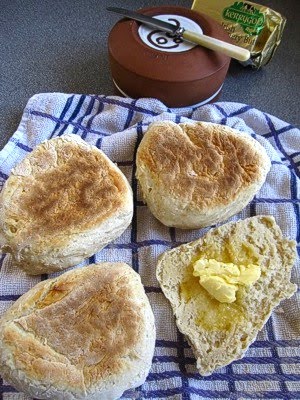
White soda farls: Farl is rather different. When making farls, the soda bread dough is rolled out into a rough circle and cut all the way through, crosswise, into four pieces or farls (“farl” is a generic term for any triangular piece of baking), and usually baked in a heavy frying pan or on a griddle, on top of the range or stove rather than in the oven. It’s a flatter bread than cake, and moister after the baking’s finished. Each farl is split in half “the wide way” before eating. It’s best when eaten hot off the griddle, but it’s also allowed to cool and then grilled or fried as part of other dishes, especially the famous Ulster Fry.

One important note: In the US and North America generally, there’s tendency to think of soda bread as something with fruit in it. This is not the case in Ireland. While people have for many years sometimes added fruit to the basic dough as a treat or for a change of pace, this is not usually referred to as soda bread, but as tea bread, fruit soda, tea cake, and by many other names. We have recipes for these below as well. But everyday soda bread in Ireland does not contain fruit.

——————————

Here’s the basic recipe for white soda bread. All these measures are approximate. The flour’s volume and liquid-absorptive capabilities, in particular, will vary depending on the local humidity.

Ingredients:
•450 g / 1 lb / 3 1/2 cups flour (either cake flour or all-purpose)
•1 teaspoon sugar (optional: you can absolutely omit this if you prefer sugar free soda bread)
•1 teaspoon salt
•1 teaspoon bicarbonate of soda
•Between 200-300 ml / 8-10 fluid ounces buttermilk, sour / soured milk, or plain (“sweet”) milk, to mix

Directions:
Sift the dry ingredients together at least once or twice to make sure the bicarbonate of soda is evenly distributed. Put the sifted dry ingredients in a good big bowl (you want stirring room) and make a well in the center. Pour about three-quarters of the buttermilk or sour milk or whatever in, and start stirring. You are trying to achieve a dough that is raggy and very soft, but the lumps and rags of it should look dryish and “floury”, while still being extremely squishy if you poke them. Add more liquid sparingly if you think you need it. (You may need more or less according to conditions: local humidity and temperature, the absorptiveness of the flour you’re using, etc.)

Blend quickly (but not too energetically!) until the whole mass of dough has become this raggy consistency. Then turn the contents of the bowl out immediately onto a lightly floured board or work surface, and start to knead.

The chief concern here is speed: the chemical reaction of the bicarb with the buttermilk started as soon as they met, and you want to get the bread into the oven while the reaction is still running on “high”. Don’t over knead! You do not want the traditional “smooth, elastic” ball of dough you would expect with a yeast bread. You simply want one that contains almost everything that went into the bowl, in one mostly cohesive lump. You should not spend more than half a minute or so kneading… the less time, the better. Fifteen seconds may well be enough, because you don’t want to develop the gluten in the flour at all. If you do, you’ll get a tough loaf. So don’t overdo it! Don’t be concerned if the dough is somewhat sticky: flour your hands, and the dough, and keep going as quickly as you can. There is a whole spectrum of “wetness” for soda bread dough in which it’s possible to produce perfectly good results: farl in particular sometimes rises better if the dough is initially wet enough to be actively sticky. You may have to experiment a few times to come to recognize the right texture of dough.

Put the cake’s baking sheet into the preheated oven. Handle it lightly and don’t jar it: the CO2 bubbles in the dough are vulnerable at this point of the process.

Let the bread alone, and don’t peek at it! It should bake for 45 minutes at 400-450° F. (One of our Irish neighbors suggests you give it the first 10 minutes at 450°, then decrease to 400°. Also, if you have a fan oven, use temperatures 10° lower or so, as fan ovens have a tendency to run hot.) At the end of 45 minutes, pick up the loaf and tap the bottom. A hollow-ish sound means it’s done. For a very crunchy crust, put on a rack to cool. For a softer crust, as above, wrap the cake in a clean dishcloth as soon as it comes out of the oven.

——————————

Irresistible Irish Soda Bread

By: Karin Christian
“A very easy, very good tasting bread. Best if made the day before, or several hours before serving.”
Original Recipe Yield 1 – 9×5 inch loaf

Ingredients:
• 3 cups all-purpose flour
• 1 tablespoon baking powder
• 1/3 cup white sugar
• 1 teaspoon salt
• 1 teaspoon baking soda
• 1 egg, lightly beaten
• 2 cups buttermilk
• 1/4 cup butter, melted

Directions:
1. Preheat oven to 325 degrees F (165 degrees C). Grease a 9×5 inch loaf pan.
2. Combine flour, baking powder, sugar, salt and baking soda. Blend egg and buttermilk together, and add all at once to the flour mixture. Mix just until moistened. Stir in butter. Pour into prepared pan.
3. Bake for 65 to 70 minutes, or until a toothpick inserted in the bread comes out clean. Cool on a wire rack. Wrap in foil for several hours, or overnight, for best flavor.
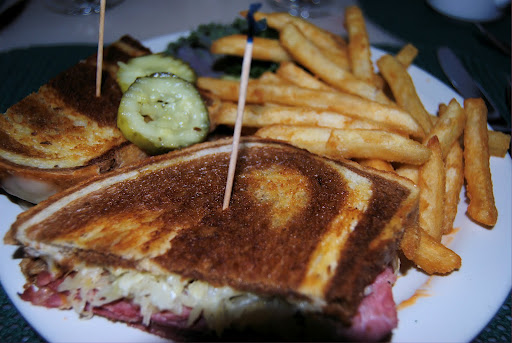
Still Looking! "The Perfect Reuben"


You just think that I have given up. Actually have 2 more places to look at. And most of you know of my bias for Westside Drive-In, Chef Lou. Most of his food is awesome! Great Rib-Eye on Fridays and Saturdays! But his Reuben, sorry, but it misses the mark. Where is the Deli Pickle? No one offers them that I have found. But, here are the standings so far.

The Reuben Sandwich Challenge Scoring

Rated on 1 to 5-Stars, here is how we rate the three places in Boise that serve a Reuben Sandwich. 1-Star is enough for this year and a 5-Star is one that meets the criteria.

1. Barbaccoa – Big thick slabs of meat, no rye toast, they used bread, and soggy from an over abundance of kraut. No grilled onion. Rating: 1-Star

2. Donny Mac’s – Rye toast was weak on the rye, heavy on the 1000 Island dressing. Sloppy to eat because of the really wet kraut. The pastrami was good. Raw onions. Rating: 2-Stars

3. Cucina di Paolo – Yea! Russian Dressing. Good pastrami and not overly salty. Great kraut. Did not notice any grilled onion. Good rye toast, although it was Marble Rye. I would prefer a straight Jewish Rye, Deli Rye. I always like a good Jewish Kosher pickle with my Reuben. None of these places had that. Rating: 4-Stars

4. Seasons Bistro – Wow!! We’ve got a foot race. Homemade Russian Dressing, as was Cucina di Paolo. Good pastrami as was Cucina di Paolo. Great kraut that is special ordered and, in my opinion, better than Cucina di Paolo. Grilled onions. Good rye, that I actually tasted the caraway seed, although it was the Marbled Rye!!! I told Rachael Hurn, Owner, that I really would like to give her the 5-Stars for this sandwich, but I couldn’t. She asked, “Why?” And I told her, “No Jewish Kosher deli pickle.” She said she would go get me one. Too late. But, Rachael does know – as did Paul at Cucina di Paolo – the difference between a Reuben and a Rachael Sandwich. She has both on the menu!!! Rating: 4½ – Stars

5. Westside Drive-In – I was disappointed. The pastrami was poorly heated. And the dressing was not Russian. I think it was 1000 with horseradish. The kraut was very good though. He also uses marbled rye. No pickle!!! And I’m really getting tired of the marbled rye. Why not a good deli rye? Sorry Lou.
Rating: 3½ – Stars

Here is another place that Robin and I tried in Eagle. Good burgers! Robin had a great Ahi Tuna sandwich. They make their own slaw and their house salads are huge. And what did I see on the menu? Reuben Sandwich with “… our own homemade Russian dressing.” Was that the gauntlet? Is there a pickle? A deli pickle? Deli rye? Good kraut? Well, I guess the next time we are in Eagle – next week – we will, or better yet, I will have to try this one. The menu description looks close. But what about the taste? This is tooooooooooooo much fun!

We really are closing in on “The Best Reuben Sandwich in Boise“. Cheers!

"Seasons" March Events


Thanks Rachael, for sending this information!

——————————

Monday, March 1st– 6:00 – 8:00 PM
Seasons Bistro, Winebar & Catering
Women and Wine
Every Monday at Seasons we will be featuring Women and Wine. Come alone and meet your neighbors or bring a friend and learn about different featured wine and cheese pairings. Cost-$15.00 per person

Thursday, March 4th– Closed from 5pm on for private party!

Friday, March 5th – 6:00 – 9:00 PM
Seasons Bistro, Winebar & Catering
Live Music with Michael Laky & Dinner Specials

Monday, March 8th – 6:00 – 8:00 PM
Women and Wine
Every Monday at Seasons we will be featuring Women and Wine. Come alone or bring a friend and learn about different featured wine and cheese pairings. Cost-$15.00 per person

Friday, March 12th – 6:00 – 9:00 PM
Seasons Bistro, Winebar & Catering
Live Music & Dinner Specials

Monday, March 15th – 6:00 – 8:00 PM
Seasons Bistro, Winebar & Catering
Women and Wine
Every Monday at Seasons we will be featuring women and wine. Come alone or bring a friend and learn about different featured wine and cheese pairings. Cost-$15.00 per person

Wednesday, March 17th – 11AM-8PM
Happy St. Patrick’s Day! Bangers & Mashed Potatoes
Take $2.00 off Ruebens today!

Friday, March 19th – 6:00 – 9:00 PM
Live Music & Dinner Specials with Will Bell
Will was featured at Boise’s ” Alive After Five” and his band was invited to play at the Boise Blues Society Corner Club event this summer. Will’s song “Missin Home” is also featured on Boise “On Hold” throughout the city.

Saturday, March 20th – 6:00 – 9:00 PM
Seasons Bistro, Winebar & Catering
Live music & dinner specials

Monday, March 22nd – 6:00 – 8:00 PM
Seasons Bistro, Winebar & Catering
Women and Wine
Every Monday at Seasons we will be featuring Women and Wine. Come alone or bring a friend and learn about different featured wine and cheese pairings. Cost-$15.00 per person

Friday, March26th – 6:00 – 9:00 PM
Live Music & Dinner Specials

Saturday, February 27th – 6:00 – 9:00 PM
Live Music & Dinner Specials

Monday, March 29th – 6:00 – 8:00 PM
Seasons Bistro, Winebar & Catering
Women and Wine
Every Monday at Seasons we will be featuring Women and Wine. Come alone or bring a friend and learn about different featured wine and cheese pairings. Cost-$15.00 per person

Wednesday, March 31st – SEASONS WINEAUXS 6:00PM
HAPPY HOUR 10% off glasses of wine
7:00PM-paired tastings from soup and salad to dessert
$35.00-non-members $30.00-members

Did you know that SEASONS is accepting reservations for group breakfast meetings. The bistro can accomodate a group of approximately 50 people for anything from coffee and breakst tea breads to full customized breakfast buffets. Please call for dates and details.

Location: 1117 E Winding Creek Dr., Eagle, Idaho 83616
Phone: 939-6680

March Marietta Madness

All month long at SEASONS BISTRO -enjoy $5.00 glasses of Marietta Old Vine Red Wine.

Join our mailing list or find us on FACEBOOK under Seasons Bistro to keep up on all events and specials.

Pork Information and Recipes


How to Cook Pork

Tips, Hints, and Recipes
By Linda Larsen, About.com Guide, About.com

Best Pot Roast
Pork has had quite a varying reputation through the years. In the mid 20th century, most pork had to be cooked well done because of the fear of trichinosis. But today pork is fed and raised differently and the meat is safe to heat when cooked to an internal temperature of 160 degrees F. If the juices run very light pink, the pork is done.
The phrase ‘Pork, The Other White Meat’ was introduced in the 1980s. Pigs don’t move around as much as cattle do, so the muscles don’t have to work as hard and don’t use as much oxygen. Less oxygen means less myoglobin, the red colored molecule, so the meat is a lighter color. Today’s pork has been bred to be 31% leaner than the pork we ate in 1983. And, pound for pound, it has more nutrients than chicken. Of course, with a lower fat content, it’s more difficult to cook pork so it’s safe to eat, yet stays tender and juicy.

Pork contains protein, water, sugar, connective tissue, and fat in varying quantities. To see how these components work together, see How to Cook Beef. Just remember, we’re searching for a balance of a safe final cooked temperature and keeping moisture in the meat.

There are five main cuts of pork:

•Leg (ham, cutlets, boneless roast)
•Side (spareribs, bacon)
•Loin (rib roast, sirloin roast, rib chop, loin chop, country style ribs, tenderloin, and Canadian-style bacon)
•Shoulder Butt (blade roast, ground pork, sausage)
•Picnic Shoulder (smoked hocks, picnic roast)
Notice that the loin, the most tender part of the animal, is where most of the common consumer cuts come from. This means that pork should be cooked like any other low fat meat: either for a short period of time at high temperatures, or for longer times at lower temperatures. Moist heat, such as braising, poaching, simmering, and crockpot cooking, also works well.

The amount of cooking time really is based on how thick the cut of pork is. Thinly cut pork chops can be pounded and then sauteed for 5-7 minutes and they’ll be done. Thicker pork chops, up to 1-1/2″ thick, can cook in the crockpot for 8-9 hours. Pork roasts usually need to cook for hours. And the super-tender pork tenderloin can be thinly sliced and cooked in seconds in a stir-fry.

A resource for Pork Recipes

Rudy’s For March


And for March and from Rudy’s in Twin Falls, we have an additional piece of trivia. I love these!

March is –
National Caffeine Awareness Month
National Flour Month
National Frozen Food Month
National Noodle Month
National Nutrition Month
National Peanut Month
National Sauce Month

This Week in the History of Food & Drink

March 1, 1989: A 75 year-long ban on beer was lifted this day in Iceland.
March 2, 1904: Dr. Seuss (Theodor Seuss Geisel) was born. Writer and cartoonist. A few of his children’s books were ‘Green Eggs and Ham,’ ‘One Fish Two Fish Red Fish Blue Fish,’ ‘Scrambled Eggs Super!’ and ‘The Butter Battle Book’
March 3: National Mulled Wine Day! Try our recipe above!
March 4: National Pound Cake Day
March 5, 1836: Charles Goodnight was born. He is said to have devised the first ‘chuck wagon’ from an Army wagon in the 1850s or 1860s, with various shelves and compartments for food, equipment, utensils, medical supplies, etc.
March 6: National Chocolate Cheesecake Day
March 7: National Crown Roast of Pork Day

I do hope you visit their website! Cheers!

Ahi Sushi Bar, Eagle, Idaho


So on Fridays, we have been teaching in Eagle for the “Eagle Arts School”. And for lunch, almost 1 1/2 hours between these two classes, we’ve been doing some culinary exploring. “Seasons”, “Rembrandt’s” and now the “Ahi Sushi Bar”. We like all three for different reasons. All are very relaxed. The “Rembrandt'” and “Seasons” are bistro style. And the “Ahi Sushi Bar” is not a bistro, but a sushi bar. It’s exciting to watch the Chef’s prepping the sushi and creating the dishes. Look at these slides and you will see. Cheers!

Rudy’s Trivia


And again, this trivia information from Rudy’s. Enjoy and by all means, pay Rudy’s a visit!!

This Week in the History of Food & Drink

February 22, 1630: Quadequina, an American Indian, introduced English colonists to popcorn. He had brought some to their first Thanksgiving dinner. (Some sources say 1631).

February 23, 1896: Leo Hirshfield introduced the Tootsie Roll at his small store in New York City. It was supposedly named after his 5 year old daughter, whose nickname was ‘Tootsie.’

February 24, 1938: DuPont begins production of nylon toothbrush bristles. A patent had been granted in 1937. The nylon bristles replaced hog bristles. No more brushing your teeth with hog hair.

February 25, 1922: Donald McLean was born. McLean was a Scottish potato expert who supposedly had the world’s largest private collection of potatoes, with 367 varieties.

February 26: National Pistachio Day

February 27, 1827: The first Mardi Gras celebration was held in New Orleans.

February 28: National Chocolate Soufflé Day

——————————

Warm Valrhona Chocolate Cake

One of our Rudy’s picks this week is France’s prized Valrhona chocolate. It’s the star of the richly delicious dessert. For a very runny center, undercook the cake a little bit and serve immediately. The cake can be held raw in the soufflé cup uncovered and refrigerated up to eight hours before baking.

Yield: 4 servings

Ingredients:
6 ½ ounces Valrhona Caribe Chocolate with 66% Cocao Mass, chopped
½ cup unsalted butter
5 teaspoons Valrhona cocoa powder
3 eggs, separated
¼ cup sugar

Method:
Preheat the oven to 450º. Lightly coat the inside of four, 4-ounce oven-proof soufflé cups with butter. Heat 2 inches of water in the bottom half of a double boiler over medium heat. In the top half, place the chocolate and butter. Melt the chocolate mixture for 5 minutes, then remove it from the heat and stir it until it is smooth. Transfer the mixture to a large stainless-steel bowl and whisk in the cocoa and all the egg yolks. Set the chocolate mixture aside. In a separate bowl, beat the egg whites with an electric mixer until soft peaks form, about 1 minute. Slowly add the sugar and continue beating until the mixture is stiff and shiny but not dry, forming a meringue. Lightly fold the meringue into the chocolate until completely combined. Divide the soufflé batter equally among the prepared soufflé cups. Place cups on a sheet pan and bake for 7 minutes, until puffy and slightly browned on top. Serve immediately by inverting each cup (with an oven mitt) onto a plate until the cake is released. Cut carefully around edges of the cakes to loosen them if they do not come out. Serve with whipped cream or ice cream.

Recipe Notes:
Be sure to not overheat the butter; overheated butter will separate and result in a greasy, crumbly cake.

——————————

First Grilling For 2010


Well, it looks like Grilling Time is here! Close to 50 degrees here today; Supposed to be close to 60 next week. The air even smells like spring. So, it was time to fire up the grill for the first time this year. Grill some Potatoes, a nice Steak and some Apples, and we’ve got a good dinner. Grilled apples? Oh yes!! After grilling them to caramelize the sugars, slice them and place on a bed of lettuce. No dressing! Just grilled apple and lettuce. YUM-O! Oh yes, can’t be grilling without the homemade Baked Beans. Just look at that platter! and drool! Cheers!

Dinner With Geno!


On 22 February, Geno called. He is in Boise for a while before returning to Arizona. We know he and Debra – we missed you Debbie!!! – both like lamb and I had some lamb shanks in the freezer, so it would only be right to have the shanks for dinner. Braised Lamb Shanks or Osso Bucco is an awesome dinner. Throw in some fresh home made Sourdough Bread and a NV Bonair Frankensauv Columbia Valley (WA) Red Table Wine and we have a dinner. But, it was also George Washington’s Birthday, so we had to have a nice fresh Cherry Pie. Here are some photos accompanied by the Taiko Drums. Enjoy.