What Is Chutney?


One of my several blog subscriptions is one from David Lebovitz on David Lebovitz Blog. I am always looking for uses of green tomatoes, and he has posted a Green Tomato Chutney. But the question always arises as to What is Chutney? Here is an article from the University of Georgia and the National Center for Home Food Preservation on just that question. Enjoy.

Preservation Principles in Chutney

What is ‘chutney’?
‘Chutney’ is a relish-type condiment; its increasing popularity reflects the inclusion of ethnic world cuisines in the Western diet.

The term ‘chutney’ includes several different varieties of sauce-type foods, drawn from traditional East Indian cuisine. The main ingredient may be an herb such as cilantro or mint; a flavoring ingredient such as coconut, onion, ginger, tamarind; or, in the most common form, chopped fruit or vegetables, simmered with spices, onion, sugar and vinegar. Fruit-based chutneys are usually cooked, then canned or refrigerated. Other chutneys like cilantro, onion, coconut, etc. are usually eaten fresh, with minimal, if any, cooking.

Fruit chutneys are most commonly available and varieties include mango, apple, apricot, cranberry, date, papaya, peach, pear, pineapple, plum, tomato and mixed fruit, to which raisins and nuts may be added to complement the texture. The result is a sweet-sour-spicy-hot versatile blend—an adventure for the taste buds.

Are there special spices commonly used in fruit chutney?
Chili powder or red pepper flakes are most common, but others include ginger (usually ground or chopped fresh ginger), garlic, turmeric, and curry powder (a mixture of ground spices like cardamom, cinnamon, cloves, coriander seed, cumin, fenugreek, mustard seed, nutmeg). Other seasonings may include salt, pepper, sugar, tamarind paste, vinegar and lemon juice.

How is chutney used?
Chutney is a perfect accompaniment to East Indian food; however, it can also be used as a side dish, sandwich spread, dip, an accompaniment to cheese and crackers, or as an ingredient to enhance the flavor of everyday dishes like chicken salad or casseroles.
What helps preserve the chutney?
Several different factors contribute to the ‘preserved’ nature of this product:

The acidity (low pH) of the chutney prevents growth of several spoilage and pathogenic bacteria, molds and yeasts. This acidity is derived from the added vinegar and the natural acids of the fruit.
Cooking the mixture to concentrate it lowers available moisture that is needed for microbial growth. The cooking step also kills most microorganisms that may be present.
Processing the filled jars in a canner uses additional heat to kill spoilage organisms that might contaminate the product as jars are filled and to produce a vacuum seal for later storage. If the two-piece canning lid is applied correctly, air is driven out of the headspace while the jars are in the canner and a vacuum seal is formed upon cooling. For most chutneys, a boiling water canning process is adequate, but other foods may require a pressure process.
During storage in the sealed jar, oxygen and additional microbial contamination is kept from the product. Too much oxygen left in the jar will cause interactions with food components that lead to quality losses (for example, undesirable changes in color, texture, and flavor). 

What problems could arise from improper preparation and processing of chutney?
If the cooking and canning steps are improperly carried out, spoilage microorganisms could grow, leading to product loss. In a worst-case scenario, specifically if the product is not acidified sufficiently (below pH 4.6), and not heat-processed adequately, pathogenic bacterial spores may survive, germinate and form toxin on room temperature storage – such as spores of the potentially fatal Clostridium botulinum. Also, if air is not excluded, physical and chemically-induced quality deterioration of the product may occur.

Where can I find recommended procedures for home-canned chutney?
Our tested mango chutney recipe is available at this website:
http://www.uga.edu/nchfp/how/can_06/mango_chutney.html
Since chutneys are essentially pickled condiments, all of our selections are found with pickled products, at this website:
http://www.uga.edu/nchfp/how/chutney.html
Where can I get more information on canning and preserving?
The National Center for Home Food Preservation has several online factsheets and resources on safe home food-preservation. This publication is a good starting point: http://www.uga.edu/nchfp/publications/publications_usda.html

In particular, this chapter provides general information for the novice food preserver: http://www.uga.edu/nchfp/publications/usda/utah_can_guide_01.pdf or http://www.uga.edu/nchfp/how/can_home.html

Refer to this factsheet for information on mangoes, such as how to cut and prepare the fruit: http://www.uga.edu/nchfp/publications/nchfp/factsheets/the_mango.html

Tips:
When cooking with vinegar, lemon juice or acid foods, use a stainless steel stockpot. This prevents leaching of metal into the food, and pitting of the vessel which might occur with other metals such as aluminum and cast iron.
Caution: Handling green mangoes may irritate the skin of some people in the same way as poison ivy. (They belong to the same plant family.) To avoid this reaction, wear plastic or rubber gloves while working with raw green mango. Do not touch your face, lips or eyes after touching or cutting raw green mangoes until all traces are washed away. 

Prepared by Elaine M. D’Sa, Ph.D., Research Coordinator with the National Center for Home Food Preservation, Department of Foods and Nutrition, College of Family and Consumer Sciences, The University of Georgia, Athens. November 2005.

Images are courtesy of the National Center for Home Food Preservation, The University of Georgia, Athens, GA.

This material is based upon work supported by the Cooperative State Research, Education, and Extension Service, U.S. Department of Agriculture, under Agreement No. 00-51110-9762.

Document Use:
Permission is granted to reproduce these materials in whole or in part for educational purposes only (not for profit beyond the cost of reproduction) provided the authors and the University of Georgia receive acknowledgment and this notice is included:

Reprinted with permission of the University of Georgia. E. D’Sa. 2005. Preservation Principles in Chutney. Athens, GA: The University of Georgia, Cooperative Extension Service.

References to commercials products, services, and information is made with the understanding that no discrimination is intended and no endorsement by the University of Georgia, U.S. Department of Agriculture and supporting organizations is implied. This information is provided for the educational information and convenience of the reader.

Here is the recipe from David Lebovitz for Green Tomato-Apple Chutney. Enjoy!

Green Tomato-Apple Chutney

Source: http://www.davidlebovitz.com/2011/07/green-tomato-apple-chutney-recipe/
Four jars (about 1 quart, 1l)

I did try peeling the tomatoes first, dropping them in boiling water for a few minutes, thinking the skins might be tough. But the skins refused to budge, so I took it as a sign they weren’t meant to be peeled. In the finished chutney, they’d softened nicely so my concerns were unfounded. If you don’t have shallots, use one red onion, thinly sliced.

To make sure to stir continuously during the last few minutes of cooking, just to make sure nothing burns as the chutney turns jam-like. I’d didn’t preserve them in jars using any canning method, figuring I’d eat it within a month or so. If you want, there’s a link at the end of the recipe for more information about canning chutney.

Ingredients:
1¾ lbs (825g) Green Tomatoes, cored and cut into chunks
2 firm Apples, cored, and cut into chunks (peeled or unpeeled)
1 c (100g) peeled and sliced Shallots
1 to 2 dried Chiles, split and seeded, or 1 fresh chile, seeded and finely chopped
1/3 c (65g) chopped candied Ginger
1 c (250ml) Apple Cider Vinegar
1 c (160g) golden Raisins
1 c (180g) light or Dark Brown Sugar
1 T Yellow or Black Mustard Seeds
1 t ground Cardamom
½ t ground Allspice
zest of one Orange or ¼ cup (45g) chopped Candied Orange Peel

Directions:
1. Mix together all the ingredients in a large, non-reactive pot. (See Note)
2. Bring to a boil, then reduce heat to a low boil and cook, stirring frequently, for 45 minutes, until the mixture is thick and jam-like.
3. Once finished, ladle the chutney into clean jars.

Storage: Chutney will keep in the refrigerator for about one month.
Note: Non-reactive means one that is made of a material that won’t react with something acidic, such as stainless steel or glazed enamel.


Fourth of July At Our House


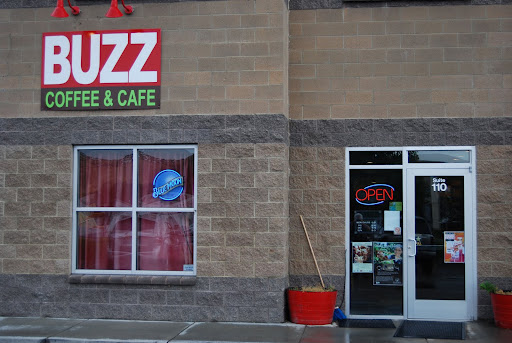
A super day! We started out by attending the parade in Boise. Then we ate some awesome food and finished off the night at the Buzz Coffee and Wine for a buffet, wine, beer and a fireworks show. Makes for a long day, but a fun day. Thank-You everyone who made this such a wonderful day and party for us, Marnie, Mac, Sophia, Chris and Margaret. Here’s our day in photos. The Frogs even are waving their flag! Enjoy!

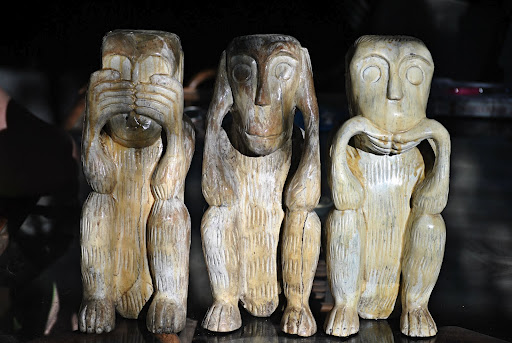
And then there is See No Evil, Hear No Evil and Speak No Evil!

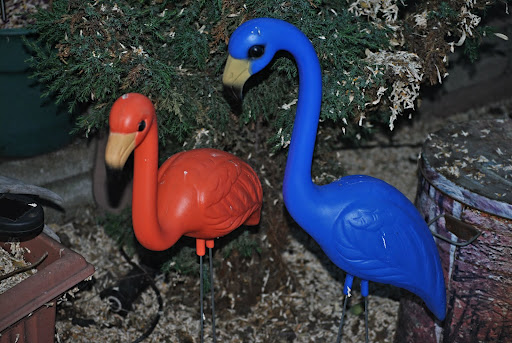
And the BSU Flamingos!

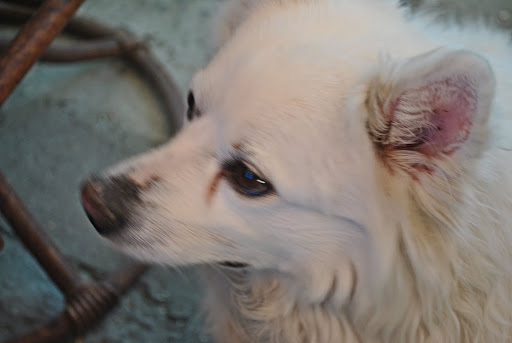
Buddy guards the ribs!

But before we can eat, we must watch the parade. It was a good parade, but I just wish that there would be more music – bands: the BSU Marching Thunder, Boise High Band and several other school bands in the area. I missed them.

Honorary Parade Grand Marshal, Sgt Bowe Bergdahl, Afganistan POW

Mayor Dave Bieter

The bagpipes. Such a joy!

Such dignity!

The drummers

Even the Hari Krishna’s were represented.

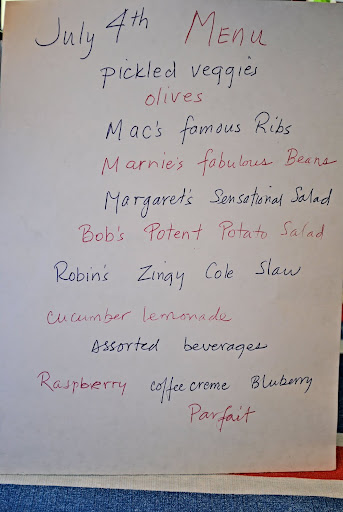
I rode my bike down to the parade and worked up a good appetite. Here is the menu! And below is the dinner. Yum-O!!

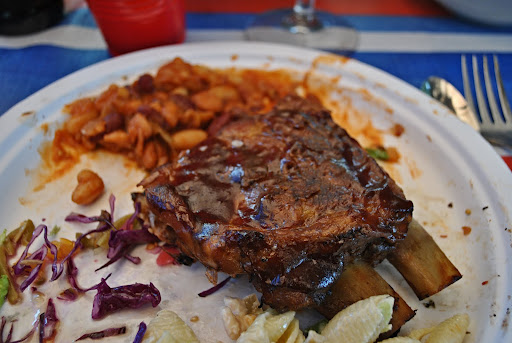
Mac’s Ribs and Bob’s Baked Beans, modified from a recipe that Marnie gave me.

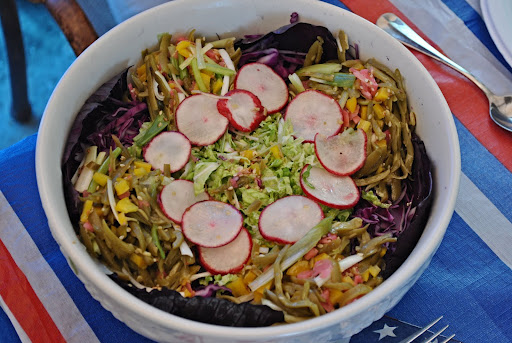
Robin’s Slaw

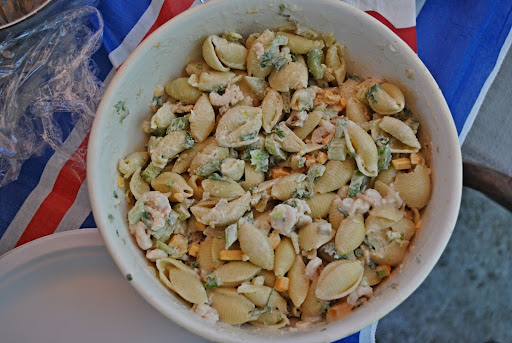
Margaret’s Shrimp and Pasta Salad

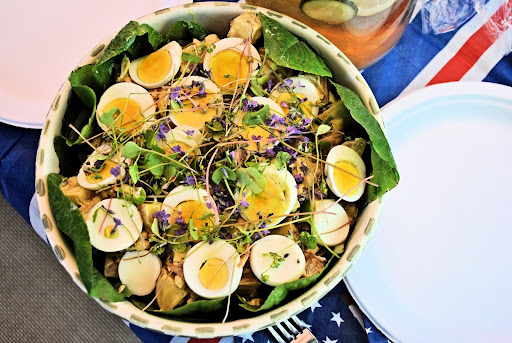
Bob’s Potato Salad
with
Miners Lettuce and Lavender Flowers

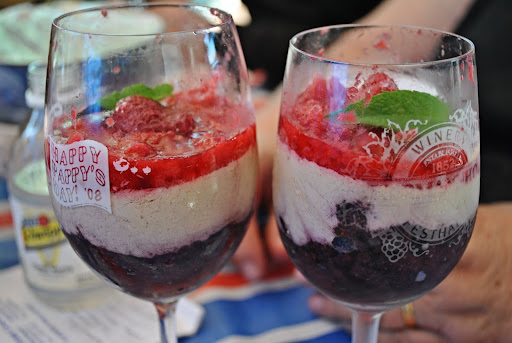
Robin’s Red, White and Blue Parfait

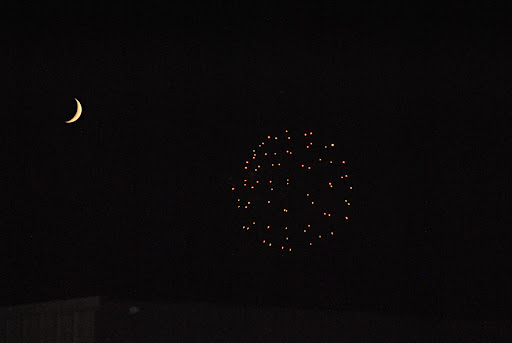
Then after dinner and watching the National July 4th Celebration from Washington, DC, we went to the Buzz Coffee and Wine for a buffet and to watch the fireworks here in Boise. A great buffet and great fireworks. Here are some photos of the show. Thanks Cristi and Tommy for opening the Buzz for this! Remember to Left-Click for a larger view. Love this Idaho sunset photo.

A long, but a great day. The company was great as was the food. And the weather could not have been any better, 94 degrees F, 34% humidity and winds 9 mph. Cheers!

Great Day At The Boise Saturday Market 02 July


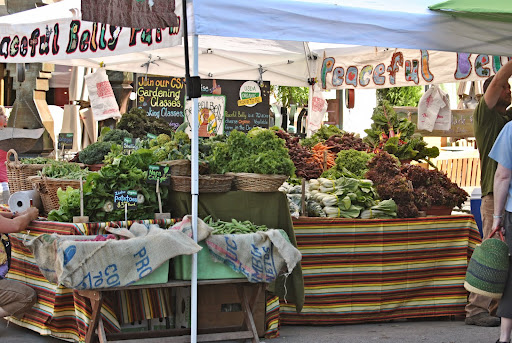
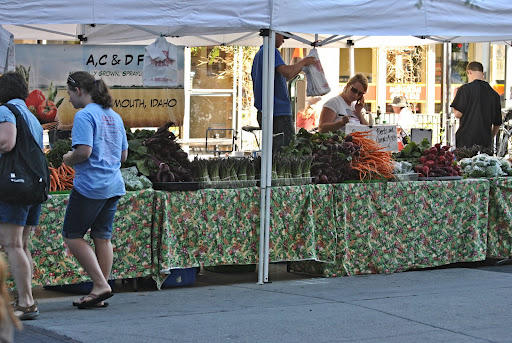
Great weather for the Boise Saturday Market! It looks like the crowds may finally be growing to keep up with the growing market. Great to see old friends, Dana, and others. Here are some photos I took. Cheers!

Here is one of the vegetable vendors. Great selections!

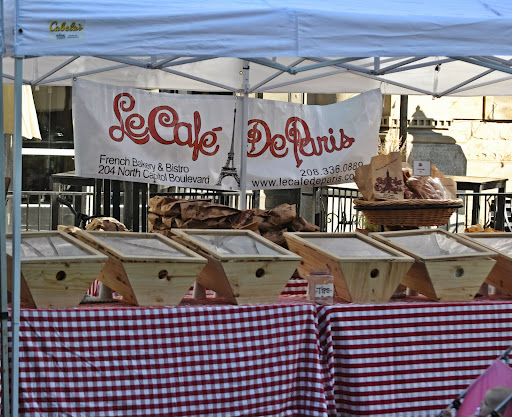
And the breads and croissants from Le Cafe de Paris. Yum-O!

And one of the other vegetable vendors.


But there is more than just vegetables. One can purchase lamb, buffalo, beef, pork, elk, doughnuts, Mexican food and wine. Many herb booths and still some plants left for the gardens. And there is one entire block – maybe two – devoted entirely to the arts. A great way to spend a Saturday morning! Think Local!

Ishtar Market and Restaurant and Grocery, Boise


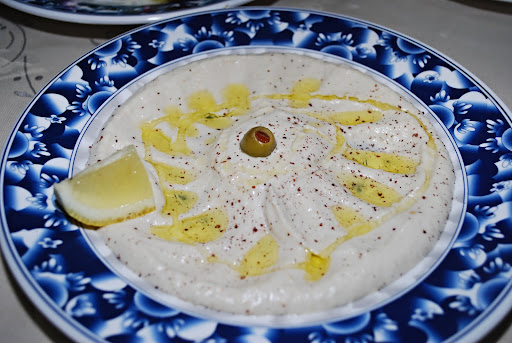
On Saturday June 25, we were honored to be invited to Patrick’s 83rd Birthday Party at Ishtar Market and Restaurant, a Middle East bakery and grocery, in Boise. Such a treat! Thank-You Barbara for inviting us. The company was great and the food was good. The only drawback was that the kabobs were a little dry. The flavors, however, hit the mark, especially the salads and humus. Look at these photos of some of the food we had. My Arabic is poor, so please don’t ask what the names of these dishes are. A real Middle East feast and party. Enjoy!

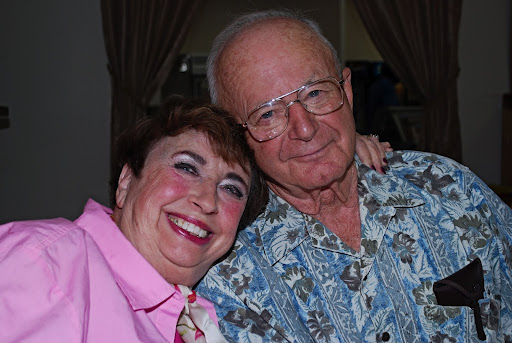
Barbara and Patrick. Happy Birthday, Patrick!

An awesome eggplant dish is in the front.

Humus

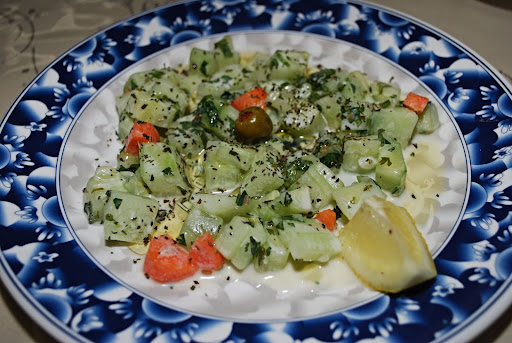
A great Cucumber Salad, a real Mediterranean salad – refreshing.

Stuffed Grape Leaves.

Here is another really awesome salad, called Fatoosh Salad and it is typically a Lebanese dish. (Thanks Michael Boss for the information.) I probably could have eaten just the salads and the humus with their own fresh baked breads. Yum-O!

This platter is called Ishtar and is a small sample of what they have to offer.

Really a great treat for dinner. I would recommend it to anyone who wants a good change for dinner tonight. It is interesting to see how the food types could generally be called Mediterranean in style, but the preparation and cooking is local to the Chef’s area, in this case, Baghdad. A fun time.

Quarterly Wine Dinner at the Buzz


On the evening of June 19th, Father’s Day, we went to the Quarterly Wine Dinner at the Buzz Bistro here in Boise! And it was a wonderful meal! Most of the recipes, I think, came from Debbie’s favorite cookbook, Cooking Light – Cooking Light Mix and Match. She said that this book is available either from Walmart or Costco for about $29.00. If the meal tonight was any indication, it might be a good book for your library of cook books. And then, Cristie and Debbie did an awesome job of matching the wines to the food presented. I found myself, which is good, rating the wines as to how they went with the meal. So the scores [20] may represent the wine/food relationship more than just how the wine was. One should always have food with wine, so this just may be one of my better scorings. At any rate, here are the photos of the meal and the wines we had with each course. Cheers!
Grilled Shrimp with Garlic

2009 La Joya Carmenere 14.5% alc, [17], $14.00
good with the shrimp and the thyme, chocolate and black cherry

2010 Jack Riesling 12.9% alc, [17], $14.00
pear on the nose and lemon, emphasizes the thyme

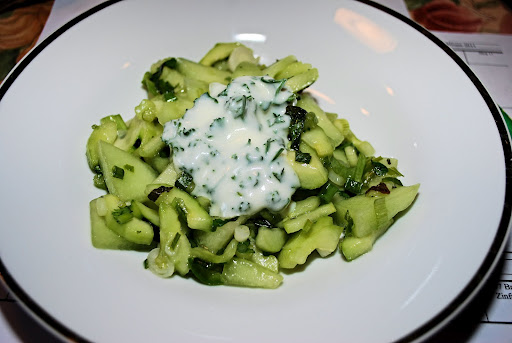
Cold Summer Soup
honeydew melon, cucumber, green onion, celery, Greek yogurt, parsley, vinegar, sugar, lemon juice

2010 Alamos Torrentes, 13.5% alc, [18], $13.00
great paring with the soup

2010 Jean-Luc Columbo Rose, 12.0% alc, [16], $14.00
did not have the same paring attributes as the Torrentes

Grilled Apple Salad

2009 Fat Bastard Shiraz 13.5% alc, [16], $13.00
salad overpowered the wine, deep red pepper and mint

2010 Apaltagnua Chardonnay (Chile) 14.0% alc, [18], $13.00
lemon on the nose, went well with the salad

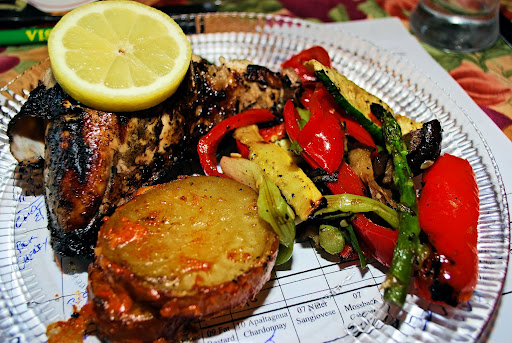
Tuscan Lemon Chicken
Grilled Potatoes
Spicy Tomato and Aioli Grilled Vegetables

2007 Niner Sangiovese, 14.9%alc, [17], $20.00
2007 Mossback Cabernet Sauvignon, 13.7% alc, [18], $22.00
Ninkasi Beer [18]
Nigera Medala [19]
The beers took the show with this chicken plate. An awesome entree!

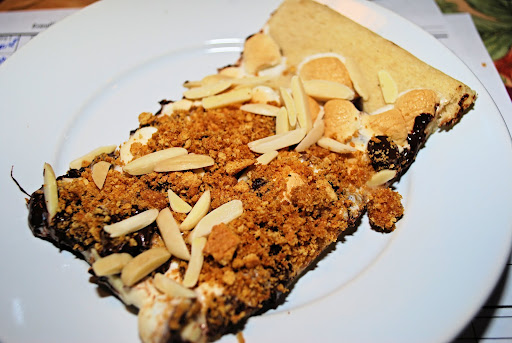
Guy Fieri’s S’mores Pizza

2007 Brazin Zinfandel (Old vine Lodi, CA) 15.0% alc, [17], $17.00
definitely a zin, big, bold and good with the chocolate

2009 Maritson Zinfandel (Dry Creek) 15.1% alc, [18], $26.00
absolutely superb with the chocolate

Interesting that Cristie added some beer varieties in with this Quarterly Dinner. And great choice. The beers, in my opinion, went so much better with the chicken and the vegetables than the wine did. A great party!

American and English Roast Beef Differences


A couple of days ago, an Italian friend asked what is the difference between American Roast Beef and English Roast Beef. Actually, in all that I have been able to find out, it seems to be the way the beef is cut up. Maybe the following will help. I hope so. Cheers! Various sources including, but not limited to: http://www.chacha.com, http://en.wiktionary.org, http://www.ehow.com

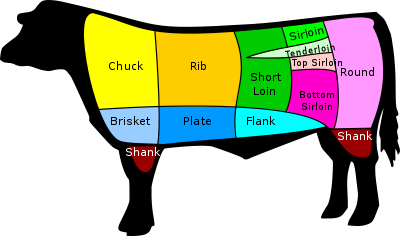
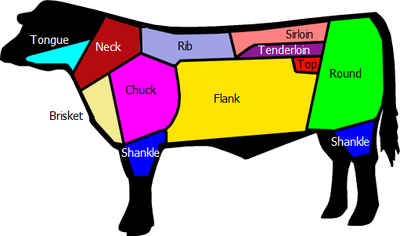
American primal cuts

American cuts of beef.
The following is a list of the American primal cuts. Beef carcasses are split along the axis of symmetry into “halves”, then across into front and back “quarters” (forequarters and hindquarters).
Forequarter cuts
The chuck is the source of bone-in chuck steaks and roasts (arm or blade), and boneless clod steaks and roasts, most commonly. The trimmings and some whole boneless chucks are ground for hamburgers.
The rib contains part of the short ribs, rib eye steaks, prime rib, and standing rib roasts.
The brisket is used for barbecue, corned beef and pastrami.
The foreshank or shank is used primarily for stews and soups; it is not usually served any other way due to it being the toughest of the cuts.
The plate is the other source of short ribs, used for pot roasting, and the outside skirt steak, which is used for fajitas. The remainder is usually ground, as it is typically a cheap, tough, and fatty meat.
Hindquarter cuts
The loin has two subprimals, or three if boneless:
the short loin, from which club, T-bone, and Porterhouse steaks are cut if bone-in, or strip steak (New York strip) and filet mignon if boneless,
the sirloin, which is less tender than short loin, but more flavorful, can be further divided into top sirloin and bottom sirloin (including tri-tip), and
the tenderloin, which is the most tender. It can be removed as a separate subprimal, and cut into fillets, tournedos or tenderloin steaks or roasts (such as for beef Wellington), or can be left on wedge or flat-bone sirloin and T-bone and Porterhouse loin steaks.
The round contains lean, moderately tough, lower fat (less marbling) cuts, which require moist cooking or lesser degrees of doneness. Some representative cuts are round steak, eye of round, top round and bottom round steaks and roasts.
The flank is used mostly for grinding, except for the long and flat flank steak, best known for use in London broil, and the inside skirt steak, also used for fajitas. Flank steaks were once one of the most affordable steaks, because they are substantially tougher than the more desirable loin and rib steaks. Many recipes for flank steak use marinades or moist cooking methods, such as braising, to improve the tenderness and flavor. This, in turn, increased the steaks’ popularity; when combined with natural leanness, increased prices have resulted.

UK primal cuts
Necks and clod
Chuck and blades
Silver loin
Rump
Silverside
Topside
Thick rib
Thin rib
Brisket
Shin
Flank
Thick flank
Leg

Dutch primal cuts
Neck
Rib
Sirloin
Tenderloin – Considered to be the premium cut, highly prized. It is called ‘ossenhaas’ in Dutch, meaning ‘oxen hare’, it tends to be slightly smaller than its American counterpart.
Top sirloin
Round – Mainly used for kogelbiefstuk (‘hip joint steak’) considered to be the basic form of steak in Dutch and Belgian cuisine.
Flank
Chuck – Best cuts are used for stoofvlees, lesser bits are used in hachee.
Brisket
Shankle


What is the difference between beef chuck roast and beef English roast?
The chuck section comes from the shoulder and neck of the beef, and it yields some of the most flavorful and economical cuts of meat. English cut is boneless cut located right behind the arm roast on the carcass.

I certainly hope this helps in your quest for some information on American and English – with a little Dutch thrown in for Good Luck! – Gian. It was fun searching for this information. Cheers!

——————————

I just heard from a piedi nudi sul divano, another food blogger, and he suggested I look at http://www.ricetteecooking.com, an Italian cooking site. The information and graphic used here is from that site. Here is the update.

Due to their composition and organoleptic characteristics, cuts cattle are sometimes divided into groups of first, second and third quality, and the classification based on the thickness of the muscles and the amount of fat and other connective tissue present:


QUALITY FIRST:
Fillet, Sirloin, topside, silverside, rump, Walnut, topside.


SECOND QUALITY:
Fesone shoulder, bobbin cover shoulder, shoulder or embryo pulp, coasts of the Cross, Royal Biancostato, Fish.


THIRD QUALITY:
Tip, brisket, neck (most ‘close to the head), Geretti, Coda.


1 Loin – 2 fillet – 3 Rump – 4 walker – 5 Topside external – 6 Walnut – 7 internal Topside – 8 fish – 9 Shank Back – 10 Chest – 11 Fesone shoulder – 12 Cover – 13 silverside shoulder – 14 real-Cutting – 15 underarm – 16 Front Shank – 17 chops – 18 Chest – 19 Neck.


Sirloin (or loin):
first class, and ‘cuts a more’ classic, tasty and fine, sirloin, and when the ‘whole T-bone overthrown and since the thread where it meets opposition, it has the classic Florentine steak, sirloin, and if’ boned, you can ‘bake in all the sauces (wine, mushrooms, onions, herbs), and’ the classic roast beef cooked the British and the Italians prefer, instead, to the blood.


Thread:
and ‘the most’ noble and valuable animal, which is below the chine, consisting of muscles, for their position, they work very little, and cut the flesh of this’ very tender and juicy; the front of the thread and ‘especially suitable for steaks, the central medallions, and the final fillet mignon and morsels; cattle can be obtained from the two threads from which you derive maximum 5-6 kg.meat.


Rump (or patch):
denomination of the first category, consisting of large muscle located near the hip, and ‘very high quality and suitable for the preparation of stews, casseroles and roast beef, the best parts are also suitable for making roasts and steaks.


Walker:
Cutting the second category, conical, is part of the semitendinosus muscle of the thigh, and ‘generally thin and very suitable for the preparation of roasts, could be confused with the thread, if well matured and cut, but it is distinguished by the less tender and juicy.


Topside external (or controgirello):
and ‘cut first-class, highly prized, especially suited to roasts, roast beef, stews, steaks and slices.


Walnut (or tracoscio):
and ‘cut first-class, very precious, oval-shaped, located at the hip, is suitable to be used for various cooking in a casserole (pot roast, stew, to cacciatore) and well done steaks and chops.


Topside internal (or rump):
and ‘cuts a more’ fine, first class, consisting of the large muscles of the upper thigh, thin enough, and slightly flattened in shape, the inner topside lends itself to various uses, from traditional steaks and chops to chops, if purchased whole, with the outer part is preparing the stew and the central part there are rare steak.


Fish (or bell):
and ‘a small cut of the second category, much appreciated, consisting of the muscles around the leg, he can do steaks with external parties, to be cooked on the grill, and lends itself to a lot of preparations like stews, pot roasts and stews, and all the cooking in a casserole with the addition of wine, tomato, vegetables, and also ‘a good piece to be eaten boiled.


Shank back (or flea):
Cut the third category, also known as muscle, and ‘the upper leg; anatomically and’ the organ of transmission of the animal, consisting of that group of muscles that, upon receipt of the pulse, they do move, and ‘ particularly suitable for the preparation of marrowbones stew and stews, pot roasts and boiled for soup, ’cause the other between a muscle and there is’ a light layer of connective tissue that makes this part attractive and tasty.


Belly (or trimming of loin):
and ‘a cut of the third category, very fat and furrowed with cartilage and requires some care in preparing cuisine, with the less valuable it can’ do to prepare ground beef meatballs, hamburgers, meat sauce ‘, and meatloaf.


Fesone shoulder:
in general, although falling in the second category of beef, it must be said that this cut has nothing to envy to the backs, once cleaned and cut width-wise, it lends itself perfectly to make steaks, cutlets, steaks, pizza and, when well beaten, even chops, trim parts can be ground to prepare meatballs, fillings, burgers and meat sauce ‘.


Cover (or shoulder meat):
and more ‘specifically
– Cover or Palotta shoulder: this cut front lends wonderfully to prepare and are well cooked goulash or stew;
– Muscle of the shoulder and ‘similar characteristics such as food, cutting previous nutritional value and’ the same as the corresponding backs, but the cost ‘significantly more’ low, and ‘suitable for the preparation of various stews.


Walker shoulder (or Sbordone):
Walkers shoulder meat you can ‘be confused with the parts of the walker leg, so much so’ similar in quality ‘, with this cut can be done steaks, roasts as well as’ boiled or overcooked.


Cutting real (or ribs):
cutting the second category, and ‘consists of the intercostal muscles and the latissimus dorsi; more’ specifically, and ‘derived from the muscles that cover the first five dorsal vertebrae.


Underarm (or fracosta):
and ‘cut second-class, very suitable for boiled.


Shank anterior (front or muscle):
and ‘cut a third category as rear, and’ consists of a bundle of thirteen groups of muscle fibers, commonly called osso buco.


Chops (or costs):
fall in second-class cuts, you can ‘use to prepare compounds of baked meat, wrapping the cut in an aluminum foil and placing it under fire.


Chest:
and more ‘specifically
– Brisket: second-class and cheap, and ‘the best cut to prepare the stew, can’ be used for roasts and they can ‘get a good broth;
– Staple: and ‘a cut made muscles crossed by abundant veins of fat, and’ particularly suitable for boiled.


Neck:
and ‘a cut of the third category, but its meat and’ tasty, and ‘consists of a large muscle mass divided into two parts: the upper one more’ lean and lower most ‘marbled with fat,’ not suitable for making steaks or cost, but is good for stews or boiled, and to prepare meatballs and sauce good ‘.

I think this has been an interesting sojourn. Thanks to Gian and others who have requested this information and who have helped to locate the information. Cheers!

June Wine Dinner at the Buzz


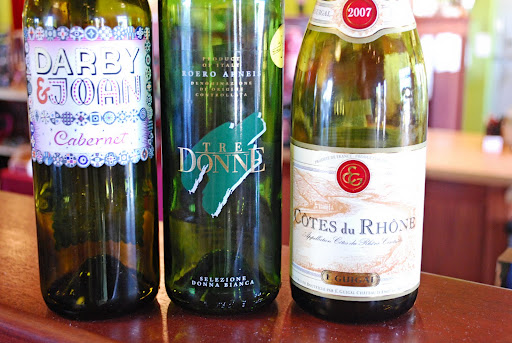
On June 14, 2011, the Buzz held another in their series of Wine Club Dinners. Like the others we have attended, this was such a delight and a wonderful dinner and the chance to taste some different wines. The parings were great. The scores I gave the wines [20] were pretty closely grouped together. The wines pictured here on the left are the three wines of Cristie’s Choice. But each of the wines was superbly matched to the entrees selected. Below are some photos of the entrees along with the wines that were presented.
If you don’t have anything specifically planned for Sunday, June 19 at 6:30pm , Father’s Day, the Buzz is holding their Quarterly Wine Dinner. This is another very exciting Wine Dinner presented by the Buzz and it is definitely a great time and wine dinner. Check for prices. Reservations are necessary!! Cheers! and maybe see you at the Quarterly Dinner? Hope so.

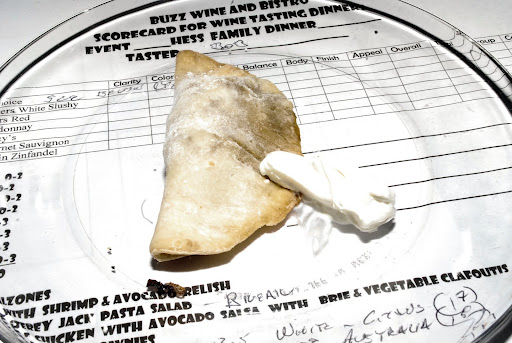
Tex Mex Calzone
2008 Lehman Layers Red 14.8% alc [15] $12.00

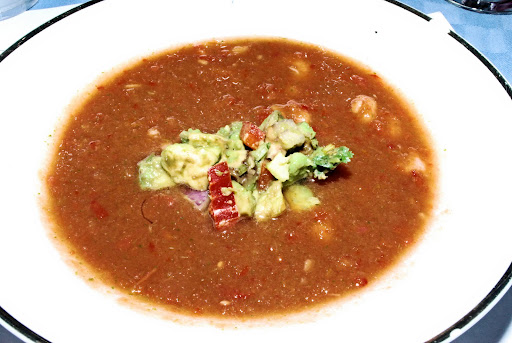
Gazpacho with Shrimp and Avocado Relish
(This was and awesome gazpacho that went extremely well with the wine.)

2009 Hess Chardonnay 13.4% alc [18] $12.00

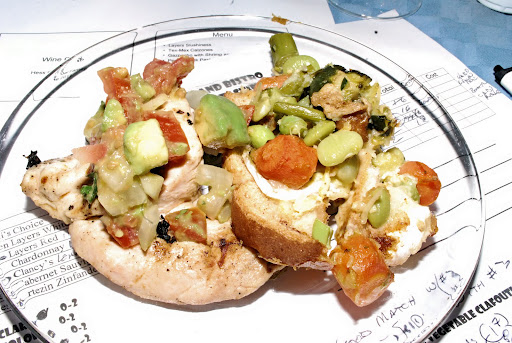
Cilantro Lime Chicken
Avocado Salsa
Brie and Vegetable Clafoutis
(A really superb main dish that went so well with the wine selection.)
2008 Hess Cabernet Sauvignon 13.5% alc [19] $12.00

Fudgy Mocha-Toffee Brownies
2009 Hess Artezin Zinfandel 14.5% alc [16] $16.00

I must apologize for missing one photo. We had a great Pepper-Jack Pasta Salad that was served with a 2008 Hess Lehman Clancy’s, 14.5% alc, [18] $12.00. The salad was wonderful and so was the wine. In the photo above, you will see Cristie’s Choice wines for the evening. These wines are presented in addition to the dinner wines.

  1. Côtes du Rhône, 13.5% alc, [17] $16.00
  2. Darby and Joan Cabernet Sauvignon 15% alc, [18], $12.00,
  3. House Jam 7% alc, [16], $12.00, sweet

So there you have have our rather exciting evening. Great to see friends Ed and Mary there and to have Margaret join us. Cheers and see you at the next event!

2011 Alley Gardens


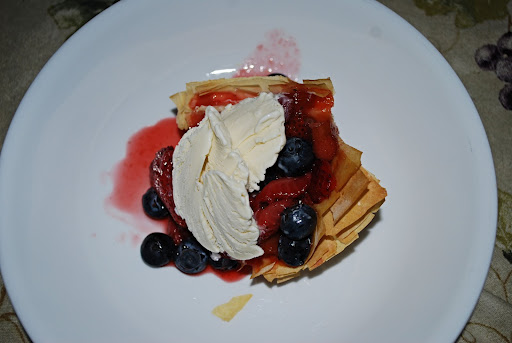
Wow! Time sure flies when you’re having so much fun! I didn’t realize that it has been 10 days since I posted anything here. A hospital visit will do that, I suppose. (Look at what Robin made for me during my recovery. Rhubarb and Strawberry Puff Pastry with Vanilla Ice Cream. I’m so lucky.)

And then, she also made this Strawberry Puffy Pastry with Pastry Cream. (That’s the Idaho State Flower on the dessert – Syringa.) So what does this to do with the Alley Gardens? Try growing strawberries and/or rhubarb in your garden. The following photos show, among other things, basic designs for your Alley Garden – you don’t really need an alley – and some of the produce you can grow in them. Enjoy and I hope this sparked your curiosity. Cheers!

Here is our Alley Garden.

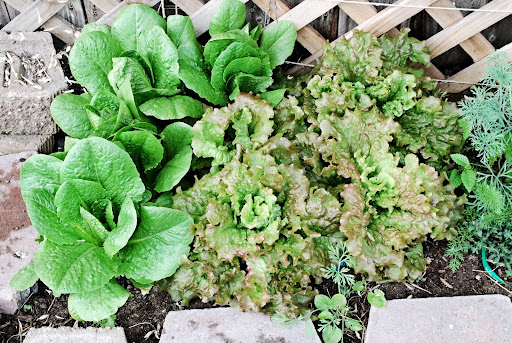
Lettuce in our garden.

And chives and flowers.

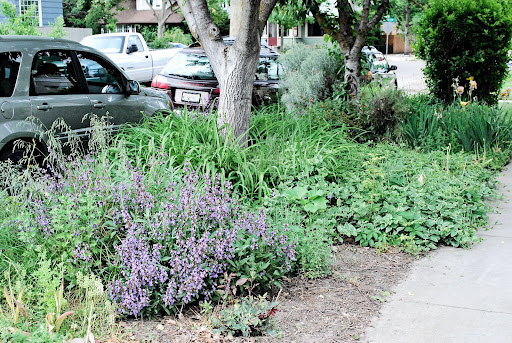
The front area between the sidewalk and the curb, is all herbs and it has been since 1986. Great color and herbs.

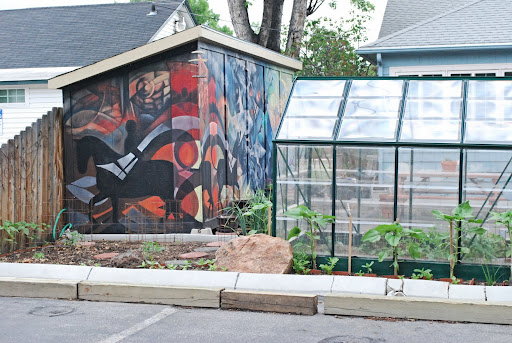
There is a Doctors office across the street and last year they installed the greenhouse. From what I understand, it was quite productive. Love the way they decorated the storage shed.

Our next door neighbor moved in last summer. This year they started a small, but productive, herb garden.

And other gardens in the area. Some are in the yards, and others are not. Use your imagination and keep the garden space an addition to your property.

These folks started theirs late last summer. This year they expanded and installed a watering system.

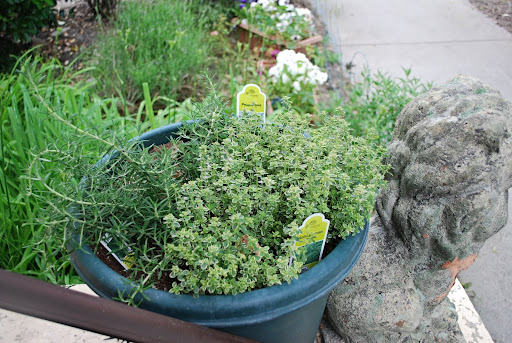
And if you don’t have the yard space. why not try “potted gardens”. This one has rosemary, mint and thyme in it.

I think that if you keep your design unique and not interfering with traffic flow, either car or pedestrian and keep it neat, the city will not “bug” you about the garden. Just have fun with these gardens and you will be surprised at how productive they can be. Enjoy!

Idaho Wine Dinner, Cottonwood Grille, Boise


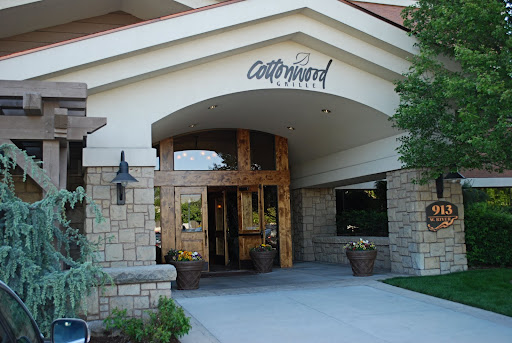
It never fails, we always have a wine dinner to go to here in Boise. And tonight, was no exception. A great location and super talent was displayed out of the kitchen of the Cottonwood Grille. And I must thank Dav Fairchild, Cottonwood Grille Manager, for taking some of these photos. The photo on the left is the entrance to the restaurant. The three, very talented Idaho wineries showcased tonight, were Vale Wine Co., Fraser Vineyards and Syringa Winery. Enjoy the photos. Left-Click any photo for a Full Screen view.

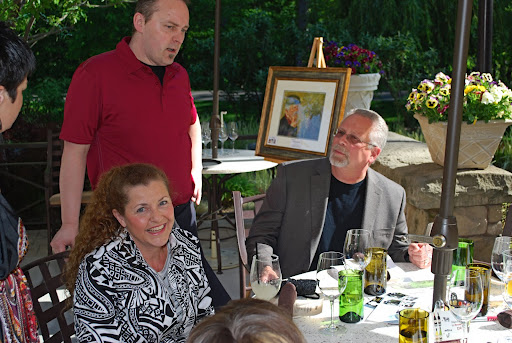
Sitting: Vicki Danielson and John Danielson – Winemaker Vale Wine Co.
Standing: Dav Fairchild – Manager Cottonwood Grille

Bev Fraser
Bill Fraser, Winemaker Fraser Vineyards

Bill Fraser, Fraser Vineyards
Mike Crowley, Winemaker/Owner Syringa Winery

Bev Fraser and daughter Shelley

Some of the crowd that were there.

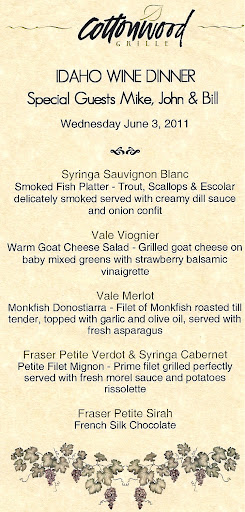
We, the people, Salute the Chefs for the following Menu. Salute!

The Menu

The Chefs. Great job!!!

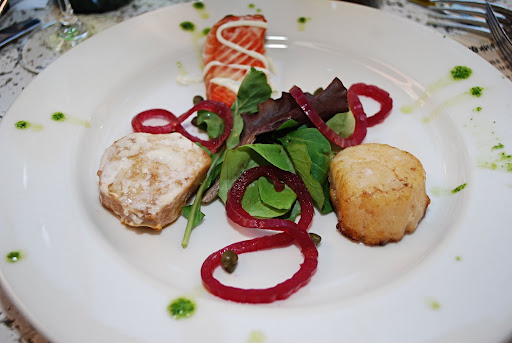
Smoked Fish Platter
Trout, Scallops and Escolar
delicately smoked and served with a creamy dill sauce, onion confit and watercress oil

2009 Syringa Sauvignon Blanc
great paring

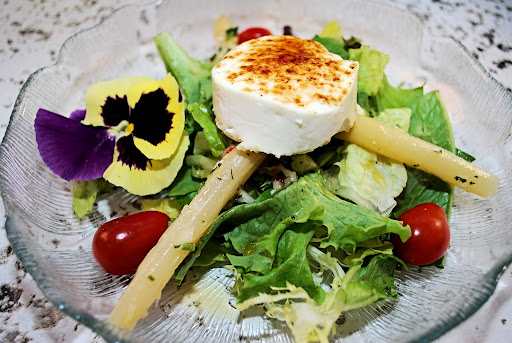
Warm Goat Cheese Salad
grilled goat cheese on mixed baby greens with strawberry balsamic vinaigrette

2010 Vale Viognier
superb paring

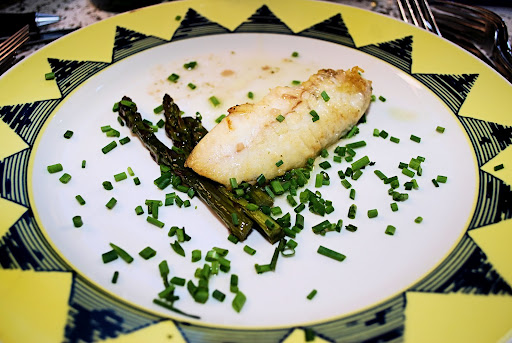
Monkfish Donostiarra
filet of monkfish roasted till tender, topped with garlic and olive oil
Fresh Asparagus

2008 Vale Merlot
big chocolate on the nose; super with the garlic and fish

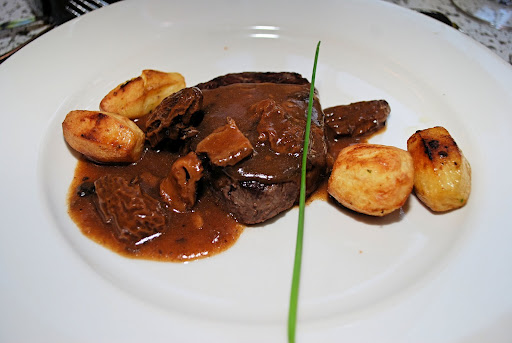
Petite Fillet Mignon
grilled perfectly and serve with fresh morel sauce
Potatoes Rissolette

2009 Fraser Petite Verdot
superb match but needs much time. lay this one down for 5+ years. 3% Cabernet Sauvignon

2007 Syringa Cabernet Sauvignon
young, still needs time, tannins, needs food

French Silk Chocolate

2009 Fraser Petite Sirah
huge, big, great paring

And as the sun sets in the West, and the delicious dinner settles, we stop and reflect on the awesome treats we have just devoured. The meal was superb and we salute the Chefs from the Cottonwood Grille on a job well done. The wine parings were also superb. All of these Idaho wineries have done an excellent job in producing superb wines. Cheers!

French Tapas At Le Café de Paris


A great night at Le Café de Paris in Boise at the French Tapas Night. It really was a celebration night and it was good to have Maize and Margaret and Susan with us. Mac – pictured to the left – did not make it to the party with us. But he did have some awesome Grilled Buffalo with Sauce Diane and Morel Mushrooms, Baked Potato with Fresh Chives and Sour Cream and Grilled Purple Asparagus Raft with Balsamic Vinegar. He didn’t go hungry! My only problem is that I did not take a photo of all of the tapas! What a dumb mistake. I’ll just have to go back to the next party or First Thursday Night at Le Café de Paris to make up for this monumental blunder. Such penance. (Mathieu – did you get the Huckleberry Jam and Perrine magnet that we left?) In the meantime, here are some photos that I did get. Enjoy!

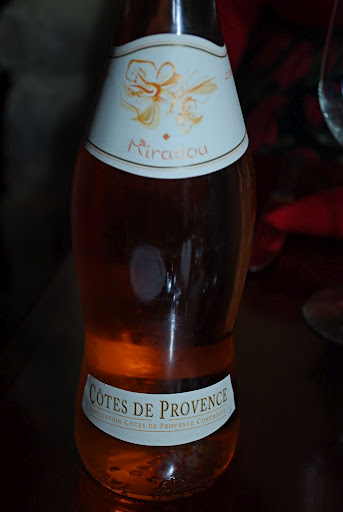
A Côtes du Provence Rosé that was excellent!

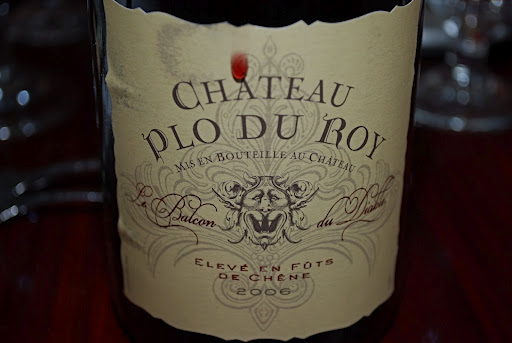
2006 Château Plo Du Roy that was superb with our tapas. A good blend of 70% Sirah and 30% Grenache. Everyone enjoyed it.

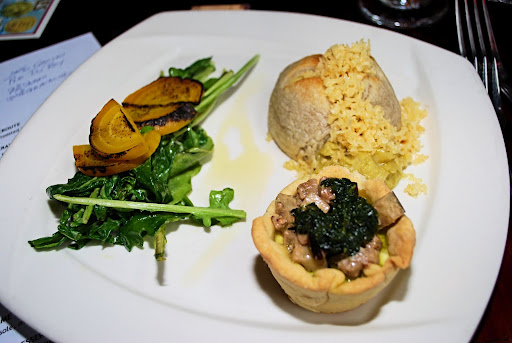
POMME de TERRE en CROUTE
potato puff pastry, melted leek puree, toasted truffle parmesan

SALADE de BETTERAVES
bruléed beets, seared arugula, mustard vinaigrette

BRAISES QUICHE NAVET
braised turnip, marinated eggplant, tarragon crème fraiche

ESCARGOTS au CHAMPAGNE
caramelized mushroom, garlic confit

CASSOULET de CANARD
elk sausage, pearl onions

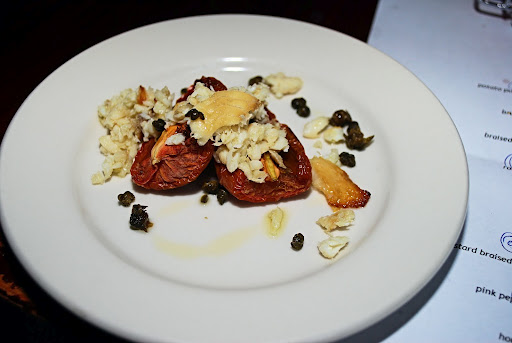
FUME MAISON UNIQUE
house smoked sole, oven-dried tomato fried capers

An awesome Muscat that was superb with the dessert.

DESSERT TAPA
TARTE TATIN de PECHE
house made chantilly

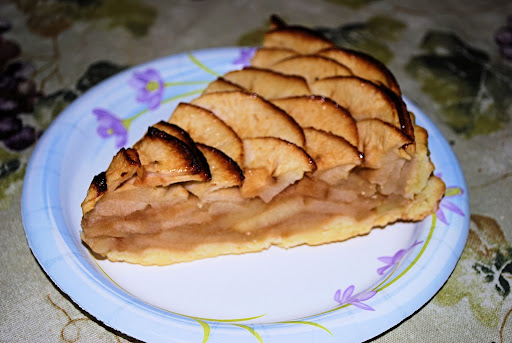
Pear Tarte
We are never allowed to leave without taking home some fresh made breakfast. In this case, a great breakfast pear dessert. No, not a chocolate croissant or something just as tempting. But nonetheless, just as good! Great with a fresh brewed El Pico coffee.