St Patrick’s Day is a little over a week away, 17 March. But you must be thinking of something to go with that Corned Beef. How about some Soda Bread. Here is some interesting information on Soda Bread. Information and recipe from European Cuisines.
Irish soda bread: a brief history
A little soda bread history
Irish baking over the centuries has been affected by two main factors. The first is our climate. The influence of the Gulf Stream prevents either great heat in the summer or cold in the winter. As a result, hard wheats, which need such heat and cold, don’t prosper. Those wheats make flour with a high gluten content that responds well to being raised with yeast. But soft wheats do grow well here.
The other factor has been the abundance of fuel. Ireland’s various medieval overlords could never exercise the tight control over forest land that landowners did in more populous, less wild areas, like England and mainland Europe. This meant that Irish people had less trouble getting their hands on firewood. Where there was no wood, there was almost always heather, and usually turf too. As a result, anyone with a hearthstone could bake at home whenever they wanted to, rather than needing to use a communal bake-oven to conserve fuel.
These two factors encouraged the Irish householder of the past two centuries to bypass yeast for everyday baking. The primary leavening agent became what’s now known here as bread soda — just plain bicarbonate of soda, to US and North American users. Hence the name soda bread. But for a long time, most bread in Ireland was soda bread: “bakery bread” was only available in big cities. Soda bread was made either in a pot or casserole over the fire, or else baked on a bakestone, an iron plate usually rested directly in/on the embers. From these two methods are descended the two main kinds of soda bread eaten in Ireland, both north and south, to the present day.
About soda bread varieties
Cake style brown soda bread: In Ireland, “plain” soda bread is as likely to be eaten as an accompaniment to a main meal (to soak up the gravy) as it’s likely to appear at breakfast. It comes in two main colors, brown and white, and two main types: cake and farl. People in the south of Ireland tend to make cake: people in Northern Ireland seem to like farl better — though both kinds appear in both North and South, sometimes under wildly differing names.
Cake is soda bread kneaded and shaped into a flattish round, then deeply cut with a cross on the top (to let the bread stretch and expand as it rises in the oven). This style of soda bread is normally baked in an oven.
These days we’d normally bake it on a baking sheet / cookie sheet. But in earlier times, before ovens were commonplace, cake was routinely made in deep, lidded iron casseroles, hanging over the open fire or sitting right in it — the casserole lids being concave to hold coals or burning turves from the fire on top, so that the bread would bake evenly in radiant heat from all sides.
The cake style of soda bread can of course be eaten hot. But it’s more usual to let the loaf cool down before eating it (it’s a little easier to handle then). It’s also a lot easier to slice, and that’s the way it’s normally seen in supermarkets and convenience stores country-wide, in both brown and white versions.
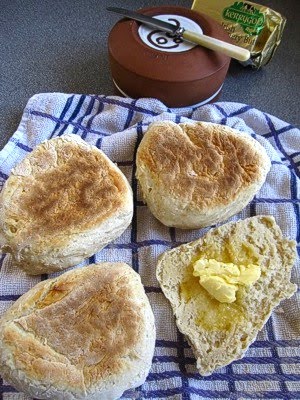
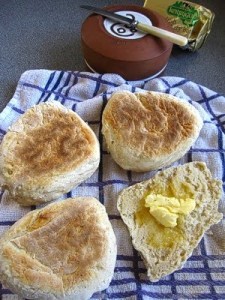 White soda farls: Farl is rather different. When making farls, the soda bread dough is rolled out into a rough circle and cut all the way through, crosswise, into four pieces or farls (“farl” is a generic term for any triangular piece of baking), and usually baked in a heavy frying pan or on a griddle, on top of the range or stove rather than in the oven. It’s a flatter bread than cake, and moister after the baking’s finished. Each farl is split in half “the wide way” before eating. It’s best when eaten hot off the griddle, but it’s also allowed to cool and then grilled or fried as part of other dishes, especially the famous Ulster Fry.
One important note: In the US and North America generally, there’s tendency to think of soda bread as something with fruit in it. This is not the case in Ireland. While people have for many years sometimes added fruit to the basic dough as a treat or for a change of pace, this is not usually referred to as soda bread, but as tea bread, fruit soda, tea cake, and by many other names. We have recipes for these below as well. But everyday soda bread in Ireland does not contain fruit.
——————————
Here’s the basic recipe for white soda bread. All these measures are approximate. The flour’s volume and liquid-absorptive capabilities, in particular, will vary depending on the local humidity.
Ingredients:
•450 g / 1 lb / 3 1/2 cups flour (either cake flour or all-purpose)
•1 teaspoon sugar (optional: you can absolutely omit this if you prefer sugar free soda bread)
•1 teaspoon salt
•1 teaspoon bicarbonate of soda
•Between 200-300 ml / 8-10 fluid ounces buttermilk, sour / soured milk, or plain (“sweet”) milk, to mix
Directions:
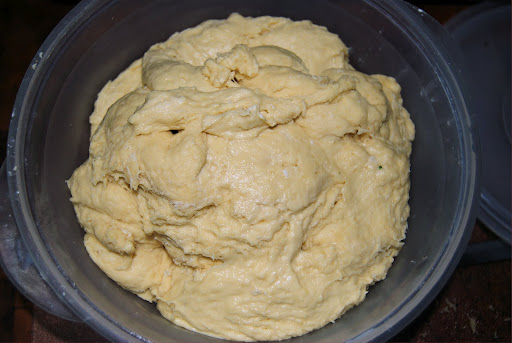
Sift the dry ingredients together at least once or twice to make sure the bicarbonate of soda is evenly distributed. Put the sifted dry ingredients in a good big bowl (you want stirring room) and make a well in the center. Pour about three-quarters of the buttermilk or sour milk or whatever in, and start stirring. You are trying to achieve a dough that is raggy and very soft, but the lumps and rags of it should look dryish and “floury”, while still being extremely squishy if you poke them. Add more liquid sparingly if you think you need it. (You may need more or less according to conditions: local humidity and temperature, the absorptiveness of the flour you’re using, etc.)
Blend quickly (but not too energetically!) until the whole mass of dough has become this raggy consistency. Then turn the contents of the bowl out immediately onto a lightly floured board or work surface, and start to knead.
The chief concern here is speed: the chemical reaction of the bicarb with the buttermilk started as soon as they met, and you want to get the bread into the oven while the reaction is still running on “high”. Don’t over knead! You do not want the traditional “smooth, elastic” ball of dough you would expect with a yeast bread. You simply want one that contains almost everything that went into the bowl, in one mostly cohesive lump. You should not spend more than half a minute or so kneading… the less time, the better. Fifteen seconds may well be enough, because you don’t want to develop the gluten in the flour at all. If you do, you’ll get a tough loaf. So don’t overdo it! Don’t be concerned if the dough is somewhat sticky: flour your hands, and the dough, and keep going as quickly as you can. There is a whole spectrum of “wetness” for soda bread dough in which it’s possible to produce perfectly good results: farl in particular sometimes rises better if the dough is initially wet enough to be actively sticky. You may have to experiment a few times to come to recognize the right texture of dough.
Put the cake’s baking sheet into the preheated oven. Handle it lightly and don’t jar it: the CO2 bubbles in the dough are vulnerable at this point of the process.
Let the bread alone, and don’t peek at it! It should bake for 45 minutes at 400-450° F. (One of our Irish neighbors suggests you give it the first 10 minutes at 450°, then decrease to 400°. Also, if you have a fan oven, use temperatures 10° lower or so, as fan ovens have a tendency to run hot.) At the end of 45 minutes, pick up the loaf and tap the bottom. A hollow-ish sound means it’s done. For a very crunchy crust, put on a rack to cool. For a softer crust, as above, wrap the cake in a clean dishcloth as soon as it comes out of the oven.
——————————
Irresistible Irish Soda Bread
By: Karin Christian
“A very easy, very good tasting bread. Best if made the day before, or several hours before serving.”
Original Recipe Yield 1 – 9×5 inch loaf
Ingredients:
• 3 cups all-purpose flour
• 1 tablespoon baking powder
• 1/3 cup white sugar
• 1 teaspoon salt
• 1 teaspoon baking soda
• 1 egg, lightly beaten
• 2 cups buttermilk
• 1/4 cup butter, melted
Directions:
1. Preheat oven to 325 degrees F (165 degrees C). Grease a 9×5 inch loaf pan.
2. Combine flour, baking powder, sugar, salt and baking soda. Blend egg and buttermilk together, and add all at once to the flour mixture. Mix just until moistened. Stir in butter. Pour into prepared pan.
3. Bake for 65 to 70 minutes, or until a toothpick inserted in the bread comes out clean. Cool on a wire rack. Wrap in foil for several hours, or overnight, for best flavor.
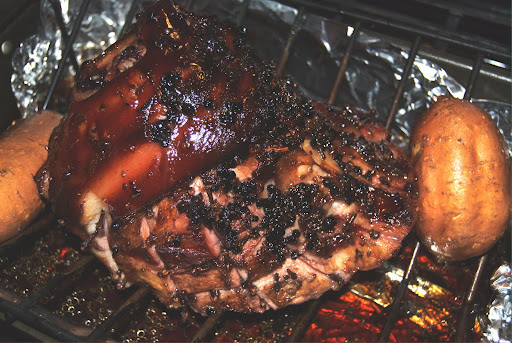 Easter is still a week away, but when you change your “traditional” dinner from lamb to say ….. well, ham, you have to make a trial run. And too, you have to have some idea of how you are going to prepare it. We decided not to go again, the “traditional” way of pineapple. Instead, we are going to use Elderberry Sauce for the coating and blending with it, clove. And about 2 pints or so of water in the pan to collect those drippings. Save those drippings. And bake with the ham some Sweet Potato or Yam. The photo here is after 1 hour at 375 degrees F. Time to re-bast with the elderberry. Don’t be afraid to let it drip into the water, which is now full of ham juice. Don’t let
 this liquid dry up. It’ll make an awesome reduced sauce. After about 2 hours at 375 degrees F, the ham should be done. Remove it from the oven and let cool for about 20 minutes. Bast one more time while still hot. Let the elderberry sauce drip into the pan. Chill the pan drippings and skim off the fat. Make a roux and remove from the pan and set aside. Pour the drippings into the pan. Reduce by about 1/2. Add the roux and thicken. Plate the meal with sauteed asparagus and the potato. You can either slice the potatoes or gently “mash” them, leaving some chunks. Place some of the Ham Elderberry Reduction on the potatoes and ham. Serve with a 2008 Tualatin Estate Frizzante Muscat or a good Asti. Cheers!









 Boise Foodie Guild