• About and Contact
  • Air Fryer Cooking Charts and Conversions
  • Air Fryer Recipes – Update: August 2020 – Chicken Olivia
  • Barcode Country List
  • Boise Foodie Blog Recipes – Updates: Nov 2024 Basic Hollandaise Sauce and Cream of Mushroom Soup
  • Boise Restaurant Guide – 52 Restaurant Choices! Updated: July 2018
  • Companion Garden Planting
  • Instant Pot Recipes – Update August 2020 – IP Chicken with Ketchup, Honey and Soy
  • Recipes from the Captain’s Shack: Dec 2020 – CS Prime Rib

Boise Foodie Guild

~ – Enjoy a meal or a recipe with us! Be sure to check the Sidebar and Menu above. Interesting resources are listed there. Most are hot links. Air Fryer (AF), Instant Pot (IP) and Captain's Shack (CS) recipes now have their own page. Subscribe to the blog. It's still FREE!

Boise Foodie Guild

Category Archives: Interesting Information

la porte brune

12 Saturday Dec 2009

Posted by Bob and Robin in Classics, Interesting Information, Things To Do, Wine and Food, Wine Dinners

≈ Leave a comment


Guess what? Andrae is back in business!! No, not in Boise, but in Walla Walla. Look at this –

La Porte Brune, has come forth from passion, not from obsession. In a day when the culinary unenlightened are herding to troughs of food at chains and uninspired local restaurants in a fervor for quantity over quality, La Porte Brune wants to reset the “American Way” by bringing the art of dining back to the culinary enlightened.

In a world of frozen, pre-cooked, pre-portioned and an“ I don’t care where my meal comes from as long as it is big and cheap”, we intend to slow it down a little. Food truly “farm to table”, simple in approach, refined in flavor and with every plate prepared with a passion for the ingredient rather then the almighty dollar.

If this is describes your perfect meal well then, you have stepped through the right door.

These meals will be presented in a tasting format, with us suggesting the wine pairing and you bringing your favorite bottle. They will move from location to location, never stopping at the same place twice. You will sit at communal tables and share your experiences with friends and strangers alike, all coming together over the perfect union of food and wine.

Those brave souls on the list will receive an e-mail detailing the night’s events. You will be given the address a few nights prior to the event, not before. Prepayment in cash when you arrive is required with a cash tip left on the table for the staff. No bill will be presented.

so, what do you think? tell us your thoughts, suggestions, concerns. whatever you would like to share about the ethos of la porte brune, we want to hear. leave your comments below. thanks!

Saturday, January 23, 2010 at 6:30pm at a soon to be disclosed location La Porte Brune’s 1st underground dinner will happen. It will be a 5 course dinner all paired with wines of the world. 20 seats available for the first dinner and they will be first come first served. The menu will be posted in the next few weeks with the wine pairings. After payment is confirmed you will be notified the day before as to the location in Walla Walla. Tell your friends and be one of the first to come through the door of culinary enlightenment!

The prices are (hold on!):
1 person – $85.00
2 people – $170.00
3 people – $255.00
4 people – $340.00
5 people – $425.00
6 people – $510.00
Knowing Chef Andrae Bopp, this will be an unforgettable meal!! Worth every succulent dollar! or bite! And just think … You bring your own bottle of wine to share with everyone! What fun! Great for a 70th birthday. Yea – Right! Cheers!!

Reblog:

  • Click to email a link to a friend (Opens in new window) Email
  • Click to share on Pinterest (Opens in new window) Pinterest
  • Click to share on Facebook (Opens in new window) Facebook
  • Click to print (Opens in new window) Print
  • More
  • Click to share on X (Opens in new window) X
  • Click to share on Instagram (Opens in new window) Instagram
Like Loading...

Making Vinegar

06 Sunday Dec 2009

Posted by Bob and Robin in Food, Food Prep, Interesting Information, Recipe: Bob and Robin Young, Recipes, Vinegars

≈ 1 Comment


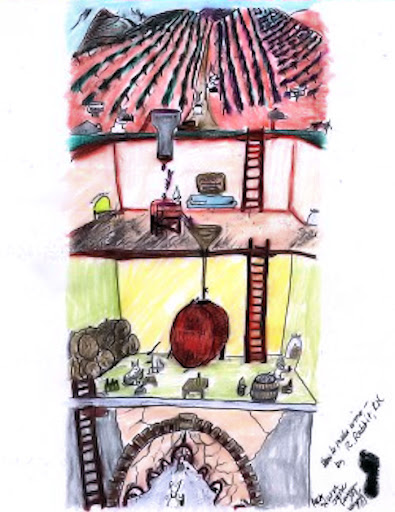
(C) Robin YoungThe graphic at the right is one that Robin did several years ago. “Rabbits Making Wine“, (C) 1988. The original used to hang at the now non-existent BB Strand, 4th and Bannock, Boise, and the artwork is now in the possession of Chef John Mortimer.

I have had some questions on how to make vinegar. And in particular, wine vinegar. We have a jug of red wine vinegar going that has been around for several years. We are now making some white wine vinegar that will be tarragon infused. Remember one thing: After you decide what you want to make, you have several decisions on how to get there. Do I want white vinegar? Or red? Infused with some herb? Or plain? Here’s some help.

White Wine or Red Wine Vinegar or Sherry Vinegar
The “formula” for making a Mother Starter is:

1). 1 cup Apple Cider Vinegar,
Unpasteurized (Not Cooked) and Unfiltered. That is the important thing – Unpasteurized and Unfiltered! I am using “Spectrum” Organic and I probably got it at the COOP. “Three Monks” is another good brand if you can find the unpasteurized.

2). 1 cup White Wine, for White Wine Vinegar, or Red Wine, for Red Wine Vinegar or Sherry for Sherry Vinegar.
Put a stopper of some sort in the top, but not tight – you want some air to get in, but not dust. Put it somewhere, it doesn’t have to be dark. Let set and forget it for two or three weeks. Try it and see if it is what you are looking for. If not, let it go longer. (Mine has been going for 5 weeks now.) When it is ready, find a 1 gallon jug, it can be plastic or glass, and pour the starter in. Add 750 ml wine. Let sit. Try it. Keep adding your “left-over” wine to it and it should go for quite a while – years.

You can use the 1 gallon of vinegar at any time. But, try to get the jug full. The longer it “cures” the sweeter it will be and the more mellow it will become. It’s trial and error now. But this will at least get you started. And think about this. If you want a Balsamic Style Vinegar, get a small, 1 gallon or so, oak wine barrel. Place your vinegar in the barrel and set it aside for several years. That’s all there is to it!

Use any wine you want. Try to keep the jug either all red or all white. Start two jugs if you have to. However, it can be mixed too. That is red and white wine together. I have 2 jugs going. The Red is a blend of any wine we had left over and has been going for years. The white is only white and I hope to keep it that way.

Try using left-over Sherry to make your vinegar, especially if you use a lot of Sherry in cooking, or you eat a lot of Turtle Soup. (My Dad used to order Turtle Soup, drink the Sherry. Tell the Waitress that he did not get any Sherry. She would bring him another. He would drink this one ….Do you see where this is going?) Commerical Sherry Vinegar tends to be extremely salty. Making your own, you can control this.

——————————

Cheers and enjoy making your vinegar!!!

Reblog:

  • Click to email a link to a friend (Opens in new window) Email
  • Click to share on Pinterest (Opens in new window) Pinterest
  • Click to share on Facebook (Opens in new window) Facebook
  • Click to print (Opens in new window) Print
  • More
  • Click to share on X (Opens in new window) X
  • Click to share on Instagram (Opens in new window) Instagram
Like Loading...

The White House Dinner Party

29 Sunday Nov 2009

Posted by Bob and Robin in Food, Food Trivia, Holiday Menu, Interesting Information, Party Time, Thought For The Day

≈ Leave a comment


Here is what they had. How ’bout you?

Potato and Eggplant Salad
White House Arugula with Onion Seed Vinaigrette
2008 Sauvignon Blanc, Modus Operandi, Napa Valley, California

Red Lentil Soup with Fresh Cheese
2006 Riesling Brooks ³Ara² Willamette Valley, Oregon

Roasted Potato Dumplings with Tomato Chutney
Chick Peas and Okra
or

Green Curry Prawns
Caramelized Salsify with Smoked Collard Greens and Coconut Aged Basmati
2007 Grenache, Beckmen Vineyards, Santa Ynez, California

Pumpkin Pie Tart
Pear Tatin
Whipped Cream and Caramel Sauce
Sparkling Chardonnay, Thibaut Janisson Brut, Monticello, Virginia

Petits Fours and Coffee
Cashew Brittle
Pecan Pralines
Passion Fruit and Vanilla Gelees
Chocolate-Dipped Fruit

OK. So what’s in your bowl, to coin a phrase? Cheers!

Reblog:

  • Click to email a link to a friend (Opens in new window) Email
  • Click to share on Pinterest (Opens in new window) Pinterest
  • Click to share on Facebook (Opens in new window) Facebook
  • Click to print (Opens in new window) Print
  • More
  • Click to share on X (Opens in new window) X
  • Click to share on Instagram (Opens in new window) Instagram
Like Loading...

36th Street Bistro (Boise)

18 Wednesday Nov 2009

Posted by Bob and Robin in Food, Interesting Information, Main Dish, Restaurants, Things To Do, Wine and Food

≈ Leave a comment


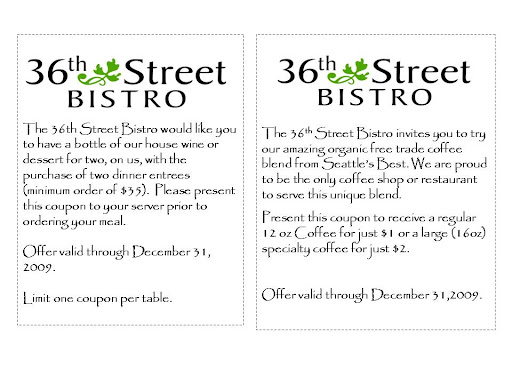
The last time Robin and I were here, it was a pretty good meal. We really need to go back. But if you are interested, Left-Click the coupons below and print them out. Take them with you and use them for coffee and/or a bottle of their house wine or a dessert for two! Can’t beat that!

Left-Click any of these graphics and print them out. Cheers and have a good meal! See their web site at 36th Street Garden Center and Bistro and check out their Fall Menu (PDF format).

Reblog:

  • Click to email a link to a friend (Opens in new window) Email
  • Click to share on Pinterest (Opens in new window) Pinterest
  • Click to share on Facebook (Opens in new window) Facebook
  • Click to print (Opens in new window) Print
  • More
  • Click to share on X (Opens in new window) X
  • Click to share on Instagram (Opens in new window) Instagram
Like Loading...

Roasted Turkey in 70 Minutes

16 Monday Nov 2009

Posted by Bob and Robin in Food, Interesting Information, Local Farmers Markets, Recipes, Things To Do

≈ Leave a comment


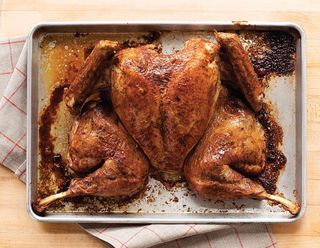
Actually, yes you can!! Robin and I made one of these turkeys yesterday, as a preliminary trial for Thanksgiving, coming up soon. The style of cooking is called spatchcocked. “Really, “spatchcocking” is just a fancy term for cooking a whole turkey or chicken by removing the backbone and splaying the bird out flat.
Spatchcocked Turkey

Spatchcocked Turkey

And it’s that simple. Really! Just cut along the both sides of the turkey’s backbone to remove it (use sturdy kitchen scissors). Flip the bird over and flatten it by breaking the breast bone. Brush the bird with olive oil, salt and pepper…Just 70 minutes later (you’ll want to baste it halfway through), you’ll have a perfectly cooked bird.

There are actually a few additional benefits to spatchcocking, in addition to the quick cooking time

–Space. Flattening the turkey out like this makes a lot more room in your crowded Thanksgiving Day oven.
–Carving. With the backbone out of the way, it’s much, much simpler to carve the bird when it’s time to serve it.
–Taste. We actually thought the meat turned out better tasting and more moist than with a traditional roast turkey. And the skin crisped up to golden perfection.” (http://thebittenword.typepad.com)

Roasted Turkey in 70 Minutes

Serves: 8 – 10
Ingredients: (Oil Mixture)
2 T Extra-Virgin Olive Oil
1 T coarse Salt
1 t freshly ground Pepper
1 whole fresh turkey (about 12+ pounds)
Our Suggestion: Add your favorite spices to this mixture: Sage, Thyme, Rosemary, etc.

Directions:
1. Preheat oven to 450°F. Stir together oil, salt, and pepper in a small bowl.
2. Rinse inside and outside of turkey; pat dry with paper towels. Spatchcock turkey*. Transfer to a rimmed baking sheet, breast side up. Let stand for 30 minutes.
3. Brush or rub turkey all over with oil mixture. Roast, rotating sheet halfway through and basting twice, until an instant-read thermometer inserted
into the thickest part of the thigh reaches 165°, about 1 hour and 10 minutes. Let stand for 20 minutes before carving.

*Spatchcocking: (See photo above)
1. Cut out the backbone. Start with the turkey breast side down. Use poultry shears to cut along both sides of the backbone, beginning at the tail end. If you hit a tough spot, try cutting with just the tip of the shears.

2. Open the turkey. Set aside backbone (and giblets) for stock. Take hold of both newly cut edges, and open the turkey. Remove any large pieces of fat. Turn the turkey, breast side up.

3. Break the breastbone. Place your hand on one side of the breast, close to the breastbone, and push down firmly until you hear a crack. Repeat on the other side. (For better leverage as you work, stand on a step stool.)

4. Flatten the turkey. Pull the thighs outward so the turkey lies flat, with the wings facing inward. Tuck the wing tips under to secure.

5. Brush with oil. Place the turkey on a rimmed baking sheet. Let stand for 30 minutes. Use a basting brush to apply oil mixture.

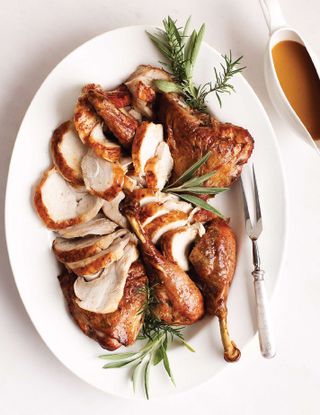
How To Carve:
A spatchcocked turkey requires a slightly different carving technique than a bird cooked the traditional way, but the basic approach remains
the same: Remove the legs and wings, and then slice the breast meat.

1. Cut legs from breast. With a sharp chef’s knife, remove each leg by cutting through the turkey where the thigh connects to the breast.

2. Separate drumsticks and thighs. At the joint of each leg, cut drumstick from thigh. Transfer thighs and drumsticks to a warm platter. Tent with foil.

3. Cut wings and breast. On one side, find the joint connecting wing and breast, and cut through it (not shown). Repeat to cut off other wing. Cut breast meat into two pieces, slicing along either side of breastbone.

4. Slice breast meat. Slice the breast meat across the grain. Arrange on the platter with the dark meat, and add the wings.

——————————

The photos are from Martha Stewart Living and the article came from The Bitten Word. This goes great with a 2008 Bedrock Wine Co. Cuvee Caritas White Wine, Sonoma County (55% 100 year old Semillon from Monte Rosso and 45% Sauvignon Blanc from Kick Ranch Vineyard) and a super gravy made from Madeira. (The gravy recipe can be found on this blog)

We found this turkey to be extremely moist and succulent. And the interesting thing is that it really is easy to do and very fast cooking. It has a wonderful flavor and moistness eaten cold in sandwiches or for “nibbling”. The skin is crusty and wonderful. That’s it. Cheers!

Reblog:

  • Click to email a link to a friend (Opens in new window) Email
  • Click to share on Pinterest (Opens in new window) Pinterest
  • Click to share on Facebook (Opens in new window) Facebook
  • Click to print (Opens in new window) Print
  • More
  • Click to share on X (Opens in new window) X
  • Click to share on Instagram (Opens in new window) Instagram
Like Loading...

Worcestershire Sauce

01 Sunday Nov 2009

Posted by Bob and Robin in Condiments, Food, Food Trivia, Herbs, Interesting Information, Things To Do

≈ 1 Comment


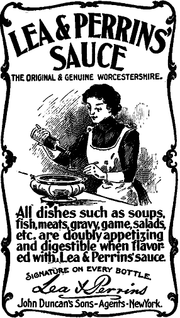
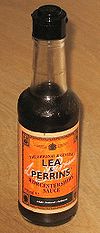
Looks like it might have been a slow day in Boise. Not really! They were having a big debate on the Food Network today on the origin and uses of Worcestershire Sauce. Here, from Wikipedia, is some information. Some of this is not cited and may need citation.

Worcestershire Sauce

From Wikipedia,
Worcestershire sauce (pronounced WOOS-tər-sheer saws), is a fermented liquid condiment used for flavouring many cooked and uncooked dishes, especially with grilled or barbecued meats. It is also used as an ingredient in the preparation of cocktails and drinks.

First made at 68 Broad Street, Worcester, England, by two dispensing chemists, John Wheeley Lea and William Henry Perrins, the Lea & Perrins brand was commercialised in 1837 and has been produced in the current Midlands Road factory in Worcester since 16 October 1897. In 1930 the business was sold to HP Foods and was subsequently acquired by the Groupe Danone. It was purchased by H.J. Heinz Company in 2005 who continue to manufacture and market “The Original Lea & Perrins Worcestershire Sauce”, under the name Lea & Perrins, Inc. Other companies manufacture similar products, often also called Worcester Sauce, and marketed under different brands.

Origins
A fermented fish sauce called garum was a staple of Greco-Roman cuisine and of the Mediterranean economy of the Roman Empire, and the use of some similar fermented anchovy sauces in Europe can be traced back to the 17th century. The Worcestershire variety became popular in the 1840s and is one of the many legacies of the British rule of the Indian sub continent. Several disputed theories exist concerning its exact discovery or invention by John Lea and William Perrins.

History
A widely reported legend has it that “Lord Marcus Sandys, ex-Governor of Bengal” (a figure unknown to history outside this tale) encountered it while in India under the Honourable East India Company in the 1830s, missed it on his return and commissioned the local apothecaries to recreate it. However, author Brian Keogh concluded in his privately published history of the Lea & Perrins firm on the 100th anniversary of the Midland Road plant, that “No Lord Sandys was ever governor of Bengal, or as far as any records show, ever in India.”

The Lord in question, whose identity was being discreetly veiled by Messrs Lea and Perrins (who used to aver on the bottle’s paper wrapping that the sauce came “from the recipe of a nobleman in the county”) was Arthur Moyses William Sandys, 2nd Baron Sandys (1792–1860) of Ombersley Court, Worcestershire, Lieutenant-General and politician, a member of the House of Commons at the time of the legend, whose given name is being confused in the tale with that of his brother and heir, Arthur Marcus Cecil Sandys, 3rd Baron Sandys (1798–1863), who did not succeed to the title, however, until 1860, when the sauce was already established on the British market. The barony in the Sandys family (pronounced “sands”) had been revived in 1802 for the second baron’s mother, Mary Sandys Hill, so at the date of the legend, in the 1830s, “Lord” Sandys was actually a Lady. No identifiable reference to her could possibly appear on a commercially bottled sauce without a serious breach of decorum. It is likely her heir agreed to sell the recipe.

A more accurate version that was published by Thomas Smith: We quote the following history of the well-known Worcester Sauce, as given in the World. The label shows it is prepared “from the recipe of a nobleman in the county.” The nobleman may be Lord Sandys. Many years ago, Mrs. Grey, author of The Gambler’s Wife and other novels, was on a visit at Ombersley Court, when Lady Sandys chanced to remark that she wished she could get some very good curry powder, which elicited from Mrs. Grey that she had in her desk an excellent recipe, which her uncle, Sir Charles, Chief Justice of India, had brought thence, and given her. Lady Sandys said that there were some clever chemists in Worcester, who perhaps might be able to make up the powder. Messrs. Lea and Perrins looked at the recipe, doubted if they could procure all the ingredients, but said they would do their best, and in due time forwarded a packet of the powder. Subsequently the happy thought struck someone in the business that the powder might, in solution, make a good sauce. The profits now amount to thousands of pounds a year.

Upon completing the necessary steps, however, the resulting product was found to be so strong that it was considered inedible, and a barrel of the sauce was exiled to the basement of Lea & Perrins’ premises. Looking to make space in the storage area a few years later, the chemists decided to try it once again, only to discover that the sauce had fermented and mellowed and was now quite palatable. In 1838 the first bottles of “Lea & Perrins Worcestershire Sauce” were released to the general public.

An alternative story was published by historian and Herald for Wales, Major Francis Jones, 1908-1993, who attributed the introduction of the recipe to Captain Henry Lewis Edwardes 1788-1866. Edwardes, originally of Rhyd-y-gors, Carmarthenshire, was a veteran of the Napoleonic wars and held the position of Deputy-Lieutenant of Carmarthenshire. He is believed to have brought the recipe home after travels in India. The article does not say how the recipe found its way to Messrs Lea and Perrins. Messrs Lea and Perrins, being John Wheeley Lea (research and product development) and William Perrins (finance), from their building in Broad Street, Worcester, ran by far the most important and successful chemist and druggist business in the county. They made their fortunes from manufacturing and selling the sauce. They built a new factory with railway access in Midland Road, Worcester and made various charitable donations to the city such as Perrins Hall in a Worcester School.

Lea & Perrins Original Recipe
The ingredients of a traditional bottle of Worcestershire sauce sold in the United Kingdom under the name “The Original & Genuine Lea & Perrins Worcestershire Sauce” are listed as malt vinegar (from barley), spirit vinegar, molasses, sugar, salt, anchovies, tamarind extract, onions, garlic, spice, and flavouring. Apart from distribution for its home market, Lea & Perrins also supplies this recipe in concentrate form to be bottled abroad.

Japanese Worcestershire sauce, often simply known as sōsu (“sauce”), or Usutā sōsu (“Worcester sauce”) is made from purees of fruits and vegetables such as apples and tomatoes, matured with sugar, salt, spices, starch and caramel. Despite this appellation, it bears only moderate resemblance to Western Worcestershire sauce. Sōsu comes in a variety of thickness, with the thicker sauces looking and tasting like a cross between the original Worcestershire sauce and HP sauce. There are many variations according to flavour and thickness, and are often named after the foods they are designed to go with, such as okonomiyaki sauce and tonkatsu sauce. These sauces, however, and others that are Worcestershire relatives are much closer in taste to American barbecue sauce. These variants have become a staple table sauce in Japan, particularly in homes and canteens, since the 1950s. It is used for dishes such as tonkatsu (breaded pork cutlets), okonomiyaki (savoury pancakes), takoyaki, yakisoba, yaki udon, sōsu katsudon and korokke.

Holbrooks worcestershire sauce from 1902
In Sheffield, England, Henderson’s Relish, very similar to Worcester sauce, is made and sold locally. This sauce is sold in the same size and shape of bottle as Lea and Perrins Worcester sauce and also has an orange label, which calls it ‘The Spicy Yorkshire Sauce’; it does not contain anchovies.

Lionel Brand (Australia) worcestershire sauce
In Australia the best-selling brand of Worcestershire sauce is Holbrooks , holding over half the market share in black sauce. Historically there were several different manufacturers of Worcestershire sauce in Australia, e.g. Lionel Brand from Taringa in Brisbane.

Lea & Perrins Worcestershire Sauce in the USA differs slightly from the original British recipe. Its ingredients are listed as: vinegar, molasses, high fructose corn syrup, anchovies, water, onions, salt, garlic, tamarind concentrate, cloves, natural flavorings and chili pepper extract. The original British recipe uses malt vinegar while the American version uses distilled white vinegar, giving the British version a slightly deeper flavour. Also, the American version uses high fructose corn syrup while the original British recipe still uses sugar, giving the American version a somewhat sweeter and less spicy taste.

Vegetarian and gluten free alternatives are available and some Worcestershire sauce powders are marketed as suitable for vegetarians. The vegetarian variety omits the anchovies (notably Henderson’s Relish, which is similar, although not considered a variety of Worcestershire Sauce). ‘Life’ Worcester sauce, produced by MH Foods (Morehands Ltd), is also vegetarian. Both this and Lea & Perrins’ sauce are suitable for coeliacs. The actual ingredients may vary between countries, for example the Canadian version of Lea & Perrins’ sauce contains gluten in the form of malt vinegar from barley. Angostura also offers a fish-free sauce, but does not advertise it as “vegetarian”. The deluxe Worcestershire Sauce Powder produced by Nikken Foods contains no anchovies. Orthodox Jews refrain from eating fish and meat in the same dish, causing Worcestershire to be problematic, as many people are unaware that it contains anchovies. Certain brands that are certified to contain less than 1/60th of the fish product can be used with meat.

Dishes using Worcestershire sauce
Worcestershire sauce is often an ingredient of Caesar Salad and can be used as steak sauce.
Welsh rarebit is a combination of Caerphilly cheese, English mustard, Worcestershire sauce, and other ingredients, frequently eaten with bread, toast or crackers. A simpler version uses Worcestershire sauce with cheese on toast, with the sauce added to the plain version during the grilling process. Worcestershire sauce also plays a key role in the flavour of original recipe Chex Mix. In the U.K., advertising by Lea & Perrins has made Worcestershire Sauce popular for use on spaghetti bolognese, beans on toast, cheese on toast, chips (French fries), gravy and sausages. It is also frequently used in chili con carne, Bloody Mary cocktails, and in a cocktail known mostly to Canadians called a Caesar.

Worcestershire sauce, known as salsa inglesa (English sauce) in Spanish, is an essential ingredient of the popular Mexican beer cocktail, the Michelada. It is also used to flavour cheeseburgers and in Mexico, it is often used on pizza. The sauce it is nearly universally available as a condiment in steakhouses throughout North America, and is also sometimes used as a condiment for bacon and eggs, hamburgers, pork chops, chicken, and certain other meats and fish. Certain brands of crisps (potato chips), such as Walker’s (U.K.) sell Worcestershire sauce flavoured crisps.

Worcestershire sauce plays a significant part in the cuisine of Asian regions which have seen significant exposure to Western cuisine. In Cantonese cuisine, Worcestershire sauce was introduced in the 19th century via Hong Kong and is today used in dim sum items such as steamed beef meatballs and spring rolls. The Cantonese name for this sauce is “gip-jap” (Chinese; pinyin: jiézhī; Cantonese Yale: gip jāp). It is also used in a variety of Hong Kong-style Chinese and “Western” dishes.

In Shanghainese cuisine, the use of Worcestershire sauce spread from European-style restaurants in the 19th and 20th century to its use as an ingredient in ubiquitous, Eastern European-inspired dishes such as Shanghai-style borscht, and as a dipping sauce in Western fusion foods such as Shanghai-style breaded pork cutlets. It is also commonly used for Chinese foods such as the shengjian mantou, which are small, pan-fried pork buns. In Shanghai, Worcestershire sauce is called “la jiangyou” (Chinese: pinyin: làjiàngyóu; literally “spicy soy sauce”). After imported Worcestershire sauce became scarce in Shanghai after 1949, a variety of local brands appeared. These are now in turn exported around the world for use in Shanghai-style dishes. Lea & Perrins has in recent years established a plant in Guangdong, China, thus increasing availability of the original variety in China. However, it does not have a dominant market share compared to the native-grown varieties. In Thailand, the Lea & Perrins Original Worcestershire sauce on sale is, according to its label, imported directly from England.

Well there is some information that you were really waiting for! Cheers!
Reblog:

  • Click to email a link to a friend (Opens in new window) Email
  • Click to share on Pinterest (Opens in new window) Pinterest
  • Click to share on Facebook (Opens in new window) Facebook
  • Click to print (Opens in new window) Print
  • More
  • Click to share on X (Opens in new window) X
  • Click to share on Instagram (Opens in new window) Instagram
Like Loading...

Annatto – What Is It?

01 Sunday Nov 2009

Posted by Bob and Robin in Condiments, Food Prep, Food Trivia, Herbs, Interesting Information

≈ Leave a comment


Good question. Basically, it’s a spice used mainly in South America, but also in Mexico, the Caribbean and in cheese. Hmmmmm!

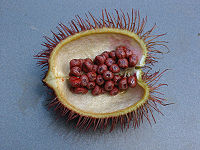
Annatto

Annatto, sometimes called Roucou, is a derivative of the achiote trees of tropical regions of the Americas, used to produce a red food coloring and also as a flavoring. Its scent is described as “slightly peppery with a hint of nutmeg” and flavor as “slightly sweet and peppery”.


Annatto is produced from the reddish pulp which surrounds the seed of the achiote (Bixa orellana L.). It is used in many cheeses (e.g., Cheddar, Red Leicester, and Brie), margarine, butter, rice, smoked fish, and custard powder.

Annatto is commonly found in Latin America and Caribbean cuisines as both a coloring agent and for flavoring. Central and South American natives use the seeds to make a body paint, and lipstick. For this reason, the achiote is sometimes called the lipstick-tree. Achiote originated in South America and has spread in popularity to many parts of Asia. The heart shaped fruits are brown or reddish brown at maturity, and are covered with short, stiff hairs. When fully mature, the fruits split open exposing the numerous dark red seeds. While the fruit itself is not edible, the orange-red pulp that covers the seed is used as a commercial food coloring and dye (similar to turmeric). The achiote dye is prepared by stirring the seeds in water.

History

Annatto has long been used by indigenous Caribbean and South American cultures. It is believed to originate in Brazil. It was probably not initially used as a food additive but for other reasons, such as body painting, to ward off evil, and as an insect repellent. The ancient Aztecs called it achiotl, and it was used for Mexican manuscript painting in the sixteenth century.

Uses

In Jamaica, annatto has had many uses over the centuries, including as a food dye, body paint, treatment for heartburn and stomach distress, sunscreen and insect repellent. In Venezuela, annatto (called locally onoto) is used in the preparation of hallacas, perico, and other traditional dishes. In Brazil, both annatto (the product) and the tree (Bixa orellana L.) are called urucum and the product itself may also be called colorau. In the Caribbean islands, both fruit and tree are popularly called achiote or bija (pronounced “bee-ha”) instead of Bixa. In the Philippines, it is called atsuete and is used as food coloring in traditional dishes. It is a major ingredient in the popular spice blend “Sazón” made by Goya Foods.

Cheddar cheese is often colored and even as early as 1860 the real reason for this was unclear: English cheesemaker Joseph Harding stated “to the cheese consumers of London who prefer an adulterated food to that which is pure I have to announce an improvement in the annatto with which they compel the cheesemakers to colour the cheese”.
One theory is that cheeses that were excessively fatty or rich turned a somewhat yellow color, and annatto was added to make cheaper cheeses appear to have more fat content, which would bring a higher price.

Reblog:

  • Click to email a link to a friend (Opens in new window) Email
  • Click to share on Pinterest (Opens in new window) Pinterest
  • Click to share on Facebook (Opens in new window) Facebook
  • Click to print (Opens in new window) Print
  • More
  • Click to share on X (Opens in new window) X
  • Click to share on Instagram (Opens in new window) Instagram
Like Loading...

Tips On Making The Perfect Jam!

07 Friday Aug 2009

Posted by Bob and Robin in Food, Food Prep, Interesting Information, Recipes, Things To Do

≈ Leave a comment


Here is some information gleaned from a BBC cooking program. Enjoy!

Jam, Jellies and Chutneys


Whether it is jams, jellies or chutney, preserved fruit brightens up all manner of breakfasts, lunches and dinners. Here we have all you need to know about preserving fruit, from must-knows to recipes and equipment.
Salting was one of the earliest methods of preserving foods, and from there preserving with sugar and acids developed. All inhibit growth of the micro-organisms which cause food to rot.
Jams and jellies set because of the action of pectin, a substance in fruit that, when cooked with sugar and acid (from the fruit), thickens and gels the preserve. In chutneys the main preserving agent is vinegar. Chutneys are usually made with vegetables, although orchard fruits are also used. Always take care when preparing jams and chutneys to do as the recipe states and sterilize and prepare equipment as directed to minimize the risk of food poisoning.

Types of jams

A traditional jam is fruit cooked, usually to a pulp, with sugar to set. Sometimes the fruit is cooked to a pulp and then sieved before the sugar is added, to get rid of excessive pips. A jelly is fruit cooked, usually with water, to a pulp. It is then dripped through a bag and the resulting juice (not pulp) is simmered with sugar until setting point is reached. A conserve could loosely be described as a very rich type of jam, sometimes with the addition of alcohol. Usually the whole fruit – raspberries, strawberries, blackcurrants, etc. – are preserved in heavy syrup rather than being cooked to a pulp.

Successful Jam Making

· Always use fruit that is in peak condition, preferably slightly under ripe – the pectin content will be at its best. Over-ripe or damaged fruit is not ideal – the pectin has begun to change to pectose and the jam will not set well. The result is likely to deteriorate rapidly.
· Jam jars need to be very clean. To sterilize jars, wash in soapy water, rinse well and then place in a cool oven – 130C/250F/Gas ½ – for 15-20 minutes.
· Use the correct amount of sugar as indicated. The sugar reacts with the pectin to set the jam.
· The amount of sugar you need depends on the amount of pectin in a fruit, but generally, the fruit to sugar ratio for traditional jams is 450g (1lb) sugar to 450g (1lb) fruit. The sugar content is sometimes a little higher or lower depending on pectin and acid content. Very acidic fruits such as blackcurrants have good pectin content – these can take an extra 50 to 100g of sugar to get a really juicy jam. Fruit such as strawberry – lower in pectin, but also much sweeter – can take the usual amount or possibly a little less.
· Use coarse-grain sugar such as preserving or granulated – this ensures a good clear jam. Coarse grains dissolve more slowly and evenly giving a better result. Fine sugars dissolve less easily and are usually more expensive too.
· Don’t add water when cooking fruits already high in sugar, such as strawberries, raspberries and blackberries.
· Don’t over boil the preserve. Once the sugar is added it usually takes a fairly short period of time to reach setting point, as long as the pectin content is good. To test for setting, put a spoonful of the jam on a cool plate and put into the fridge for a few minutes. After that time the jam or jelly will form a wrinkly skin if it is ready.
· Always cover the jam immediately it has been poured into the jars as this gives a good seal and prevents mildew appearing on the surface.
· Always store preserves in a cool, dry area, away from direct sunlight, and use within the year.

Know the pectin content of the fruit used – the higher the pectin content, the better the set. If you use fruit with low pectin content, try adding some fruit with high pectin content such as apples, damsons or redcurrants to give a good result. Alternatively, commercial pectin can be added to low-pectin fruits to ensure a good set. Pectin is best added to the fruit before the addition of the sugar.

High-pectin fruits: blackcurrants, redcurrants, cooking apples, damsons, quinces, gooseberries and some plums.
Low-pectin fruits: blackberries, cherries, elderberries, pears, rhubarb, strawberries and medlars.

So there you have some good tips for making jams. Let’s share some. Here’s a recipe. Cheers!

Victoria Plum Jam

3⅓ lbs Victoria plums
Cup of Water
2¾ lbs Caster Sugar
Juice of one lemon
· Put the whole plums and the water in a large stainless steel pan and bring to the boil. Reduce the heat slightly and bubble away for 30 minutes.
· Add the sugar and lemon juice and stir well. Continue to bubble for another 20 minutes or until setting point.
· Pass the mixture through a sieve to remove the stones and pour into sterilized jars.

Reblog:

  • Click to email a link to a friend (Opens in new window) Email
  • Click to share on Pinterest (Opens in new window) Pinterest
  • Click to share on Facebook (Opens in new window) Facebook
  • Click to print (Opens in new window) Print
  • More
  • Click to share on X (Opens in new window) X
  • Click to share on Instagram (Opens in new window) Instagram
Like Loading...

Brick 29 Bacon Feast

15 Wednesday Jul 2009

Posted by Bob and Robin in Celebrations, Food, Interesting Information, Party Time, Restaurants, Things To Do

≈ 1 Comment


I received this from the Brick 29 in Nampa this morning. If you have never been to this restaurant, you really should go. Well worth it.

Hi Bob and Robin,

I wanted to let you know about the Blue Ribbon Bacon Tour that is coming to I’m Treasure Valley on August 1 at Brick 29 Restaurant. The event is making a stop in Nampa to celebrate local blogger Bacon Unwrapped and author of Bacon: A Love Story, Heather Lauer.

There will be lots of bacon themed food and drinks featuring bacon prepared by celebrated local chef Dustan Bristol. The event will also feature a bacon eating contest.

Representatives from Bacon Salt and Bakon Vodka will also be in attendance and serving samples of their products.

There will be lots of fun, eating and drinking. We would love to have you at the event and if you could mention the event on your blog linking to Bacon Nation.

Please let me know if you have any questions, would like to speak to Heather or need more information.

Thank you!

Sincerely,
Nina Simmons

So there you have it. I guess it really is a “pork fat thing!” Cheers.

Reblog:

  • Click to email a link to a friend (Opens in new window) Email
  • Click to share on Pinterest (Opens in new window) Pinterest
  • Click to share on Facebook (Opens in new window) Facebook
  • Click to print (Opens in new window) Print
  • More
  • Click to share on X (Opens in new window) X
  • Click to share on Instagram (Opens in new window) Instagram
Like Loading...

McFadden Market Coop, Meridian

07 Thursday May 2009

Posted by Bob and Robin in Interesting Information, Local Markets

≈ Leave a comment


Thanks to Tammy McLure, Indian Creek Winery, for pointing me in this direction. I always enjoy new out-door markets opening in the area.
This market/coop is opening in Meridian, and here is a short “blog blip” about them, taken from their web site.

“McFadden Market Co-op started with a simple vision: to highlight the work of farmers and producers in the Treasure Valley area, to share high-quality fresh food with others, and to help restore historic downtown Meridian, Idaho.

What started as a dream is becoming a reality: The historic 2nd & Broadway building has been purchased and plans are underway to restore and add to the beautiful brick building that housed both the McFadden Market and the Meridian Exchange Bank for years. Working with the city of Meridian, the owners are making plans to revitalize the 2nd and Broadway area, including wider sidewalks, restaurants and ample parking. And a committed group of farmers, producers and community members is meeting regularly to bring the co-op into existence… New! McFadden Co-op is proud to present the McFadden Farmer’s Market:

Kick-off Event: Earth Day Celebration & Farmer’s Market April 25, 10am-2pm Meridian City Hall Parking Lot, Main & Broadway.

Weekly Market: Tuesdays, 5pm-8pm Meridian City Hall Parking Lot, Main & Broadway.

Vendor Information: If you are interested in being a vendor for the market, please contact event coordinator Melenda Stave, or Check here for more information on becoming a vendor.”

So there is the “blog blip” about the new McFadden Market and Coop in Meridian. See their web site for more information. Cheers!

Reblog:

  • Click to email a link to a friend (Opens in new window) Email
  • Click to share on Pinterest (Opens in new window) Pinterest
  • Click to share on Facebook (Opens in new window) Facebook
  • Click to print (Opens in new window) Print
  • More
  • Click to share on X (Opens in new window) X
  • Click to share on Instagram (Opens in new window) Instagram
Like Loading...
← Older posts
Newer posts →

  • Bob and Robin's avatar Bob and Robin
  • rockinrobin43's avatar rockinrobin43

Meta

  • Create account
  • Log in
  • Entries feed
  • Comments feed
  • WordPress.com

Copyright Notice

Creative Commons License
This blog and all work herein is licensed under a Creative Commons Attribution-Noncommercial-No Derivative Works 3.0 United States License.

The Current Weather at the Captain’s Shack

Click the image to see the very latest and current weather at the Captain's Shack in Boise, Idaho

Enter your email address to follow this blog and receive notifications of new posts by email.

Join 183 other subscribers

Thanks to all of these readers and subscribersz of this blog!

  • 321,590 and 598,479 Folks Reached

Monthly Archives of this Blog

Translate This Page

Assoc of Food Bloggers

Association of Food Bloggers

BFM Drive-Thru

Boise Farmers Market Drive-Thru

Air Fryer Cooking Time and Temperature Conversion Calculator

To convert to the AirFryer

AirFryer Recipes

https://www.airfryerrecipes.com/

Air Fryer Conversions

Rule of 25%. Reduce oven/frying temperature by 25% and time by 25%.

Fork To Spoon – Air Fryer and Instant Pot Recipes

Great resource for AF and IP information and recipes.

AirBnB Buhl, Idaho

Welcome to Mary Anne’s place, a historic cottage in the heart of Kelley’s Canyon Orchard. Just 20 minutes from Twin Falls, unwind in this quiet retreat by enjoying the pleasant sound of a nearby creek and views that look out into the orchard. 4 guests · 2 bedrooms · 3 beds · 1 bath, Wifi · Free parking · Kitchen, Entire House! 1903 River Rd, Filer, Idaho 83328

Bloglovin’

RSS Links

RSS Feed RSS - Posts

RSS Feed RSS - Comments

-----------------------
I Know. Not Idaho Products, But still Worth A Try!
----------------------

Rockin’ Rs

----------------------
Items of Blog Interest.
-----------------------

Member of The Internet Defense League

The History Kitchen

Interesting historical information about food - prep, origins and uses. Written by a kitchen anthropologist!

-----------------------
Of Concern To This Blog
----------------------

Recent Posts

  • Trike Restaurant Finds Worthy of Posting
  • Food Via ETrike
  • An Awesome Chicken Dish
  • Sushi Shack
  • Awesome Oven BBQ Pork Ribs

-----------------------
Think Local!! Buy Local!!

Let them know you saw their logo on this blog. Thanks!
----------------------

Buy Local!

If you are not from Idaho, think about Buying Local in Your area! As for us, we have lived in Idaho since 1982. We Buy Idaho wherever possible.

Chef Jake Sandberg, Crispeats

Food References and Recipes

Buy Local

And it does ... Just Make Sense! Regardless of where you are from.

------------------------
Think Local!! Idaho Products.

Let them know you saw their logo on this blog. Thanks!
-----------------------

The New Boise Farmers Market

Summer and Winter - 1500 Shoreline Dr, Boise (Americana and Shoreline)

Idaho Farmers Markets

A listing of statewide Farmer's Markets with contacts.

Find Your Local Farmers Market

Click on the graphic to find your local farmers market either by city or zip code.

Acme Baked Shop, Boise

Available at the Boise COOP. Some of the best bread in Boise and all local!! They make the bread for the 10 Barrel Brew Pub, Angell's Bar and Grill, Salt Tears, all here in Boise. Awesome rye bread that actually tastes like rye bread. And the baguettes .... Wonderful. (208) 284-5588 or runsvold2000@gmail.com

Brown’s Buffalo Ranch

Give them a call or EMail for awesome buffalo meat.

Desert Mountain Grass Fed Beef (formerly Homestead Natural Beef)

Desert Mountain Grass Fed Beef, with Bob and Jessica Howard of Howard Ranch in Hammett. The company will only sell whole animals to the Boise Co-op and Whole Foods stores in Boise and Utah. They will also be at the Boise Farmers Market.

Falls Brand Pork roducts

Click the image for pork recipes.

Kelley’s Canyon Orchard

1903 River Rd, Filer, ID 83328 Hours: 10am - 6pm, Phone: (208) 543-5330

Malheur River Meats

Matthews Idaho Honey

Matthews All-Natural Meats

Meadowlark Farms

All natural Eggs, Lamb and Chicken

Purple Sage Farms

True Roots Farm

Available at the Boise Farmers Market and online at https://www.trueroots.farm

True Roots is a local produce farm committed to sustainable and chemical-free farming practices. We raise pesticide-free and non-GMO produce fresh from the farm, offering a diverse variety of farm-fresh services to our local community. Since our founding in 2014, our mission has been to provide farm-direct access to clean, reliable, and affordable produce.

Reel Foods Fish Market

1118 Vista Avenue, Boise, ID 83705 (208) 713-8850 Monday-Friday: 10am-6pm, Saturday: 9am-5pm. Sunday: Gone Fishin’

Standard Restaurant Supply

Plenty of items for the home, too. Check them out. 6910 Fairview, Boise 83704 (208) 333-9577

-----------------------
Some Awesome Recipe and Spice Sources. Culturally diverse.

Let them know you saw their logo on this blog. Thanks!
------------------------

Crockpot Recipes

Many good recipes here.

A Taste of France

A collection of French recipes

Basque Recipes

Best Ever Recipes of Mexico

Malaysian Recipes

Awesome Malaysian recipes.

Memorie di Angelina Italian Recipes

My Best German Recipes Web Site

Regional and Oktober Fest Recipes

There are a lot of recipes here.

Sauer Kraut Recipes

Recipes By Robin and Bob

Recipes that we have collected and created throughout the years.

Recipes of Elizabeth W. Young, Bob’s Mother

These are the recipes that my Mother collected over 85 or so years. The photo of my Mother was one of the last I have of her. It was taken in July, 1987.

Recipes From The Mediterranean Area

Soup and Chowder Recipes

Recipes from "My Recipes"

Deep South Dish Recipes

The Recipes of Greece

Tasty Mexican Recipes

The Shiksa In The Kitchen

Great Jewish recipes!

-----------------------
Some Great Boise Restaurants.

Let them know you saw their logo on this blog. Thanks!
-----------------------

Asiago’s – Italian

Bella Aquila, Eagle, ID

775 S Rivershore Ln., Eagle, ID 83616 (208) 938-1900

Bar Gernika – Basque Pub and Eatery

202 S Capitol Blvd, Boise (208) 344-2175 (Checked)

Cottonwood Grille

913 W River St., Boise (208) 333.9800 cg@cottonwoodgrille.com

Enrique’s Mexican Restaurant

482 Main St., Kuna (208) 922-5169 New name. Was El Gallo Giro. Same owners and kitchen. The Best Mexican restaurant in the Boise/Kuna area, bar none!

Flying Pie Pizzaria

Goldy’s Breakfast Bistro

108 S Capitol Blvd., Boise (208) 345-4100

Goldy’s Corner Cafe

625 W Main St., Boise (208) 433-3934

Guanabanas – Island Restaurant and Bar

960 N Highway A1A, Jupiter, FL

Janjou Pâtisserie

Janjou Pâtisserie, 1754 W State St., Boise, Idaho 83702 (208) 297.5853

Mai Thai Asian Cuisine

750 West Idaho Street Boise, ID 83702 (208) 344-8424

Mazzah Grill – Mediterranean and Greek Cuisine

1772 W State St., Boise (208) 333-2566

Richards Inn by Chef Richard Langston

Formerly - Vincino's. New location at 500 S Capitol Blvd., Boise (208) 472-1463. Reservations are highly suggested.

The Orchard House

14949 Sunnyslope Rd., Caldwell (208) 459-8200

The Ravenous Pig

1234 N. Orange Ave. Winter Park, FL

-----------------------
Think Local!! Boise Breweries, Brew Pubs and Wine Bars.
Let them know you saw their logo on this blog. Thanks!
-----------------------

10 Barrel Brewery Boise

830 W Bannock St., Boise (208) 344-5870

Cloud 9 Brewery and Pub

Opening Fall 2013 in the Albertson's Shopping Center, 18th and State in the old Maxi Java

Edge Brewing Company

525 N Steelhead Way, Boise, ID 83704 (208) 323-1116

-----------------------
Miscellaneous Items
-----------------------

Blog Syndication

NetworkedBlogs
Blog:
Boise Foodie Guild
Topics:
Food, Recipes, Cooking
 
Follow my blog

Blog Badge

Local & Regional Food Blogs - BlogCatalog Blog Directory

  • Subscribe Subscribed
    • Boise Foodie Guild
    • Join 72 other subscribers
    • Already have a WordPress.com account? Log in now.
    • Boise Foodie Guild
    • Subscribe Subscribed
    • Sign up
    • Log in
    • Report this content
    • View site in Reader
    • Manage subscriptions
    • Collapse this bar
%d