Rhone Night In Boise
26 Friday Mar 2010
Posted in Celebrations, Food, Party Time, Photos By: Bob Young, Wine and Food, Wine Dinners
26 Friday Mar 2010
Posted in Celebrations, Food, Party Time, Photos By: Bob Young, Wine and Food, Wine Dinners
23 Tuesday Mar 2010
Posted in Celebrations, Food, Rudy's Twin Falls

Once again, we have this awesome trivia from Rudy’s – A Cooks Paradise in Twin Falls. At the end, is a surprise!
March 22, 1841: Cornstarch patented. The Englishman Orlando Jones patented cornstarch in 1841
March 23, 1923: ‘Yes, We Have No Bananas’ was written by Frank Silver and Irving Cohn. It was one of the most popular songs of the 1920s
March 24: National Chocolate Covered Raisin
March 25, 1775: George Washington planted pecan trees (some of which still survive) at Mount Vernon. The trees were supposedly a gift to Washington from Thomas Jefferson. (Some sources date this planting at 1799).
March 26, 1753: Benjamin Thompson, Count von Rumford was born. American physician who invented the percolator, a pressure cooker and a kitchen stove. He is frequently credited with creating the dessert, Baked Alaska.
March 27: National Paella Day
Let’s celebrate! Break out the paella pans, stoke up the fires, bring on the rice and let’s cook, cook, cook!!
March 27th is National Spanish Paella Day!
There are hundreds of paella recipes and every cook has their favorite. Paella is a typical Spanish recipe and is traditionally cooked in a paellera – a round flat pan with two handles – which is then put on the table. It is normally made using shellfish but can also be made with chicken or rabbit. In many Spanish villages, especially in coastal areas, they use a giant (see the photo) paellera to cook a paella on festival days which is big enough to feed everybody.
A paella is very flexible so if you don’t have the exact ingredients or if you find some of them hard to get hold of, substitute them for something similar. Getting fresh shellfish can be a problem, but you can always use frozen fish and use fish stock instead of water to increase the flavor. Here’s one recipe from http://www.spain-recipes.com. (Understand, this is a translation.)
1/2 Pint of Oil
1 Chicken, Cut To 8 Pieces
2 Bowls (cups) of Rice (1lb. 5 Oz. Approximately)
5 Bowls (cups) of Meat Broth (I would use beef stock)
1 Green Pepper
1 Red Pepper
1 Small Can Of Peas
1 Small Onion
2 Tomatoes
Saffron
1 Clove of Garlic (Optional)
Parsley
Salt
Start by heating half of the oil and once warm add the cut chicken and let it cook for 15 min. Once it’s brown, reserve it in a dish. Add the chopped onion. After 5 minutes, add diced tomatoes, without seeds and peeled.
Let it braise about 5 minutes more, mashing the tomatoes with a skimmer. Strain it and throw it in the paella pan.
Add the rest of the oil to the paella pan. Throw the green pepper, cut to square pieces of half inch. Add the fried chicken. Keep stirring with a wooden tablespoon, without letting it go brown. Throw salt, and the meat broth, hot but not boiling. This is completed with the 5 broth bowls (cups).
Shake the paella pan a little taking it by the handles so that it is broth flows all over. All this should be made to medium fire.
Meanwhile, in a mortar mash a little bit of garlic, the parsley and the saffron, with a little bit of salt so that it doesn’t slip, and it wet it with a couple of soup spoonfuls of temperate water. Spill this mixture on the rice and shake again the paella pan. When the broth has reduced to the half, decorate the paella with the red pepper cut to ribbons, and the peas.
Let it cook about 20 minutes. Once the rice is cooked and the broth has reduced, retire the paella pan from the fire, on a wet cloth, leaving it rest for about 5 minutes. Serve it with some big clusters of lemon without peeling like decoration.
Serves: 6
Your turn! Have fun with this and follow the recipe as close as possible. Don’t burn the rice!! And that’s the hardest part. Every time we have had paella, it’s always been in a party situation. So keep it that way. Have a party. Plenty pealla to eat and lots of good, big Spanish Red to go with it. Thanks to Rudy’s – A Cook’s Paradise for this information and the recipe. Cheers!
20 Saturday Mar 2010
Posted in Food, Main Dish, Seasons Bistro, Things To Do, Wine and Food
Slow Roasted Coffee & Herb Crusted Prime Rib with Pesto Mashed Potatoes and Blanched Asparagus
$21.99
Winter Scallop Salad
$16.99
Soups:
-White Bean with Ham
-Moroccan Bean
-Free Range Turkey Pot Pie
-Gumbo
Bloggers Note: Robin and I will vouch for the exquisitness of the Moroccan Soup, the Gumbo, the Chocolate Raspberry Cake (if there is any left) and the pot pie!
Chocolate Mousse Bars
Raspberry filled Almond Cake with Cream Cheese Frosting
Assorted Fresh Fruit Pies
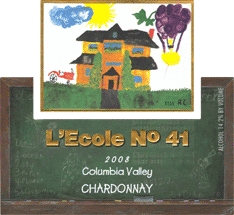
This elegantly balanced Chardonnay shows robust acidity and purity of fruit with subdued tropical fruit, orange blossom and Asian pear flavors and subtle mineral nuances that gain complexity on a long, robust finish. $26.99
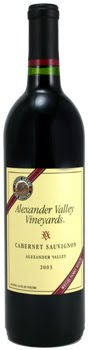
There are few places better suited for Cabernet Sauvignon than the Alexander Valley, which is why it’s become our signature wine. Warm summer days tempered by morning coastal fogs combine to help create a refined Cabernet that is at once approachable upon release, yet with the fortitude to develop with time. In the glass, the 2007 Estate Cabernet displays big aromas of black cherry, cassis, cocoa powder and plum and flavors of cassis, black cherry and plum along with soft, integrated tannins. This is certainly a great wine to serve with beef, whether braised short ribs or a Tuscan steak rubbed with olive oil and rosemary.
$23.99
WILL BELL
Will Bell has been playing as a professional musician for most of his life. Growing up in Tulsa, Oklahoma , Will’s musical influences naturally come from a mixture of southern rock, country, and a strong connection to the blues. He has been the opening act for bands such as Jefferson Starship , Bruce Willis, Coco Montoya and the Paul Delay Blues Band just to name a few. Will’s dynamic solo act has been entertaining audiences in the Boise and Sun Valley areas as well as venues and vineyards throughout the Northwest. Will released a CD titled “Once In A Blue Moon” that has been selling locally and internationally to rave reviews.
In the summer of 09′ Will was featured at Boise’s ” Alive After Five” and his band ” The SwampKats” was invited to play at the Boise Blues Society Corner Club’s summer bash . Will’s song “Missin Home” is also featured on Boise “On Hold” throughout the city . Currently you can find Will playing at Season’s Bistro in Eagle, Id. Call 939-6680 for reservations Seasons Bistro
“Welcome to the Boise Foodie Guild Blog. There’s not a degreed Chef among us, but we sure do like to try different foods, whether it is at a restaurant or in our own kitchens. You will find some recipes here. If not, look at Recipes From Bob and Robin. There are 100’s there! So sit back and enjoy our wonderings.”
This is a quote from the dynamic food duo Bob & Robin Young. If you haven’t been to their website or facebook page check them out at: http://boisefoodieguild.blogspot.com/
or Bob or Robin Young on facebook.
Boise Foodie Guild Recent Post:
The Reuben Sandwich Challenge Scoring
Rated on 1 to 5-Stars, here is how we rate the several places in Boise that serve a Reuben Sandwich. 1-Star is enough for this year and a 5-Star is one that meets the criteria.
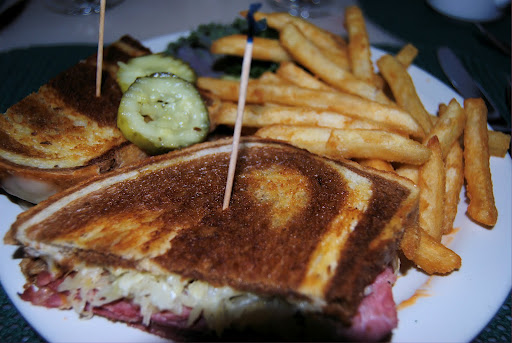
4. Seasons Bistro – Wow!! We’ve got a foot race. Homemade Russian Dressing, as was Cucina di Paolo. Good pastrami as was Cucina di Paolo. Great kraut that is special ordered and, in my opinion, better than Cucina di Paolo. Grilled onions. Good rye, that I actually tasted the caraway seed, although it was the Marbled Rye!!! I told Rachel Hurn, Owner, that I really would like to give her the 5-Stars for this sandwich, but I couldn’t. She asked, “Why?” And I told her, “No Jewish Kosher deli pickle.” She said she would go get me one. Too late. But, Rachael does know – as did Paul at Cucina di Paolo – the difference between a Reuben and a Rachael Sandwich. She has both on the menu!!!
Rating: 4½
Are we really closing in on “The Perfect Reuben Sandwich in Boise”? It looks like a difficult job, but someone has to find Boise’s Best. Or am I being a traditionalist? To coin a phrase, “It’s tradition!”, or so it’s been said. If I had a fiddle and if I could play it, I’d shout “It’s Tradition!” from the roof top. At this point in time, the Seasons Bistro (Eagle) and Cucina di Paolo (Boise) are taking the lead. They have set the bar pretty high. Cheers
18 Thursday Mar 2010
Posted in Food, Food Prep, Recipe By: Robin Young, Things To Do
A couple of weeks ago, Robin came up with this variation of guacamole that is really awesome. And for someone like me that thinks avocado is like eating tasteless mush, that’s really saying something. I ate the better part of the bowl full. If it is not spicy enough for you, add either more jalapeno or more of the seeds and ribs of the pepper. Cheers!
Author: Bob and Robin Young
Web Page: http://www.rockinrs.com/rnrcontents.htm
Comments: This is a really good guacamole with a twist.
Degree of Difficulty: Easy
Servings: 24
Ingredients:
1 can White Canelli Beans, drained
1 c Onion, chopped
¼ bunch Cilantro, chopped
1 Lime, juiced
1 sm Jalapeno, seeds removed and diced
1 med Avocado, ripe and pitted, peeled
1 lg Tomato, diced
Directions:
1.) In a food processor, combine the beans, onion, cilantro, lime juice, jalapeno and salt and pepper to taste. Process until mostly smooth. Pour into a bowl.
2.) Mash the avocado and add to the bean mixture. Dice the tomato and add to the bean mixture. Fold all together to combine. Place in the refrigerator for 45 minutes to cool and blend the flavors.
Preparation Time: 15 minutes
Inactive Time: 45 minutes
Total Time: 1 hour
Here is a Printable Recipe
18 Thursday Mar 2010
Posted in Bread, Celebrations, Food, Holiday Menu, Photos By: Bob Young
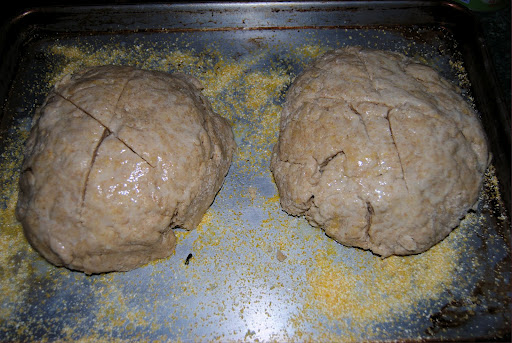
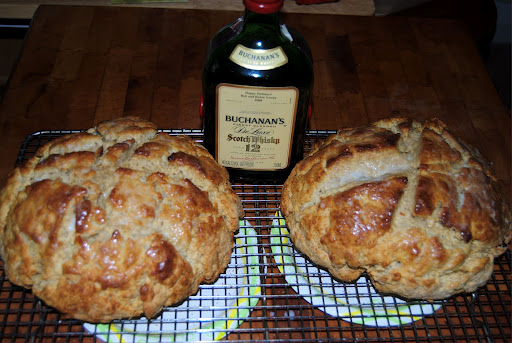
St Patrick’s Day was awesome! Thanks to Leanne and Tom Felzien for opening their home for a great meal! And thanks to Gail an Bob for the “tour” of Scotland and the Whisky tasting. We took some Irish Soda Bread – recipe is on the previous post. I altered it somewhat: Instead of 4 c of All-Purpose Flour, I used 3 cups and then 1/2 cup of Whole Wheat flour and 1/2 cup of Oat Flour. 19 of us devoured almost 2 loaves. It must have been good! Here are the photos. Cheers.
17 Wednesday Mar 2010
Posted in Classics, Food, Food Prep, Recipe: Bob and Robin Young, Recipes, Things To Do
Nope! I’m not done yet! It is springtime warm outside and my BBQ is saying, “Pulled Pork!”. (Is that a gauntlet Mr Joe?) But that will have to wait, and I have been working on that too this morning. But today is St Patrick’s Day and here to go with your Corned Beef and Cabbage, Green Wine, Guinness Stout and some good Scotch Whisky, is my rendition of an Irish Soda Bread.
Author: Bob and Robin Young
Web Page: http://www.rockinrs.com
Degree of Difficulty: Easy
Oven Temperature: 375°F
Servings: 20
Ingredients:
3 c All-Purpose flour
1 c Whole wheat flour
1 t Baking Soda
1 T Baking Powder
4 T Honey, use a light, floral honey. Tupelo is good.
½ t Salt
½ c Butter, room temperature
1 c Butter milk
1 Egg
¼ c Butter, melted
¼ c Buttermilk
Directions:
1.) Pre-heat oven to 375°F. Lightly grease a large baking sheet.
2.) In a large bowl, mix together the flour, honey, baking soda, baking powder, salt and butter. Stir in 1 cup Buttermilk and egg.
3.) Turn the dough out onto a lightly floured surface and knead lightly. Form dough into a round and place on a prepared baking sheet.
4.) In a small bowl, combine the melted butter with ¼ cup of buttermilk; brush the loaf with this mixture. Use a sharp knife and cut an “X” into the top of the loaf.
5.) Bake in a pre heated oven for 40 – 50 minutes or until a tooth pick inserted into the loaf comes out clean (190°F). You can continue to brush the loaf with the butter mixture while it bakes.
Preparation Time: 15 minutes
Cooking Time: 50 minutes
Total Time: 1 hour and 5 minutes
Do enjoy the day!!
17 Wednesday Mar 2010
Posted in Anthropology of Food, Food, Food Trivia, Interesting Information, Trivia
Mar 3, 2009 Stephanie Jolly , Source: Suite101.com
While many North Americans associate corned beef and cabbage with Ireland, this popular St Patrick’s Day meal has roots in America, and is not traditional Irish food.
Corned beef, a salt-cured brisket, was traditionally packed and stored in barrels with coarse grains, or “corns” of salt. One of the earliest references to corned beef appears in the 12th century Gaelic poem Aislinge Meic Conglinne, where it references a dainty, gluttonous indulgence. By the 17th century, salting beef had become a major industry for Irish port cities of Cork and Dublin, where Irish beef was cured and exported to France, England and later to America.
Traditional Irish Recipes Contain Salt Pork Instead of Corned Beef
With the majority of Irish beef being exported, beef was an expensive source of protein and unavailable to the majority of Irish citizens. Cows, if owned at all, were raised predominately for their dairy products, from which butter, cheese and cream could be obtained, and were only slaughtered when they were no longer good for milking. Sheep were raised as a source of wool and hogs and pigs were one of the only livestock species raised by the peasantry for consumption.
Salt pork and bacon, therefore, became the commonly consumed meat protein of Irish tables. In Feast and Famine, Leslie Clarkson writes that “fat from bacon supplemented the lack of fat in the farmhouse diet” and Sir Charles Cameron states that he does “not know of any country in the world where so much bacon and cabbage is eaten.” Even today corned beef and cabbage appears infrequently in Irish pubs and restaurants, except for those in heavily touristed areas, and is much more likely to be replaced its traditional counterpart – an Irish stew with cabbage, leeks, and a bacon joint.
Corned Beef & Cabbage Eaten by Irish Immigrants After Arriving in America
After the Irish potato blight, or Great Famine, of the mid-19th century brought hundreds of Irish emigrants to the shores of America, the newly immigrated Irish Americans found corned beef to be both more accessible and more affordable than it was in Ireland. Both corned beef and cabbage were ingredients of the lower working class, and their popularity among the Irish population likely had little to do with similarities to the food of Ireland and more to due with the relatively inexpensive nature of salt cured beef and green cabbage.
For several decades following the Irish immigration, St Patrick’s Day was celebrated with music, crafts and revelry but banquets, while lavish, contained a scarcity of traditional Irish cuisine. However by the 1920s, corned beef and cabbage came to have an association with Irish American cooking, according to Hasia Diner in Hungering for America: Italian, Irish and Jewish Foodways in the Age of Migration and joined Irish bacon and greens as a food reminiscent of Ireland.
Corned Beef’s Association with St Patrick’s Day Has Irish American Origins
While both salted beef and green cabbage have historic connections with Ireland, the ritual of serving corned beef and cabbage for St Patrick’s Day is exclusively an Irish American tradition. The scarcity and high price of beef in Ireland prevented it from being consumed by the majority of the Irish peasantry until arriving in America, where corned brisket and cabbage were cheap and readily available to the poor. As the stigma of eating working class food faded and the celebration of Irish ancestry grew in popularity, corned
And from Foodtimeline.com, we have:
“Corned beef
While the process of preserving meat with salt is ancient, food historians tell us corned beef (preserving beef with “corns” or large grains of salt) originated in Medieval Europe. The Oxford English Dictionary traces the first use of the word corn, meaning “small hard particle, a grain, as of sand or salt,” in print to 888. The term “corned beef” dates to 1621.
“Emphasizing its long history in the Irish diet, Regina Sexton…points out that a similar product is mentioned in the 11th-century Irish text Aislinge meic Con Glinne many wonderful provisions, pieces of every palatable food…full without fault, perpetual joints of corned beef’. She adds that corned beef has a particular regional association with Cork City. From the late 17th century until 1825, the beef-curing industry was the biggest and most important asset to the city. In this period Cork exported vast quantities of cured beef to Britain, Europe, America, Newfoundland, and the W. Indies. During the Napoleonic wars the British army was supplied principally with corned beef which was cured in and exported from the port of Cork.”
—Oxford Companion to Food by Alan Davidson, [Oxford University Press:Oxford] 1999 (page 218)
Corned beef was very popular in colonial America because it was an economical and effective way to preserve meat. The following corning directions are from The Virginia House-Wife by Mary Randolph, 1824, pages 22-23:
“To corn beef in hot weather
Take a piece of thin brisket or plate, cut out the ribs nicely, rub it on both sides well with two large spoonsful of pounded salt-petre; pour on it a gill of molasses and a quart of salt; rub them both in; put it in a vessel just large enough to hold it, but not tight, for the bloody brine must run off as it makes, or the meat will spoil. Let it be well covered top, bottom, and sides, with the molasses and salt. In four days you may boil it, tied up in a cloth, with the salt, &c. about it: when done, take the skin off nicely, and serve it up. If you have an ice-house or refrigerator, it will be best to keep it there.–A fillet or breast of veal, and a leg or rack of mutton, are excellent done in the same way.” “Some people wonder about the shared culinary/cultural heritage of the Irish and Jewish peoples when it comes to corned beef. The practice of curing meat for preservation purposes certainly dates back to ancient times. The use of salt was adopted/adapted by many peoples and cultures, and was widely used during the Middle Ages. Evidence suggests that both Irish and Jewish cooks were making corned (salt) beef independently, long before they met in New York.
“Corned beef comes in two versions: The Jewish special on rye, or the traditional Irish boiled dinner, aka New England boiled dinner. Tonight should be the big night for the Irish version.”
—Boiled dinner, The Boston Globe, March 15, 1990 (p.3)
15 Monday Mar 2010
Posted in Food, Food Prep, Food Trivia, Photos, Photos By: Bob Young, Restaurants, The Perfect Reuben
Yesterday, Pi Day, 3.14, Robin says, “The Plaza Grill” is having a Reuben special for lunch. That’s all I needed. Read about their Reuben, #7.
Rated on 1 to 5-Stars, here is how we rate the several places in Boise that serve a Reuben Sandwich. 1-Star is enough for this year and a 5-Star is one that meets the criteria.
1. Barbaccoa – Big thick slabs of meat, no rye toast, they used bread, and soggy from an over abundance of kraut. No grilled onion. Rating: 1-Star
2. Donny Mac’s – Rye toast was weak on the rye, heavy on the 1000 Island dressing. Sloppy to eat because of the really wet kraut. The pastrami was good. Raw onions. Rating: 2-Stars
3. Cucina di Paolo – Yea! Russian Dressing. Good pastrami and not overly salty. Great kraut. Did not notice any grilled onion. Good rye toast, although it was Marble Rye. I would prefer a straight Jewish Rye, Deli Rye. I always like a good Jewish Kosher pickle with my Reuben. None of these places had that. Rating: 4-Stars
4. Seasons Bistro – Wow!! We’ve got a foot race. Homemade Russian Dressing, as was Cucina di Paolo. Good pastrami as was Cucina di Paolo. Great kraut that is special ordered and, in my opinion, better than Cucina di Paolo. Good rye, that I actually tasted the caraway seed, although it was the Marbled Rye!!! I told Rachael Hurn, Owner, that I really would like to give her the 5-Stars for this sandwich, but I couldn’t. She asked, “Why?” And I told her, “No Jewish Kosher deli pickle.” She said she would go get me one. Too late. But, Rachael does know – as did Paul at Cucina di Paolo – the difference between a Reuben and a Rachael Sandwich. She has both on the menu!!! Rating: 4½ – Stars
5. Westside Drive-In – I was disappointed. The pastrami was poorly heated. And the dressing was not Russian. I think it was 1000 with horseradish. The kraut was very good though. He also uses marbled rye. No pickle!!! And I’m really getting tired of the marbled rye. Why not a good deli rye? Sorry Lou.
Rating: 3½ – Stars
6. Willowcreek Grill – Most of their lunches that we’ve had here have been pretty good. Great salads and a good clam chowder. Sorry, but I can not say the same about their Reuben Sandwich. Where’s the pickle?? The taste just was not there. The pastrami was just OK. But the kraut at least perked it somewhat. The rye – mediocre marbled at best. The sauce – OK, but nothing to write home about. The cheese is hard to find. It looks impressive, but the taste is just not there. Sorry.
Rating: 3 – Stars
7. The Plaza Grill at the Owyhee Hotel Yea!!! Look at that green “thing” on the sandwich. A Pickle! Yea! And out of 7 Reuben establishments tried, this is the first pickle! But then, from their menu, “Grilled Reuben on Rye – Grilled on rye with cured lean corned beef, sauerkraut, Thousand Island dressing and melted Swiss cheese” $9.95. Did I see Thousand Island dressing? Sure did. Wrong dressing, remember? Should be Russian dressing. Too bad. And, I don’t think that the kraut was grilled long enough, either. It was still pretty runny. Can’t get rid of that Marbled Rye either. There’s got to be a bakery in Boise that makes their own rye bread – Deli Rye bread that tastes like rye or caraway. I was glad to see the pickle – but sad to see the Thousand Island dressing.
Rating: 3½ – Stars
Are we really closing in on “The Perfect Reuben Sandwich in Boise“? It looks like a difficult job, but someone has to find Boise’s Best. Or am I being a traditionalist? To coin a phrase, “It’s tradition!”, or so it’s been said. If I had a fiddle and if I could play it, I’d shout “It’s Tradition!” from the roof top. At this point in time, the Seasons Bistro (Eagle) and Cucina di Paolo (Boise) are taking the lead. They have set the bar pretty high. Cheers!
10 Wednesday Mar 2010
Posted in Food, Main Dish, Photos By: Bob Young, Wine and Food, Wine Dinners
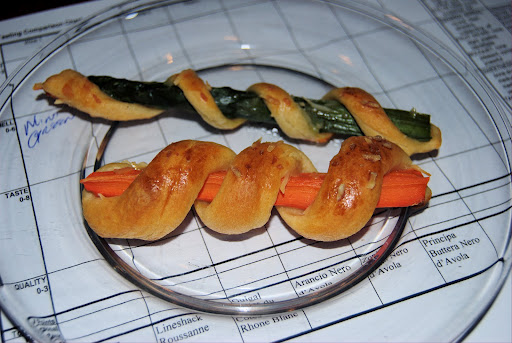
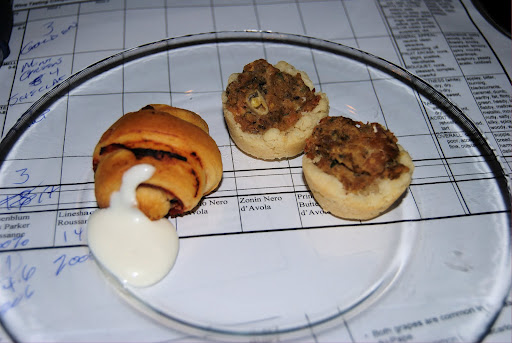
09 March 2010 the Buzz held another wonderful dinner and wine tasting! The theme this month was Varietals of the World: Marsanne and Roussane. If you missed this one, you can redeem yourself next month on Tuesday 13 April or Wednesday 14 April. On the 27 March, there will be a quarterly dinner and tasting and the wines will be from Zonin. Reservations are necessary so call the Buzz! Make your reservations and join in on the fun and festivities. You won’t be disappointed.
But for now, here are some photos from the dinner. See what you missed?
Open up with these delicious Vegetable Spiral Sticks and
Savory Crescent Bites and Salmon Tartlets.
Add a delicious Butternut Squash Bisque (sorry for my sloppiness!) and a
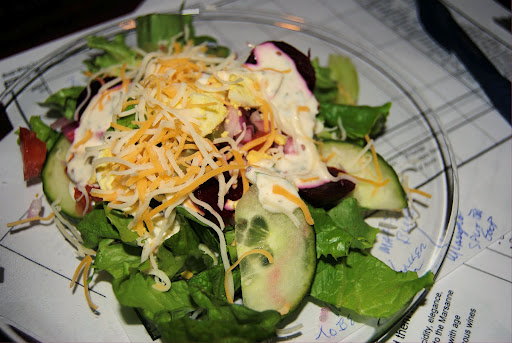
Fresh Irish Pub Salad and you have some delightful “Good Eats”.
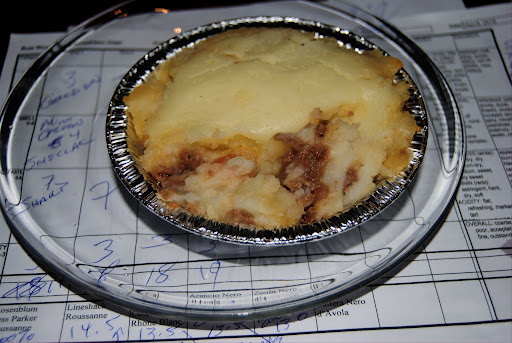
And now a wonderful Shepard’s Pie. Yum-O!
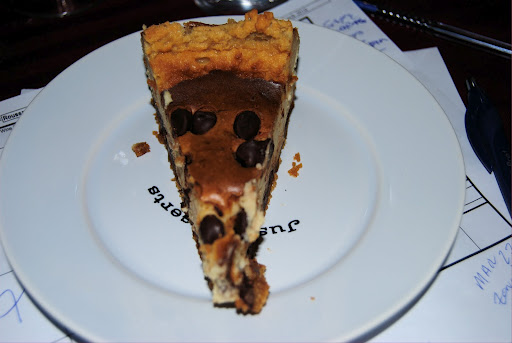
And then top the evening off with a Bailey’s Chocolate Chip Cheesecake and you have complete contentment!
But, believe it or not, that was not all. We had some wonderful wines to go with everything. My score is in ( ) out of 20.
2006 Rosenbkum Fess Parker Roussane – (17). 14.6 alcohol. Very golden color with hints of mint and green grass. Shellack. A sharp taste. Meant to be aged.
2008 Lineshack Roussane – (18). 14.5% alcohol. This one too is meant to be aged. Not quite as sharp as the first one. No shellac.
2007 Guigal Cotes du Rhone Blanc – (18). 13.5% alcohol. Clear color. Earthy and grassy on the nose. Mellow.
2008 Arancio Nero d’Avola – (19). 13.5% alcohol. Nice red. Deep and rich. (The first three were whites) Chocolate frosting on the nose. Used in Marsala.
2007 Zonin Nero d’Avola – (19). 13.0% alcohol. Very dark red and full of plums.
2006 Principa Buttera Nero d’Avola – (20). 13.0% alcohol. Very fruity red. Big, but not overbearing like a Zin. Bold, yet soft and succulent. An awesome wine.
So there you have our evening. Hope to see you next time. Cheers!
06 Saturday Mar 2010
Posted in Food, Food Prep, Recipe: Bob and Robin Young
St Patrick’s Day is a little over a week away, 17 March. But you must be thinking of something to go with that Corned Beef. How about some Soda Bread. Here is some interesting information on Soda Bread. Information and recipe from European Cuisines.
Irish soda bread: a brief history
A little soda bread historyIrish baking over the centuries has been affected by two main factors. The first is our climate. The influence of the Gulf Stream prevents either great heat in the summer or cold in the winter. As a result, hard wheats, which need such heat and cold, don’t prosper. Those wheats make flour with a high gluten content that responds well to being raised with yeast. But soft wheats do grow well here.
The other factor has been the abundance of fuel. Ireland’s various medieval overlords could never exercise the tight control over forest land that landowners did in more populous, less wild areas, like England and mainland Europe. This meant that Irish people had less trouble getting their hands on firewood. Where there was no wood, there was almost always heather, and usually turf too. As a result, anyone with a hearthstone could bake at home whenever they wanted to, rather than needing to use a communal bake-oven to conserve fuel.
These two factors encouraged the Irish householder of the past two centuries to bypass yeast for everyday baking. The primary leavening agent became what’s now known here as bread soda — just plain bicarbonate of soda, to US and North American users. Hence the name soda bread. But for a long time, most bread in Ireland was soda bread: “bakery bread” was only available in big cities. Soda bread was made either in a pot or casserole over the fire, or else baked on a bakestone, an iron plate usually rested directly in/on the embers. From these two methods are descended the two main kinds of soda bread eaten in Ireland, both north and south, to the present day.
About soda bread varietiesCake style brown soda bread: In Ireland, “plain” soda bread is as likely to be eaten as an accompaniment to a main meal (to soak up the gravy) as it’s likely to appear at breakfast. It comes in two main colors, brown and white, and two main types: cake and farl. People in the south of Ireland tend to make cake: people in Northern Ireland seem to like farl better — though both kinds appear in both North and South, sometimes under wildly differing names.
Cake is soda bread kneaded and shaped into a flattish round, then deeply cut with a cross on the top (to let the bread stretch and expand as it rises in the oven). This style of soda bread is normally baked in an oven.
These days we’d normally bake it on a baking sheet / cookie sheet. But in earlier times, before ovens were commonplace, cake was routinely made in deep, lidded iron casseroles, hanging over the open fire or sitting right in it — the casserole lids being concave to hold coals or burning turves from the fire on top, so that the bread would bake evenly in radiant heat from all sides.
The cake style of soda bread can of course be eaten hot. But it’s more usual to let the loaf cool down before eating it (it’s a little easier to handle then). It’s also a lot easier to slice, and that’s the way it’s normally seen in supermarkets and convenience stores country-wide, in both brown and white versions.
White soda farls: Farl is rather different. When making farls, the soda bread dough is rolled out into a rough circle and cut all the way through, crosswise, into four pieces or farls (“farl” is a generic term for any triangular piece of baking), and usually baked in a heavy frying pan or on a griddle, on top of the range or stove rather than in the oven. It’s a flatter bread than cake, and moister after the baking’s finished. Each farl is split in half “the wide way” before eating. It’s best when eaten hot off the griddle, but it’s also allowed to cool and then grilled or fried as part of other dishes, especially the famous Ulster Fry.
One important note: In the US and North America generally, there’s tendency to think of soda bread as something with fruit in it. This is not the case in Ireland. While people have for many years sometimes added fruit to the basic dough as a treat or for a change of pace, this is not usually referred to as soda bread, but as tea bread, fruit soda, tea cake, and by many other names. We have recipes for these below as well. But everyday soda bread in Ireland does not contain fruit.
Here’s the basic recipe for white soda bread. All these measures are approximate. The flour’s volume and liquid-absorptive capabilities, in particular, will vary depending on the local humidity.
Ingredients:
•450 g / 1 lb / 3 1/2 cups flour (either cake flour or all-purpose)
•1 teaspoon sugar (optional: you can absolutely omit this if you prefer sugar free soda bread)
•1 teaspoon salt
•1 teaspoon bicarbonate of soda
•Between 200-300 ml / 8-10 fluid ounces buttermilk, sour / soured milk, or plain (“sweet”) milk, to mix
Directions:
Sift the dry ingredients together at least once or twice to make sure the bicarbonate of soda is evenly distributed. Put the sifted dry ingredients in a good big bowl (you want stirring room) and make a well in the center. Pour about three-quarters of the buttermilk or sour milk or whatever in, and start stirring. You are trying to achieve a dough that is raggy and very soft, but the lumps and rags of it should look dryish and “floury”, while still being extremely squishy if you poke them. Add more liquid sparingly if you think you need it. (You may need more or less according to conditions: local humidity and temperature, the absorptiveness of the flour you’re using, etc.)
Blend quickly (but not too energetically!) until the whole mass of dough has become this raggy consistency. Then turn the contents of the bowl out immediately onto a lightly floured board or work surface, and start to knead.
The chief concern here is speed: the chemical reaction of the bicarb with the buttermilk started as soon as they met, and you want to get the bread into the oven while the reaction is still running on “high”. Don’t over knead! You do not want the traditional “smooth, elastic” ball of dough you would expect with a yeast bread. You simply want one that contains almost everything that went into the bowl, in one mostly cohesive lump. You should not spend more than half a minute or so kneading… the less time, the better. Fifteen seconds may well be enough, because you don’t want to develop the gluten in the flour at all. If you do, you’ll get a tough loaf. So don’t overdo it! Don’t be concerned if the dough is somewhat sticky: flour your hands, and the dough, and keep going as quickly as you can. There is a whole spectrum of “wetness” for soda bread dough in which it’s possible to produce perfectly good results: farl in particular sometimes rises better if the dough is initially wet enough to be actively sticky. You may have to experiment a few times to come to recognize the right texture of dough.
Put the cake’s baking sheet into the preheated oven. Handle it lightly and don’t jar it: the CO2 bubbles in the dough are vulnerable at this point of the process.
Let the bread alone, and don’t peek at it! It should bake for 45 minutes at 400-450° F. (One of our Irish neighbors suggests you give it the first 10 minutes at 450°, then decrease to 400°. Also, if you have a fan oven, use temperatures 10° lower or so, as fan ovens have a tendency to run hot.) At the end of 45 minutes, pick up the loaf and tap the bottom. A hollow-ish sound means it’s done. For a very crunchy crust, put on a rack to cool. For a softer crust, as above, wrap the cake in a clean dishcloth as soon as it comes out of the oven.
By: Karin Christian
“A very easy, very good tasting bread. Best if made the day before, or several hours before serving.”
Original Recipe Yield 1 – 9×5 inch loaf
Ingredients:
• 3 cups all-purpose flour
• 1 tablespoon baking powder
• 1/3 cup white sugar
• 1 teaspoon salt
• 1 teaspoon baking soda
• 1 egg, lightly beaten
• 2 cups buttermilk
• 1/4 cup butter, melted
Directions:
1. Preheat oven to 325 degrees F (165 degrees C). Grease a 9×5 inch loaf pan.
2. Combine flour, baking powder, sugar, salt and baking soda. Blend egg and buttermilk together, and add all at once to the flour mixture. Mix just until moistened. Stir in butter. Pour into prepared pan.
3. Bake for 65 to 70 minutes, or until a toothpick inserted in the bread comes out clean. Cool on a wire rack. Wrap in foil for several hours, or overnight, for best flavor.