Good question. Basically, it’s a spice used mainly in South America, but also in Mexico, the Caribbean and in cheese. Hmmmmm!
AnnattoAnnatto, sometimes called Roucou, is a derivative of the achiote trees of tropical regions of the Americas, used to produce a red food coloring and also as a flavoring. Its scent is described as “slightly peppery with a hint of nutmeg” and flavor as “slightly sweet and peppery”.
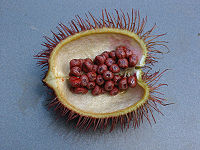
Annatto is produced from the reddish pulp which surrounds the seed of the achiote (Bixa orellana L.). It is used in many cheeses (e.g., Cheddar, Red Leicester, and Brie), margarine, butter, rice, smoked fish, and custard powder.Annatto is commonly found in Latin America and Caribbean cuisines as both a coloring agent and for flavoring. Central and South American natives use the seeds to make a body paint, and lipstick. For this reason, the achiote is sometimes called the lipstick-tree. Achiote originated in South America and has spread in popularity to many parts of Asia. The heart shaped fruits are brown or reddish brown at maturity, and are covered with short, stiff hairs. When fully mature, the fruits split open exposing the numerous dark red seeds. While the fruit itself is not edible, the orange-red pulp that covers the seed is used as a commercial food coloring and dye (similar to turmeric). The achiote dye is prepared by stirring the seeds in water.
HistoryAnnatto has long been used by indigenous Caribbean and South American cultures. It is believed to originate in Brazil. It was probably not initially used as a food additive but for other reasons, such as body painting, to ward off evil, and as an insect repellent. The ancient Aztecs called it achiotl, and it was used for Mexican manuscript painting in the sixteenth century.
UsesIn Jamaica, annatto has had many uses over the centuries, including as a food dye, body paint, treatment for heartburn and stomach distress, sunscreen and insect repellent. In Venezuela, annatto (called locally onoto) is used in the preparation of hallacas, perico, and other traditional dishes. In Brazil, both annatto (the product) and the tree (Bixa orellana L.) are called urucum and the product itself may also be called colorau. In the Caribbean islands, both fruit and tree are popularly called achiote or bija (pronounced “bee-ha”) instead of Bixa. In the Philippines, it is called atsuete and is used as food coloring in traditional dishes. It is a major ingredient in the popular spice blend “Sazón” made by Goya Foods.
Cheddar cheese is often colored and even as early as 1860 the real reason for this was unclear: English cheesemaker Joseph Harding stated “to the cheese consumers of London who prefer an adulterated food to that which is pure I have to announce an improvement in the annatto with which they compel the cheesemakers to colour the cheese”.
One theory is that cheeses that were excessively fatty or rich turned a somewhat yellow color, and annatto was added to make cheaper cheeses appear to have more fat content, which would bring a higher price.












 Boise Foodie Guild