Actually, yes you can!! Robin and I made one of these turkeys yesterday, as a preliminary trial for Thanksgiving, coming up soon. The style of cooking is called spatchcocked. “Really, “spatchcocking” is just a fancy term for cooking a whole turkey or chicken by removing the backbone and splaying the bird out flat.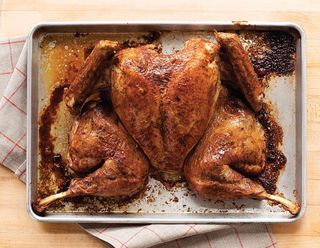
And it’s that simple. Really! Just cut along the both sides of the turkey’s backbone to remove it (use sturdy kitchen scissors). Flip the bird over and flatten it by breaking the breast bone. Brush the bird with olive oil, salt and pepper…Just 70 minutes later (you’ll want to baste it halfway through), you’ll have a perfectly cooked bird.
–Space. Flattening the turkey out like this makes a lot more room in your crowded Thanksgiving Day oven.
–Carving. With the backbone out of the way, it’s much, much simpler to carve the bird when it’s time to serve it.
–Taste. We actually thought the meat turned out better tasting and more moist than with a traditional roast turkey. And the skin crisped up to golden perfection.” (http://thebittenword.typepad.com)
Serves: 8 – 10
Ingredients: (Oil Mixture)
2 T Extra-Virgin Olive Oil
1 T coarse Salt
1 t freshly ground Pepper
1 whole fresh turkey (about 12+ pounds)
Our Suggestion: Add your favorite spices to this mixture: Sage, Thyme, Rosemary, etc.
Directions:
1. Preheat oven to 450°F. Stir together oil, salt, and pepper in a small bowl.
2. Rinse inside and outside of turkey; pat dry with paper towels. Spatchcock turkey*. Transfer to a rimmed baking sheet, breast side up. Let stand for 30 minutes.
3. Brush or rub turkey all over with oil mixture. Roast, rotating sheet halfway through and basting twice, until an instant-read thermometer inserted
into the thickest part of the thigh reaches 165°, about 1 hour and 10 minutes. Let stand for 20 minutes before carving.
*Spatchcocking: (See photo above)
1. Cut out the backbone. Start with the turkey breast side down. Use poultry shears to cut along both sides of the backbone, beginning at the tail end. If you hit a tough spot, try cutting with just the tip of the shears.
2. Open the turkey. Set aside backbone (and giblets) for stock. Take hold of both newly cut edges, and open the turkey. Remove any large pieces of fat. Turn the turkey, breast side up.
3. Break the breastbone. Place your hand on one side of the breast, close to the breastbone, and push down firmly until you hear a crack. Repeat on the other side. (For better leverage as you work, stand on a step stool.)
4. Flatten the turkey. Pull the thighs outward so the turkey lies flat, with the wings facing inward. Tuck the wing tips under to secure.
5. Brush with oil. Place the turkey on a rimmed baking sheet. Let stand for 30 minutes. Use a basting brush to apply oil mixture.
How To Carve: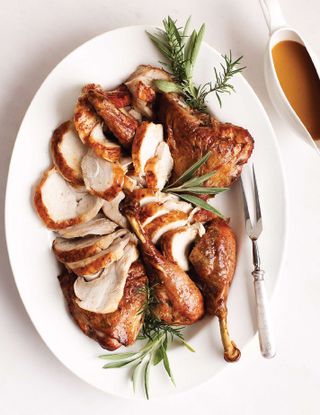 A spatchcocked turkey requires a slightly different carving technique than a bird cooked the traditional way, but the basic approach remains
the same: Remove the legs and wings, and then slice the breast meat.
1. Cut legs from breast. With a sharp chef’s knife, remove each leg by cutting through the turkey where the thigh connects to the breast.
2. Separate drumsticks and thighs. At the joint of each leg, cut drumstick from thigh. Transfer thighs and drumsticks to a warm platter. Tent with foil.
3. Cut wings and breast. On one side, find the joint connecting wing and breast, and cut through it (not shown). Repeat to cut off other wing. Cut breast meat into two pieces, slicing along either side of breastbone.
4. Slice breast meat. Slice the breast meat across the grain. Arrange on the platter with the dark meat, and add the wings.
The photos are from Martha Stewart Living and the article came from The Bitten Word. This goes great with a 2008 Bedrock Wine Co. Cuvee Caritas White Wine, Sonoma County (55% 100 year old Semillon from Monte Rosso and 45% Sauvignon Blanc from Kick Ranch Vineyard) and a super gravy made from Madeira. (The gravy recipe can be found on this blog)
We found this turkey to be extremely moist and succulent. And the interesting thing is that it really is easy to do and very fast cooking. It has a wonderful flavor and moistness eaten cold in sandwiches or for “nibbling”. The skin is crusty and wonderful. That’s it. Cheers!

 Boise Foodie Guild