Looks like it might have been a slow day in Boise. Not really! They were having a big debate on the Food Network today on the origin and uses of Worcestershire Sauce. Here, from Wikipedia, is some information. Some of this is not cited and may need citation.
From Wikipedia,
Worcestershire sauce (pronounced WOOS-tər-sheer saws), is a fermented liquid condiment used for flavouring many cooked and uncooked dishes, especially with grilled or barbecued meats. It is also used as an ingredient in the preparation of cocktails and drinks.
First made at 68 Broad Street, Worcester, England, by two dispensing chemists, John Wheeley Lea and William Henry Perrins, the Lea & Perrins brand was commercialised in 1837 and has been produced in the current Midlands Road factory in Worcester since 16 October 1897. In 1930 the business was sold to HP Foods and was subsequently acquired by the Groupe Danone. It was purchased by H.J. Heinz Company in 2005 who continue to manufacture and market “The Original Lea & Perrins Worcestershire Sauce”, under the name Lea & Perrins, Inc. Other companies manufacture similar products, often also called Worcester Sauce, and marketed under different brands.
Origins
A fermented fish sauce called garum was a staple of Greco-Roman cuisine and of the Mediterranean economy of the Roman Empire, and the use of some similar fermented anchovy sauces in Europe can be traced back to the 17th century. The Worcestershire variety became popular in the 1840s and is one of the many legacies of the British rule of the Indian sub continent. Several disputed theories exist concerning its exact discovery or invention by John Lea and William Perrins.
History
A widely reported legend has it that “Lord Marcus Sandys, ex-Governor of Bengal” (a figure unknown to history outside this tale) encountered it while in India under the Honourable East India Company in the 1830s, missed it on his return and commissioned the local apothecaries to recreate it. However, author Brian Keogh concluded in his privately published history of the Lea & Perrins firm on the 100th anniversary of the Midland Road plant, that “No Lord Sandys was ever governor of Bengal, or as far as any records show, ever in India.”
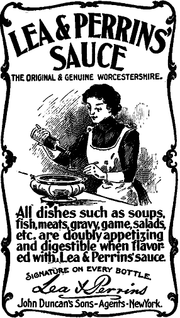 The Lord in question, whose identity was being discreetly veiled by Messrs Lea and Perrins (who used to aver on the bottle’s paper wrapping that the sauce came “from the recipe of a nobleman in the county”) was Arthur Moyses William Sandys, 2nd Baron Sandys (1792–1860) of Ombersley Court, Worcestershire, Lieutenant-General and politician, a member of the House of Commons at the time of the legend, whose given name is being confused in the tale with that of his brother and heir, Arthur Marcus Cecil Sandys, 3rd Baron Sandys (1798–1863), who did not succeed to the title, however, until 1860, when the sauce was already established on the British market. The barony in the Sandys family (pronounced “sands”) had been revived in 1802 for the second baron’s mother, Mary Sandys Hill, so at the date of the legend, in the 1830s, “Lord” Sandys was actually a Lady. No identifiable reference to her could possibly appear on a commercially bottled sauce without a serious breach of decorum. It is likely her heir agreed to sell the recipe.
A more accurate version that was published by Thomas Smith: We quote the following history of the well-known Worcester Sauce, as given in the World. The label shows it is prepared “from the recipe of a nobleman in the county.” The nobleman may be Lord Sandys. Many years ago, Mrs. Grey, author of The Gambler’s Wife and other novels, was on a visit at Ombersley Court, when Lady Sandys chanced to remark that she wished she could get some very good curry powder, which elicited from Mrs. Grey that she had in her desk an excellent recipe, which her uncle, Sir Charles, Chief Justice of India, had brought thence, and given her. Lady Sandys said that there were some clever chemists in Worcester, who perhaps might be able to make up the powder. Messrs. Lea and Perrins looked at the recipe, doubted if they could procure all the ingredients, but said they would do their best, and in due time forwarded a packet of the powder. Subsequently the happy thought struck someone in the business that the powder might, in solution, make a good sauce. The profits now amount to thousands of pounds a year.
Upon completing the necessary steps, however, the resulting product was found to be so strong that it was considered inedible, and a barrel of the sauce was exiled to the basement of Lea & Perrins’ premises. Looking to make space in the storage area a few years later, the chemists decided to try it once again, only to discover that the sauce had fermented and mellowed and was now quite palatable. In 1838 the first bottles of “Lea & Perrins Worcestershire Sauce” were released to the general public.
An alternative story was published by historian and Herald for Wales, Major Francis Jones, 1908-1993, who attributed the introduction of the recipe to Captain Henry Lewis Edwardes 1788-1866. Edwardes, originally of Rhyd-y-gors, Carmarthenshire, was a veteran of the Napoleonic wars and held the position of Deputy-Lieutenant of Carmarthenshire. He is believed to have brought the recipe home after travels in India. The article does not say how the recipe found its way to Messrs Lea and Perrins. Messrs Lea and Perrins, being John Wheeley Lea (research and product development) and William Perrins (finance), from their building in Broad Street, Worcester, ran by far the most important and successful chemist and druggist business in the county. They made their fortunes from manufacturing and selling the sauce. They built a new factory with railway access in Midland Road, Worcester and made various charitable donations to the city such as Perrins Hall in a Worcester School.
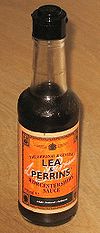 Lea & Perrins Original Recipe
The ingredients of a traditional bottle of Worcestershire sauce sold in the United Kingdom under the name “The Original & Genuine Lea & Perrins Worcestershire Sauce” are listed as malt vinegar (from barley), spirit vinegar, molasses, sugar, salt, anchovies, tamarind extract, onions, garlic, spice, and flavouring. Apart from distribution for its home market, Lea & Perrins also supplies this recipe in concentrate form to be bottled abroad.
Japanese Worcestershire sauce, often simply known as sōsu (“sauce”), or Usutā sōsu (“Worcester sauce”) is made from purees of fruits and vegetables such as apples and tomatoes, matured with sugar, salt, spices, starch and caramel. Despite this appellation, it bears only moderate resemblance to Western Worcestershire sauce. Sōsu comes in a variety of thickness, with the thicker sauces looking and tasting like a cross between the original Worcestershire sauce and HP sauce. There are many variations according to flavour and thickness, and are often named after the foods they are designed to go with, such as okonomiyaki sauce and tonkatsu sauce. These sauces, however, and others that are Worcestershire relatives are much closer in taste to American barbecue sauce. These variants have become a staple table sauce in Japan, particularly in homes and canteens, since the 1950s. It is used for dishes such as tonkatsu (breaded pork cutlets), okonomiyaki (savoury pancakes), takoyaki, yakisoba, yaki udon, sōsu katsudon and korokke.
Holbrooks worcestershire sauce from 1902
In Sheffield, England, Henderson’s Relish, very similar to Worcester sauce, is made and sold locally. This sauce is sold in the same size and shape of bottle as Lea and Perrins Worcester sauce and also has an orange label, which calls it ‘The Spicy Yorkshire Sauce’; it does not contain anchovies.
Lionel Brand (Australia) worcestershire sauce
In Australia the best-selling brand of Worcestershire sauce is Holbrooks , holding over half the market share in black sauce. Historically there were several different manufacturers of Worcestershire sauce in Australia, e.g. Lionel Brand from Taringa in Brisbane.
Lea & Perrins Worcestershire Sauce in the USA differs slightly from the original British recipe. Its ingredients are listed as: vinegar, molasses, high fructose corn syrup, anchovies, water, onions, salt, garlic, tamarind concentrate, cloves, natural flavorings and chili pepper extract. The original British recipe uses malt vinegar while the American version uses distilled white vinegar, giving the British version a slightly deeper flavour. Also, the American version uses high fructose corn syrup while the original British recipe still uses sugar, giving the American version a somewhat sweeter and less spicy taste.
Vegetarian and gluten free alternatives are available and some Worcestershire sauce powders are marketed as suitable for vegetarians. The vegetarian variety omits the anchovies (notably Henderson’s Relish, which is similar, although not considered a variety of Worcestershire Sauce). ‘Life’ Worcester sauce, produced by MH Foods (Morehands Ltd), is also vegetarian. Both this and Lea & Perrins’ sauce are suitable for coeliacs. The actual ingredients may vary between countries, for example the Canadian version of Lea & Perrins’ sauce contains gluten in the form of malt vinegar from barley. Angostura also offers a fish-free sauce, but does not advertise it as “vegetarian”. The deluxe Worcestershire Sauce Powder produced by Nikken Foods contains no anchovies. Orthodox Jews refrain from eating fish and meat in the same dish, causing Worcestershire to be problematic, as many people are unaware that it contains anchovies. Certain brands that are certified to contain less than 1/60th of the fish product can be used with meat.
Dishes using Worcestershire sauce
Worcestershire sauce is often an ingredient of Caesar Salad and can be used as steak sauce.
Welsh rarebit is a combination of Caerphilly cheese, English mustard, Worcestershire sauce, and other ingredients, frequently eaten with bread, toast or crackers. A simpler version uses Worcestershire sauce with cheese on toast, with the sauce added to the plain version during the grilling process. Worcestershire sauce also plays a key role in the flavour of original recipe Chex Mix. In the U.K., advertising by Lea & Perrins has made Worcestershire Sauce popular for use on spaghetti bolognese, beans on toast, cheese on toast, chips (French fries), gravy and sausages. It is also frequently used in chili con carne, Bloody Mary cocktails, and in a cocktail known mostly to Canadians called a Caesar.
Worcestershire sauce, known as salsa inglesa (English sauce) in Spanish, is an essential ingredient of the popular Mexican beer cocktail, the Michelada. It is also used to flavour cheeseburgers and in Mexico, it is often used on pizza. The sauce it is nearly universally available as a condiment in steakhouses throughout North America, and is also sometimes used as a condiment for bacon and eggs, hamburgers, pork chops, chicken, and certain other meats and fish. Certain brands of crisps (potato chips), such as Walker’s (U.K.) sell Worcestershire sauce flavoured crisps.
Worcestershire sauce plays a significant part in the cuisine of Asian regions which have seen significant exposure to Western cuisine. In Cantonese cuisine, Worcestershire sauce was introduced in the 19th century via Hong Kong and is today used in dim sum items such as steamed beef meatballs and spring rolls. The Cantonese name for this sauce is “gip-jap” (Chinese; pinyin: jiézhī; Cantonese Yale: gip jāp). It is also used in a variety of Hong Kong-style Chinese and “Western” dishes.
In Shanghainese cuisine, the use of Worcestershire sauce spread from European-style restaurants in the 19th and 20th century to its use as an ingredient in ubiquitous, Eastern European-inspired dishes such as Shanghai-style borscht, and as a dipping sauce in Western fusion foods such as Shanghai-style breaded pork cutlets. It is also commonly used for Chinese foods such as the shengjian mantou, which are small, pan-fried pork buns. In Shanghai, Worcestershire sauce is called “la jiangyou” (Chinese: pinyin: làjiàngyóu; literally “spicy soy sauce”). After imported Worcestershire sauce became scarce in Shanghai after 1949, a variety of local brands appeared. These are now in turn exported around the world for use in Shanghai-style dishes. Lea & Perrins has in recent years established a plant in Guangdong, China, thus increasing availability of the original variety in China. However, it does not have a dominant market share compared to the native-grown varieties. In Thailand, the Lea & Perrins Original Worcestershire sauce on sale is, according to its label, imported directly from England.
Well there is some information that you were really waiting for! Cheers!

 Boise Foodie Guild
the us verison has changed in 2011from vinegar, molasses, high fructose corn syrup, anchovies, water, onions, salt, garlic, tamarind concentrate, cloves, natural flavorings and chili pepper extract. to distilled white vingar, molasses,water,sugar, onions,anchovies,salt,garlic,cloves tamarind extract,natural flavorings and chili pepper extract.
LikeLike