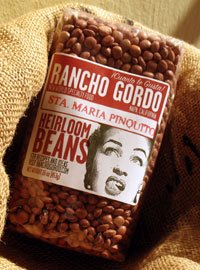
 From several sources, we have the following information on Pinquito Beans.
First, from Ranch Gordo we have, “A specialty bean from Santa Maria, California. Pinquitos are a cross between a pink bean and a small white bean and are a standard in Santa Maria style BBQ. Use to make side-dish beans, chili beans or substitute for in any recipe where pintos are called for. In Santa Maria the classic combination is pinquitos with BBQ tri-tip.”
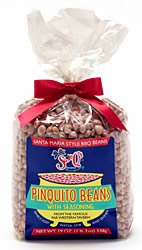
From Wikipedia, we learn, “Pinquito Beans
Pinquito beans are an essential component of the traditional Santa Maria Style Barbecue menu. Pinquito beans are a cross between a pink bean and a small white bean. How they came to be grown in the Santa Maria Valley remains a mystery. Some say the beans were given as a gift by a Mexican vaquero to one of the early Swiss-Italian settlers. Others contend that a lady brought several plants with her when she migrated to the area from Europe. Pinquito Beans grow well in the fertile soil and mild climate of the Santa Maria Valley, which is the only place where Pinquito beans are grown commercially.”
And to define the Santa Maria BBQ, “Santa Maria Style Barbecue originated in the mid 1800s when local ranchers would host Spanish-style feasts each spring for their vaquero. They barbecued meat over earthen pits filled with hot coals of local red oak. The meal would be served with pinquitos, small pink beans that are considered indigenous to the Santa Maria Valley.
According to local barbecue historian R.H. Tesene, “The Santa Maria Barbecue grew out of this tradition and achieved its ‘style’ when local residents began to string cuts of beef on skewers or rods and cook the meat over the hot coals of a red oak fire.”
In 1931, the Santa Maria Club started a “Stag Barbecue,” which was held on the second Wednesday of every month, with up to 700 patrons attending each event. By the late 1950s, three local restaurants—The Far Western Tavern, Hitching Post and Jocko’s—were on their way to becoming landmarks of Santa Maria Style Barbecue. The original cut was top-block sirloin. Then, as today, the meat was rolled in a mixture of salt, pepper and garlic salt before being barbecued over the red oak coals, which contribute a smoky, hearty flavor. In the 1950s, a local butcher named Bob Schutz perfected the tri-tip, a triangular bottom sirloin cut that quickly joined top-block sirloin as a staple of Santa Maria Style Barbecue. “
OK, so there we have some information on the now infamous Pinquito Bean. It’s time to try some! Cheers!

 Boise Foodie Guild
Cali transplant here… I was born and raised in Santa Maria CA and let me tell you the BBQ is second to none and something truly unique to the area. Growing up you could drive down Broadway and on every corner there would be some non profit BBQing their version of the best Tri-Tip and beans around. While I do enjoy other BBQ there is nothing like a Santa Maria style bbq. Tri-tip, beans and bread and don’t forget the salsa. When we moved up here we made sure to bring 2 big boxes of red oak and our SuzyQ !
LikeLike
Thanks for your comments. Love to hear from you.
LikeLike
It is my understanding that the pinquito bean was brought over by Portuguese immigrants from the Azores in the mid-1800s.
LikeLike
Thank-You for the delightful comment. I'm glad you like this blog. You might also like the recipe that Robin made for Mexican Chocolate Tofu Pudding – http://boisefoodieguild.blogspot.com/2011/02/mexican-chocolate-tofu-pudding.html. You will be surprised at this one. Cheers!
LikeLike
Thank you for your wonderful Boise Foodie Guild site! I originally visited to find out what pinquito beans were, and not only found that info, but also many other interesting things. I particularly like the recipe for "Energy Boosting Stuffed Bell Peppers". I've been looking for a yummy-sounding recipe that uses ground turkey, and this one caught my attention. I'm looking forward to trying it! Thanks!L. Warner, Portland, OR
LikeLike