The other day while I was looking for the Mole Recipes that are listed below,I came across this recipe for Bolillos, 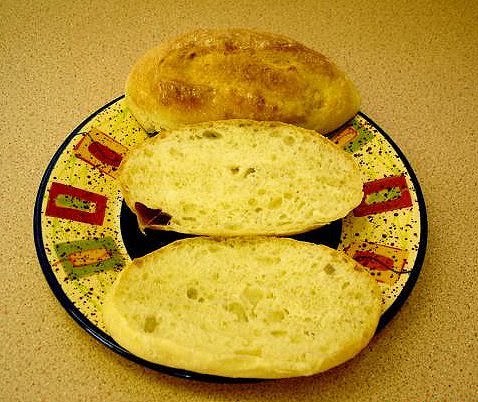 Mexican rolls. One of the recipes, has bolillos (the double “ll” is pronounced like a “y”) mentioned. I had no idea what they were, so I searched for these also. From the photo, the bread looks like it has a fairly open crumb. And from the recipe, the bread might be soft, yet sweet and maybe a little heavy from the lard. I would not try anything else except lard, at least for the first batch. That way, you will know what the rolls are supposed to taste like and I might ask for them at the next Mexican restaurant we go to.
At the end of the recipe is a short discussion on the history of the bread. The photo to the left and the recipe comes from The Fresh Loaf, a baking blog that I subscribe to. Do try these rolls and let us know how you like – or dislike – them.
Source: Adapted from The Freshloaf, http://www.thefreshloaf.com
Ingredients:
1 pkg (1/4 ounce or 7 g) Active Dry Yeast
1⅓ c (330 mL) Warm Water (105 to 115°F or 40 to 46°C)
3 T (15 mL) Tupelo Honey
1 T (15 mL) Lard or vegetable shortening, melted and cooled
1½ t (7 mL) Sea Salt
3¼ to 4 c (810 mL to 1 L) Bread Flour
¼ c (60 mL) Cold Water
1 t (5 mL) Cornstarch
Directions:
1. Sprinkle yeast over the warm water in large mixer bowl; stir to mix. Let stand 5 minutes.
2. Stir honey, lard and salt into yeast mixture; add 2½ cups (625 mL) flour. Mix at low speed; then beat at medium speed until very elastic, about 5 minutes. Gradually stir in as much of the remaining flour needed to make soft dough, ½ to 1 cup (125 to 250 mL).
3. Knead dough on floured surface, adding just as much remaining flour needed to prevent sticking, until dough is smooth and elastic, 5 to 10 minutes. Place the dough in greased bowl; turn dough over to grease top. Let rise, covered, in warm place until doubled, about 1 hour.
4. Stretch and Fold; knead briefly in a Cuisinart with a dough hook. Let rest 10 minutes. Divide dough into 10 equal pieces; roll each piece into ball on floured surface with palm of hand.
5. Starting at center and working toward opposite ends, roll each ball on floured surface with palms of hands into oval tapered at both ends. Each piece should be about 5½ inches (14 cm) long and 2 inches (5 cm) wide at center. Place, evenly spaced, on 2 greased baking sheets; let rise, loosely covered, until almost doubled, about 25 minutes.
6. Meanwhile, heat oven to 375°F (190°C). Mix cold water and cornstarch in small saucepan. Heat over high heat, stirring constantly, to boiling; boil until thickened and clear, about 2 minutes.
7. Brush risen rolls with warm cornstarch mixture. Slash each roll lengthwise with razor blade or sharp, thin knife to ½ inch (1.3 cm) from each end, cutting about ½ inch (1.3 cm) deep.
8. Bake until rolls are golden brown and sound hollow when tapped, 30 to 35 min¬utes. Remove from baking sheets; cool on wire racks.
Makes 10 rolls
Discussion:
From Wikipedia, the free encyclopedia
Mexican bolillos
A bolillo (English pronunciation: /bɵˈliːjoʊ/ bo-LEE-yoh) is a type of savoury bread traditionally made in Mexico, where it originates. It is a variation of the baguette, and is often baked in an horno de piedra.
It is about 15 cm (six inches) long, in the shape of an oval, with a crunchy crust and a soft inside, known as migajón. It is the main ingredient for tortas and molletes. A variation of the bolillo is the telera, which is very similar, though it has a more rounded shape, is divided in three sections, and is usually softer. Other variations include bolillos made of alternate ingredients such as whole wheat, wheat germ or flax.
Names:
The bolillo is a variation of the baguette, and thus often has names in the local language reflecting this. In Yucatán they are known as barras. In Guadalajara and Sonora they are called birotes which are often made with sourdough. In northern Mexico they’re known both as bolillos and pan blanco, whereas in Northeast Mexico it is known as pan francés. In Sinaloa, they are called torcido and birote. In Brazil, a similar bread is made and known as pão francês or pão de sal.
So there you have something else to try. And to me, they look interesting. At any rate, if you do try these, please let us know what you think and if you had any problems. Cheers!

 Boise Foodie Guild
Love the daily Boise Foodie Guild getting great ideas for dinners
LikeLike